
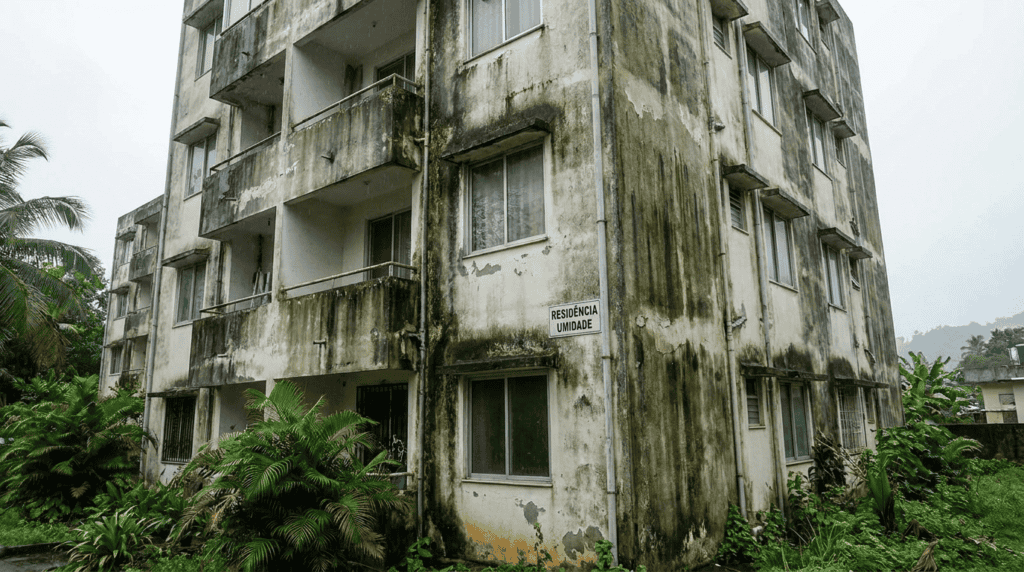
Mould appears in Sunshine Coast commercial buildings after the wet season because warm, humid air meets cool surfaces and condenses — and because air conditioning that runs only during business hours leaves the building humid for the other sixteen hours of the day. Cleaning the visible growth without addressing the moisture guarantees it returns, usually within weeks.
On the Sunshine Coast, storms typically run from November to March, with east coast low pressure systems from January to June and cyclones possible from December to April. That is a long window in which buildings take on moisture faster than they lose it. Every year we see the same pattern: businesses reopen in February to musty carpet, spotted ceiling tiles and black speckling on the air-conditioning grilles, and treat it as a cleaning problem when it is a moisture problem with a cleaning symptom.
Why subtropical commercial buildings are especially prone
Mould needs three things: spores, which are everywhere; organic material to feed on, which includes plasterboard paper facing, carpet backing, ceiling tiles, dust and skin cells; and moisture. Only the third is controllable.
Several conditions common to Sunshine Coast commercial buildings push the moisture side of that equation:
- Air conditioning that only runs in business hours. The system dehumidifies from 8am to 5pm, then the building sits at ambient humidity overnight and all weekend. Surfaces that were cooled during the day become condensation points.
- Oversized air conditioning. A unit sized for peak load cools the space quickly and cycles off before it has removed much moisture. The room is cold and still humid.
- Poor return air paths. Partitioned offices and storerooms with no return path develop dead pockets where air does not move.
- Slab moisture. Ground floor tenancies without an effective vapour barrier wick moisture into flooring adhesive and carpet backing.
- Shaded southern elevations. External walls that never see sun stay damp for days after rain.
- Wet entries. Sustained rain means saturated entry matting that is never dried and quietly becomes a reservoir.
Where to look first
Mould rarely announces itself in the middle of a room. Check these in order:
- Air-conditioning grilles, diffusers and the ceiling immediately around them. Black speckling here is the classic condensation signature.
- Ceiling tiles, particularly near roof penetrations, gutters and box gutters.
- Behind and beneath furniture on external walls, where air does not circulate.
- Storerooms and comms rooms with no ventilation.
- Under and behind entry matting, especially rubber-backed mats laid on carpet.
- Window reveals and sills, where thermal bridging creates a cold surface.
- Washroom ceilings and behind cisterns, where exhaust fans are undersized or not running.
- Under sinks and tea points, for slow leaks that never reach the floor.
- Carpet at the base of external walls, which will smell before it looks wrong.
If a space smells musty but nothing is visible, trust the smell. Microbial volatile organic compounds are detectable well before growth becomes visible, and the source is usually behind or beneath something.
How to actually prevent mould after the wet season
Control humidity, not just temperature
Aim to keep indoor relative humidity below roughly 60%. Practical measures for a commercial tenancy:
- Run air conditioning in fan or dehumidify mode outside business hours during the wet season rather than shutting it down entirely. The energy cost is far lower than a remediation.
- Have the system serviced before the wet season, not after. Blocked condensate drains and dirty coils are two of the most common causes of localised mould.
- Fit a cheap hygrometer in the areas that have had problems and actually look at it. Data beats opinion.
Fix the water before you clean the mould
Roof leaks, blocked box gutters, failed flashings, leaking pipework in a wall cavity and condensate overflow all produce recurring mould in a fixed location. If growth keeps returning in the same spot, the source is water ingress, not inadequate cleaning.
Dry entries properly
During sustained rain, entry matting can hold litres of water. Lift and dry mats, and where a site takes heavy rain traffic, consider a matting system that can be lifted and dried rather than a fixed mat sitting on carpet. Our guide to entrance matting and floor protection covers specification in more detail.
Move air in dead spaces
Leave storeroom and comms room doors ajar where security allows, or fit a transfer grille. Pull furniture 50 mm off external walls. Small changes in air movement make a disproportionate difference.
Keep surfaces free of the food source
Dust is organic matter. High dusting, vent cleaning and regular carpet steam cleaning reduce the nutrient layer that surface mould colonises. This is where routine cleaning genuinely does contribute to prevention.
Cleaning existing mould: what is reasonable and what is not
Small areas of surface mould on hard, non-porous surfaces — tiles, glass, sealed benchtops, painted surfaces in sound condition — can generally be cleaned as part of a commercial cleaning scope. The method matters more than the product:
- Ventilate the area and use appropriate PPE, including P2 respiratory protection where growth is more than incidental.
- Contain the area so spores are not dispersed through the building.
- Physically remove the growth with detergent and mechanical action — wiping, not spraying and leaving.
- Only then apply a disinfectant if one is warranted, and allow the required contact time.
- Dry the surface thoroughly.
- Identify and correct the moisture source, or repeat the process in a month.
A note on bleach: chlorine bleach whitens mould on porous materials without removing the root structure, so the surface looks clean and regrows. It also must never be combined with acidic washroom cleaners. Physical removal plus drying is more effective than chemical bleaching on almost every surface a cleaner encounters. See cleaning chemical safety.
When to stop and call a remediation specialist
Routine cleaning is not the right response when:
- The affected area is large or spread across multiple rooms.
- Growth is on or inside porous materials — plasterboard, ceiling tiles, insulation, carpet underlay — which usually need removal rather than cleaning.
- There is visible growth inside the air-conditioning system or ductwork.
- The building has been flooded or has had sustained water ingress.
- Occupants are reporting persistent respiratory symptoms that improve away from the building.
In those cases the sequence is water source, then drying, then material removal, then cleaning. Our flood restoration service covers extraction, antimicrobial application, structural drying with air movers and dehumidifiers, and hygrometer monitoring until the structure reaches dry standard — which is the step most often skipped, and the reason mould reappears six weeks later.
A wet season plan for Sunshine Coast facility managers
| When | Action |
|---|---|
| October | Service air conditioning; clear condensate drains; clean gutters and box gutters; check roof flashings |
| October | Inspect and reseal external door seals and window reveals |
| November | Set after-hours HVAC to run in fan or dehumidify mode; place hygrometers in known problem areas |
| December–March | Weekly visual check of grilles, ceiling tiles, storerooms and entry matting; lift and dry saturated mats |
| After any storm | Inspect for ingress within 24–48 hours; begin drying immediately if found |
| March–April | Post-season deep clean: high dusting, vent cleaning, carpet steam clean, hard floor restoration |
| Year round | Log every musty smell report with location and date — patterns emerge quickly |
The wider pre-season checklist is in our guide to storm season preparation for Sunshine Coast businesses.
Frequently asked questions
Why does mould keep coming back in the same spot after cleaning?
Because the moisture source has not been addressed. Recurring growth in a fixed location almost always indicates a leak, a condensation point, a blocked condensate drain or a ventilation dead spot. Cleaning removes the symptom; it cannot remove the cause.
Should we run the air conditioning overnight during the wet season?
Running in fan or dehumidify mode outside business hours is generally far cheaper than remediating mould damage, and it is the single most effective control in a sealed commercial tenancy. Speak to your HVAC contractor about the most efficient mode for your system.
Can carpet with mould be saved?
Sometimes. If growth is surface-level and the carpet has been wet for less than about 48 hours, professional hot water extraction with an appropriate antimicrobial and proper structural drying can recover it. Carpet that has been saturated for longer, or where the underlay is affected, usually needs the underlay replaced at minimum.
Is mould in an office a work health and safety issue?
It can be. Mould exposure can affect people with asthma, allergies or compromised immunity, and a persistent damp problem in a workplace is reasonably treated as a hazard to be identified and controlled like any other. Document reports, act on them, and keep a record of what was done.
Does a musty smell always mean mould?
Not always, but it usually means excess moisture somewhere, which is the precondition for mould. Drains, damp underlay, a leaking chiller line and standing water in a plant room can all produce the smell. Investigate the moisture regardless.
How soon after water damage does mould start growing?
Mould can begin establishing on damp organic materials within roughly 24 to 48 hours in warm conditions. That is why rapid extraction and drying matters far more than how thoroughly the area is cleaned afterwards.
Get ahead of the wet season
If your building has a mould history, the time to act is before November, not after March. Talk to Divine Commercial Cleaning about a pre-season inspection and a wet season cleaning schedule for your site — and if you already have water damage, ask about our flood restoration and structural drying service.

Dianne, originally from Rockhampton, hails from a business-oriented family, with her father owning electrical stores and her uncle serving as Mayor. Moving to the Sunshine Coast at 13, she later pursued a rewarding real estate career and raised three children. As a single mom, she balanced university studies with domestic cleaning work. Armed with a Bachelor’s Degree in Business, majoring in Supply Chain Management, Dianne founded and grew Divine Commercial Cleaning into a thriving company. Her success is rooted in strong family mentorship, a positive attitude, and a solution-oriented approach, offering tailored cleaning services with integrity and strategic insight.