
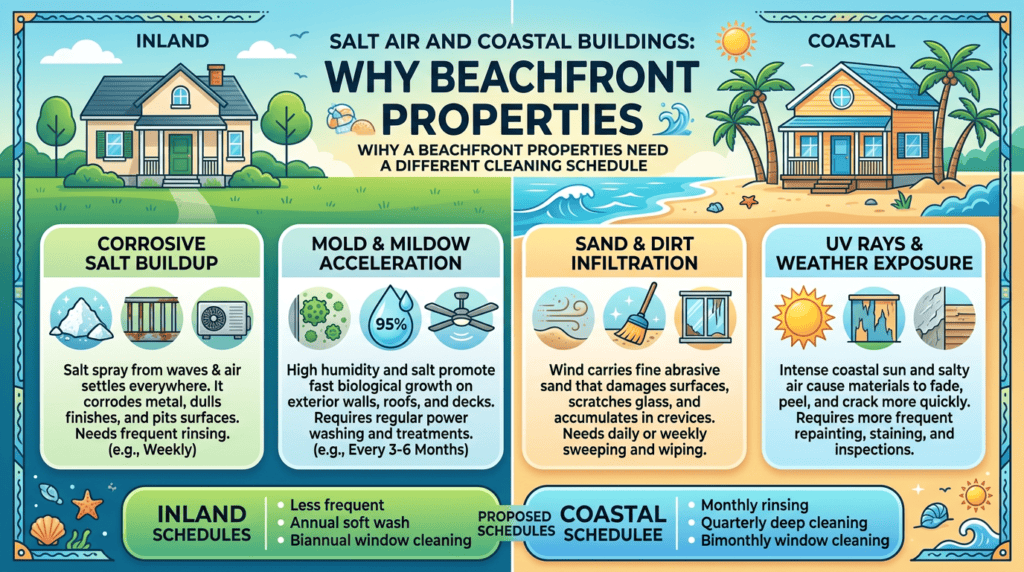
Salt air damages coastal commercial buildings by depositing hygroscopic salt crystals on glass, metal and render, which draw moisture from the air, hold it against the surface, and accelerate corrosion, glass etching and staining. Buildings within a few hundred metres of the surf at Mooloolaba, Alexandra Headland, Kings Beach, Coolum, Marcoola or Noosa need a different cleaning specification from an identical building at Kunda Park or Sippy Downs — not just a more frequent one.
Most commercial cleaning scopes treat the Sunshine Coast as one location. In practice a beachfront tenancy and a hinterland business park have meaningfully different maintenance needs, and the cost of ignoring that shows up in prematurely aged window frames, stained render and hardware that fails years early.
What salt actually does to a building
Glass: etching, not just dirt
Salt spray settles on glass and combines with airborne dust and pollutants. Left in place through repeated wet-dry cycles, the deposits become progressively harder to remove and can begin to etch the glass surface, particularly on the seaward elevation. Etching is permanent — no amount of cleaning restores it, and the panel eventually needs replacing or professional restoration.
The practical implication: the interval between cleans matters more on coastal glass than the quality of any single clean.
Aluminium window frames and balustrades
Anodised and powder-coated aluminium is corrosion-resistant, not corrosion-proof. Salt trapped in the frame channel, in the drainage weep holes and under gaskets creates a persistent electrolyte layer. The first visible signs are white powdery blooming on powder coat and pitting or chalking on anodised finishes. Most aluminium warranties on coastal sites carry a washing frequency condition — often quarterly or more — and a claim can be refused where washing has not been done.
Stainless steel
Grade 304 stainless, common in handrails, door hardware and signage, develops ‘tea staining’ — brown surface discolouration — in marine environments. It is cosmetic rather than structural in most cases, but it makes a building look neglected, and it responds far better to regular washing than to occasional aggressive treatment. Grade 316 performs better in coastal conditions but still needs washing.
Render, paint and concrete
Salt crystallising within the surface pores of render and masonry causes spalling and progressive surface breakdown. Combined with the Sunshine Coast’s UV load and wet season rainfall, painted external walls on a beachfront building age noticeably faster than the same specification inland.
Roofing, gutters and fixings
Sheltered areas that are not washed by rain — under eaves, behind downpipes, on the underside of awnings — are the worst affected, because salt accumulates and never gets rinsed off. Fixings and fasteners in these locations corrode first.
The single most important principle: rinse the sheltered areas
This is the point most building owners miss. Surfaces that get direct rain are partially self-cleaning. Surfaces that are shielded from rain but still exposed to salt-laden air accumulate salt indefinitely.
Sheltered zones to include explicitly in a coastal cleaning scope:
- Window and door frames, especially the underside of head sections
- Window channels, tracks and weep holes
- Under awnings, soffits and eaves
- Covered walkways and undercrofts
- Balcony undersides and the inside faces of balustrades
- Behind downpipes and service pipework
- Signage backs and mounting brackets
- Louvres and plant screens
- Door hardware, hinges and locksets on external doors
How often should a coastal commercial building be washed?
Frequency should be set by distance from the surf, elevation exposure and the finish in question. The table below reflects the intervals we typically recommend for Sunshine Coast sites, and aligns broadly with the washing conditions many finish manufacturers attach to their coastal warranties.
| Distance from surf | External glass | Frames and metalwork | Render and painted walls |
|---|---|---|---|
| Beachfront to ~200 m | Monthly to 6-weekly | Monthly to quarterly | 6–12 monthly |
| ~200 m to 1 km | 6-weekly to quarterly | Quarterly | Annually |
| 1–5 km | Quarterly to 6-monthly | 6-monthly | Annually to biennially |
| Beyond 5 km / hinterland | 6-monthly | Annually | As required |
Adjust upward for buildings on an exposed headland, buildings with an unobstructed north-easterly aspect, and buildings where a warranty specifies a minimum washing frequency.
Method matters: how coastal washing should be done
- Rinse first with clean fresh water. The primary objective is to dissolve and carry away salt. Applying detergent to a salt-loaded surface without rinsing first simply moves the salt around.
- Use a mild pH-neutral detergent. Aggressive alkaline or acidic cleaners strip protective oxide layers on anodised aluminium and damage powder coat.
- Wash with a soft brush or cloth, not abrasives. Abrasive pads on powder coat or anodising cause micro-scratching that then holds salt more readily.
- Moderate pressure on framing. High-pressure water directed at window seals and glazing gaskets can force water past the seal. Pressure washing is right for concrete, pavers and hardstand; framing and glazing should be washed at low pressure or by hand.
- Flush window tracks and weep holes. Blocked weep holes hold water in the frame permanently — a leading cause of frame corrosion and internal water ingress during storms.
- Rinse thoroughly and squeegee glass. Detergent residue attracts new soil; leaving a coastal building’s glass to air dry produces mineral spotting.
- Work top down, on a cool overcast day where possible. Hot glass in direct sun dries before it can be squeegeed and spots.
Our commercial window cleaning service uses purified water systems for exterior glass on many coastal sites, because deionised water leaves no mineral residue and gives a spot-free finish without detergent.
What else the coastal environment loads onto your building
- Sand. Tracked into entries constantly, and abrasive underfoot. It grinds into carpet fibre and scratches hard floor sealer. Entry matting specification and vacuum frequency matter far more on a beachfront site — see entrance matting and floor protection.
- Bird activity. Gull and pigeon droppings are acidic and will etch paint, render and vehicle paint in a car park within days. Prompt removal is a maintenance measure, not a cosmetic one.
- Sunscreen and body oils. A genuine issue for beachfront cafes, surf clubs, gyms and retail — these transfer to glass, door hardware, seating and need a degreasing approach rather than a general purpose cleaner.
- UV. Accelerates the breakdown of sealers, paint and plastics, shortening the life of hard floor coatings near glazed frontages.
- Humidity. Compounds every other issue, and drives mould risk during the wet season — covered in our guide to preventing mould in Sunshine Coast commercial buildings.
Building a coastal cleaning specification
If your building sits near the water, add these lines to your scope of works:
- Fresh water rinse of all external glazing, framing and metalwork at a stated frequency
- Explicit inclusion of sheltered and rain-shadowed surfaces
- Flushing of window tracks and weep holes at each external clean
- pH-neutral detergent specified; abrasives and acid cleaners excluded from framing
- Increased frequency on the seaward elevation compared with the leeward
- Entry matting lifted, cleaned beneath and dried, at a stated frequency
- Bird fouling removal as a reactive task with a defined response time
This is particularly relevant for strata and body corporate properties along the coastal strip, where the committee is responsible for maintaining common property in good condition and where deferred external washing turns into a special levy for facade restoration a decade later.
Frequently asked questions
How often should windows be cleaned on a beachfront commercial building?
Monthly to six-weekly for buildings within about 200 metres of the surf, extending to quarterly further back. The driver is preventing salt deposits from bonding to the glass, which is a function of time rather than of how dirty the glass looks.
Will pressure washing damage my window frames?
It can. High pressure directed at glazing gaskets and seals can force water past them and can damage powder coat and anodising. Frames and glazing should be washed at low pressure or by hand; save pressure washing for concrete, pavers, driveways and hardstand.
What is the brown staining on our stainless steel handrails?
Almost certainly tea staining, a surface corrosion effect common on grade 304 stainless in marine environments. It is generally cosmetic, and regular fresh water washing with a mild detergent both removes early staining and slows its return. Severe cases need specialist passivation treatment.
Does salt air affect the inside of the building too?
Yes, where doors and windows are opened for natural ventilation. Salt settles on internal glass, hardware and electronics, and internal metalwork near openings corrodes faster than it would inland. Coastal cafes and surf clubs see this most acutely.
Is a warranty on window frames really conditional on washing?
Frequently, yes. Many powder coat and anodised aluminium warranties specify a washing regime for marine and coastal environments, with shorter intervals closer to the surf. It is worth reading the warranty documents for your building and matching the cleaning schedule to them — and keeping records that you did.
Can we just wait for rain to wash the building?
Rain helps on directly exposed surfaces, but it does nothing for the sheltered areas where salt accumulates most heavily, and rain itself carries salt in coastal air. Relying on rain leaves exactly the zones that corrode first untouched.
Protect a coastal asset properly
If you own or manage a commercial or strata property near the water on the Sunshine Coast, we can assess your elevations and put together a washing schedule matched to your exposure and your finish warranties. Request a coastal building assessment from Divine Commercial Cleaning.

Dianne, originally from Rockhampton, hails from a business-oriented family, with her father owning electrical stores and her uncle serving as Mayor. Moving to the Sunshine Coast at 13, she later pursued a rewarding real estate career and raised three children. As a single mom, she balanced university studies with domestic cleaning work. Armed with a Bachelor’s Degree in Business, majoring in Supply Chain Management, Dianne founded and grew Divine Commercial Cleaning into a thriving company. Her success is rooted in strong family mentorship, a positive attitude, and a solution-oriented approach, offering tailored cleaning services with integrity and strategic insight.