
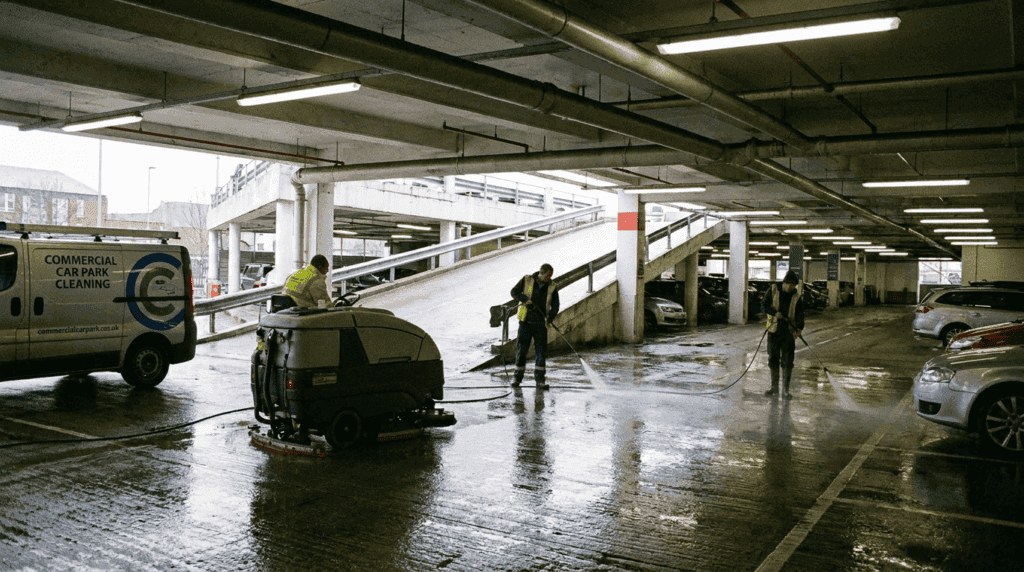
Commercial car park cleaning covers sweeping and litter removal, pressure washing of hardstand, removal of oil and fuel stains, chewing gum removal, stormwater grate and pit clearing, line marking and signage cleaning, and management of the wash water so it does not enter the stormwater system. That last point is the one most businesses do not think about, and it is the one that carries regulatory consequences.
A car park is usually the first and last thing a customer, patient or tenant experiences. It is also the part of a commercial property most likely to be maintained by nobody in particular — not in the internal cleaning scope, not in the landscaping contract, not on anyone’s calendar.
What a car park clean actually involves
Sweeping and litter
Mechanical sweeping or blowing removes leaf litter, sand, grit and rubbish. On Sunshine Coast sites, sand and organic litter are the dominant loads, and both find their way inside on shoes if the car park is neglected. Sand in particular is abrasive and shortens the life of internal hard floor sealer and carpet — see entrance matting and floor protection.
Pressure washing
Concrete and asphalt hold a film of tyre rubber, oil residue, exhaust particulate and biological growth. Pressure washing restores the surface appearance and, importantly, restores slip resistance on pedestrian routes where biological film has developed. Shaded areas that stay damp grow algae and lichen that become genuinely slippery when wet.
Oil and fuel stain removal
Fresh spills lift with an absorbent and a degreaser. Older stains that have penetrated porous concrete need a poultice-style treatment with dwell time, and complete removal is not always achievable. Speed matters enormously — a spill treated within hours usually comes out; one left for a month usually does not.
Chewing gum
Concentrated at entries, near seating, at lift lobbies and at trolley bays. Removed with steam or a targeted hot water system rather than by scraping, which damages the surface.
Stormwater grates, pits and channel drains
Clearing these is both a flood-prevention and a pollution-prevention measure. Sediment in a pit is carried into the waterway with the next downpour. See our guide to storm season preparation.
Line marking, bollards, signage and wheel stops
Washing restores visibility of bay markings, disabled parking symbols, no-standing zones and directional arrows. Faded or obscured line marking is a safety and accessibility issue, not a cosmetic one.
Multi-storey and basement specifics
Enclosed car parks accumulate dust and exhaust particulate on walls, ceilings, pipework and light fittings, which reduces light levels significantly over time. They also require ventilation-aware methods, careful water management with nowhere for run-off to go, and attention to lift lobbies and stair cores where pedestrian soiling concentrates.
The part most businesses get wrong: where the water goes
Wash water from a car park is not clean. It carries oil, grease, heavy metals from brake dust, tyre particulate, detergent and sediment. Allowing it to run into a stormwater drain discharges those contaminants directly into local waterways, because stormwater on the Sunshine Coast is not treated — it flows to creeks, the Maroochy and Mooloolah rivers, and the ocean.
Under the Environmental Protection Act 1994 (Qld), it is prohibited to deposit a prescribed water contaminant into stormwater drains, roadside gutters or waterways — or to deposit contaminants where they could wash, blow or move into a stormwater drain. Prescribed contaminants expressly include sediment, oil, chemicals and litter. Sunshine Coast Council investigates stormwater pollution complaints, specifically including mobile cleaning and trade businesses, and can issue warnings, direction notices, on-the-spot fines or pursue prosecution. In practice, a contractor washing a car park straight into a grate creates a liability for the property owner as well as themselves.
Acceptable approaches include:
- Capture and recovery. Blocking or bunding the drain and vacuum-recovering the wash water for appropriate disposal.
- Drain inserts and socks. Filtering solids and hydrocarbons before discharge, where recovery is impractical and the contamination load is low.
- Dry methods first. Sweeping, absorbents on oil spots and gum removal by steam before any wet washing, so far less contamination is mobilised.
- Discharge to sewer with approval. Where a trade waste approval is held and a suitable connection exists.
Ask any contractor quoting a car park wash exactly how they will manage the water. If the answer is vague, that is your answer.
How often should a commercial car park be cleaned?
| Property type | Sweep / litter | Pressure wash |
|---|---|---|
| Shopping centre or high-traffic retail | Daily | Quarterly, entries more often |
| Medical centre or health precinct | Weekly | 6-monthly |
| Professional office building | Weekly to fortnightly | Annually to 6-monthly |
| Strata residential or mixed use | Weekly | Annually, bin room surrounds more often |
| Warehouse or industrial | Fortnightly | Annually, plus reactive spill response |
| Basement or multi-storey | Weekly | Annually, with wall and ceiling wash every 2–3 years |
| Childcare or school | Weekly | 6-monthly, with drop-off zones prioritised |
Increase the pressure washing frequency at coastal sites where salt and sand load is higher, and at any site where shaded areas grow algae.
Safety and liability: why car park cleaning is worth budgeting
- Slip and trip. Algae and lichen on shaded pedestrian routes are slippery when wet, and the Sunshine Coast’s wet season keeps them wet for weeks. Pedestrian crossings, ramps and stair treads should be prioritised over open bays.
- Visibility. Dirty light fittings in a basement can cut illumination substantially. Washing diffusers is a cheap lighting upgrade.
- Blocked drainage. A blocked pit turns a heavy shower into a flooded car park and, for basements, into water entering the building.
- Accessibility. Obscured accessible parking markings and shared zone lines create genuine access problems and complaints.
- Fire and vermin. Accumulated leaf litter and rubbish in corners and behind bin enclosures attracts vermin and is a fire load — see bin room and waste area cleaning.
Who is responsible for the car park?
- Standalone owner-occupied premises. The business, unless the lease says otherwise.
- Leased commercial premises. Usually the landlord as part of common area maintenance, recovered through outgoings. Check the lease.
- Strata and body corporate. Car parks that form common property are the body corporate’s responsibility to maintain in good condition. Exclusive use car parks may be allocated differently — the community management statement is the reference. See our strata cleaning services.
- Shopping centres. Centre management, generally through the outgoings pool. See shopping centre cleaning.
The common failure mode is a car park that everyone assumes someone else is handling. If you cannot name the contract it sits under, it probably does not sit under one.
Frequently asked questions
How much does commercial car park cleaning cost?
It is priced on area, surface type, access, the level of contamination and how wash water must be managed. A single-level open car park is straightforward; a basement with no drainage fall and restricted headroom is not. Get the quote against a defined area and scope so it is comparable.
Can car park wash water go down the stormwater drain?
No. Wash water carries oil, brake dust, sediment and detergent, and stormwater on the Sunshine Coast discharges untreated to local waterways. Depositing prescribed water contaminants into stormwater drains, roadside gutters or waterways is prohibited under the Environmental Protection Act 1994 (Qld), and Sunshine Coast Council investigates these discharges. The wash water must be captured, filtered or otherwise lawfully managed.
Can old oil stains be removed from concrete?
Often substantially reduced rather than fully removed. Fresh spills treated promptly usually come out cleanly. Old stains that have penetrated the concrete may need a poultice treatment with dwell time and may leave a shadow. Set expectations before the work rather than after.
Is pressure washing safe on asphalt?
Yes, at appropriate pressure and with the right nozzle and distance. Excessive pressure on aged or oxidised asphalt can strip the binder and expose aggregate. Concrete tolerates higher pressure than asphalt.
How long does a car park need to be closed?
Most car parks are cleaned in sections so the site stays operational. Pressure washing a section typically takes a few hours including drying. Retail and medical sites are usually done outside trading hours to avoid disruption entirely.
Does car park cleaning include line marking?
Cleaning restores the visibility of existing line marking. Repainting is a separate trade and is usually quoted separately, though it is sensible to schedule it immediately after a wash while the surface is clean.
Get your car park onto a schedule
If your Sunshine Coast property’s car park is not on anyone’s cleaning contract, we can assess it, advise on frequency and manage the wash water properly. Request a car park cleaning quote from Divine Commercial Cleaning — we can quote it alongside your external and internal cleaning so it is covered in one arrangement.

Dianne, originally from Rockhampton, hails from a business-oriented family, with her father owning electrical stores and her uncle serving as Mayor. Moving to the Sunshine Coast at 13, she later pursued a rewarding real estate career and raised three children. As a single mom, she balanced university studies with domestic cleaning work. Armed with a Bachelor’s Degree in Business, majoring in Supply Chain Management, Dianne founded and grew Divine Commercial Cleaning into a thriving company. Her success is rooted in strong family mentorship, a positive attitude, and a solution-oriented approach, offering tailored cleaning services with integrity and strategic insight.