
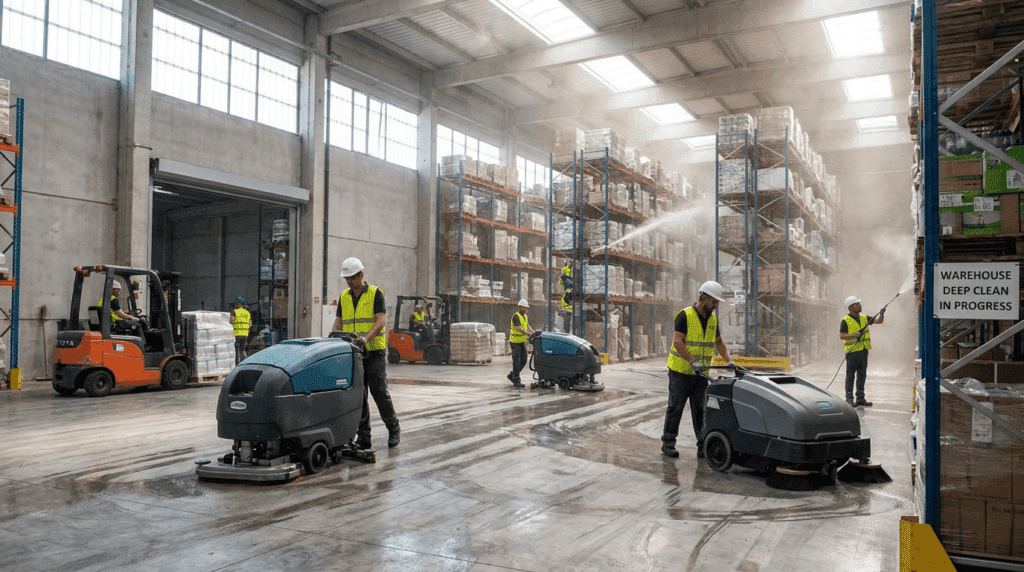
Warehouse cleaning centres on four things: keeping the concrete floor clean enough to be safe and to stop dust circulating, controlling the fine dust that settles on racking and stock, keeping loading docks and yard areas clear, and cleaning at height where dust accumulates on beams, sprinkler heads and light fittings. It is a different discipline from office cleaning — the areas are larger, the equipment is heavier, and the work has to be planned around forklift movements and stock.
The Sunshine Coast’s industrial and logistics footprint has grown substantially, with established estates at Kunda Park, Warana, Coolum and Caloundra alongside newer development around Aura and Palmview. Many of those warehouses are cleaned to a standard set years ago for a smaller operation, and the gap shows up as dust complaints, slip incidents and stock damage.
Why warehouse dust is worth taking seriously
Dust in a warehouse is not just untidy. It has four practical consequences:
- Product contamination. Anything stored uncovered — packaging, textiles, food, electronics, medical consumables — picks up settled dust, which becomes a customer complaint or a rejected consignment.
- Fire and sprinkler performance. Accumulated dust on sprinkler heads can delay activation, and combustible dust accumulations add to the fire load.
- Lighting. Dust on high-bay fittings and skylights reduces light levels measurably over a few years, which affects both safety and pick accuracy.
- Air quality and respiratory exposure. Fine dust disturbed by forklift movement stays airborne and is inhaled by staff for the rest of the shift.
The critical point about high-level dust is that removing it requires a method that captures rather than disperses. Blowing dust off beams with compressed air simply relocates it onto the stock and the floor and puts it into the air staff are breathing. High-level vacuuming with appropriate filtration, or a captured-air method, is the correct approach.
Concrete warehouse floors: what actually works
Warehouse floors are almost always sealed or polished concrete, and they carry a heavy load: forklift tyre rubber, pallet debris, dust, hydraulic oil, shrink wrap and cardboard fibre.
Ride-on or walk-behind scrubbing
Manual mopping does not work at warehouse scale — it moves soil rather than removing it, and it leaves the floor wet for far too long. A scrubber-drier applies solution, agitates and recovers it in one pass, leaving the floor dry and immediately trafficable. Machine size is chosen for the aisle width and the area; running a small machine over a large warehouse costs more in labour than hiring the right one.
Tyre marking and rubber
Black forklift tyre marks are the most visible soil in most warehouses. They need an appropriate alkaline detergent, a more aggressive pad and dwell time. Left to build up, they become progressively harder to remove.
Oil and hydraulic fluid
Treat promptly with an absorbent and a degreaser. On unsealed or worn-sealed concrete, oil penetrates and the stain becomes permanent. It is also the leading slip hazard in a warehouse.
Line marking and floor demarcation
Pedestrian walkways, forklift routes, racking bays and exclusion zones only work if they are visible. Scrubbing restores their visibility; repainting is a separate trade but should be scheduled straight after a deep clean.
Sealed versus polished floors
Polished concrete needs pH-neutral cleaners — alkaline products dull the polish over time. Sealed floors may need periodic recoating in traffic lanes. Our guide to strip and seal flooring covers when a recoat is due, and the same logic applies at warehouse scale.
Loading docks, yards and hardstand
The dock is where outside comes inside. If it is dirty, the warehouse floor cannot stay clean.
- Pressure wash the dock apron and yard periodically to remove tyre rubber, oil, sediment and biological growth. See high pressure cleaning.
- Clear stormwater grates and channel drains before the wet season — docks flood readily and the water goes straight inside. See storm season preparation.
- Manage the wash water. Yard wash water carries oil and sediment. Depositing prescribed water contaminants into stormwater drains, roadside gutters or waterways is prohibited under the Environmental Protection Act 1994 (Qld), and Sunshine Coast Council investigates these discharges.
- Clean dock levellers and pit areas, which accumulate debris and are a genuine trip and pinch hazard.
- Remove shrink wrap, strapping and pallet debris from the yard promptly — it blows into drainage and racking.
Racking and stock areas
Racking cleaning is planned work, not routine work, because it usually requires stock to be moved or the aisle to be closed.
- Beam tops and upright faces. The primary dust reservoir in any warehouse.
- Under bottom beams and behind end frames. Where debris, dust and vermin evidence accumulate unseen.
- Pallet wrap and strapping caught in racking. A fire load and a snag hazard.
- Aisle floors under racking. Often missed by scrubbing machines that only run the open aisle.
Schedule racking cleaning during stocktake, a seasonal low period or a planned shutdown. Coordinate with a racking inspection at the same time — the cleaner is already at height and damage is far easier to spot on a clean upright.
High-level cleaning: beams, lights, sprinklers and roof sheeting
This is specialised work and needs to be treated as such:
- Requires an elevated work platform and appropriate working-at-heights controls and training.
- Dust must be vacuumed and captured, not blown.
- Sprinkler heads must not be knocked, painted over or loaded with debris — disturbance can trigger a discharge.
- Light fittings and skylights should be cleaned as part of the same access visit; the lighting improvement is often the most noticeable result.
- Roof and gutter clearing before storm season fits naturally into the same access arrangement.
Warehouse cleaning frequencies
| Task | Typical frequency |
|---|---|
| Amenities, lunchroom, washrooms | Daily |
| Office and dispatch area | Daily |
| Main aisle and pick face floor scrubbing | Daily to weekly, by traffic volume |
| Full floor scrub including under racking | Monthly to quarterly |
| Loading dock and apron sweep | Daily to weekly |
| Dock and yard pressure wash | Quarterly to 6-monthly |
| Racking and beam dusting | 6-monthly to annually |
| High-level beams, lights, sprinklers | Annually |
| Skylights and internal roof glazing | Annually |
| Gutters and roof drainage | Annually, before November |
Sector-specific requirements
- Food and beverage storage. Cleaning and pest control records, food-safe chemicals, and cleaning that supports the site’s food safety program. Related: food service facility cleaning and hygiene.
- Medical and pharmaceutical distribution. Controlled dust levels, documented cleaning, and often restricted access requiring vetted staff. All our cleaners hold police checks, which matters for secure and restricted sites.
- Cold storage. Specialised methods — conventional wet cleaning is impractical below freezing, and condensation management on entry to and exit from chilled areas is a slip risk.
- Manufacturing and workshop areas. Swarf, coolant, oil and process dust require a heavier approach than a distribution warehouse. See industrial facility cleaning.
Safety considerations that shape the scope
- Forklift and pedestrian separation. Cleaning crews must be inducted, visible in high-vis, and preferably scheduled outside forklift operating hours.
- Wet floors. A scrubber-drier that leaves the floor dry behind it is a safety control as much as a productivity tool.
- Working at height. Any work above ground level needs a documented control and appropriate equipment.
- Chemical storage. Warehouses often hold larger chemical volumes. Current safety data sheets must be readily accessible and a hazardous chemicals register maintained — see cleaning chemical safety and SDS obligations.
- Isolation. Conveyors and automated equipment must be isolated before cleaning around them.
Frequently asked questions
How often should a warehouse floor be scrubbed?
Main aisles and pick faces in a busy distribution warehouse are usually scrubbed daily to weekly. A full scrub including under racking is typically monthly to quarterly. Traffic volume, product type and whether the site handles food or medical goods all shift the answer.
Can we clean a warehouse during operating hours?
Partially. Amenities, offices and dispatch areas can be done during the day. Floor scrubbing and any work at height are safer and faster outside forklift operating hours. Most Sunshine Coast warehouses run cleaning early morning, after the last shift, or on weekends — see day cleaning versus after-hours cleaning.
What is the best way to remove forklift tyre marks?
A scrubber-drier with an appropriate alkaline detergent and a more aggressive pad, with sufficient dwell time. Long-accumulated marks may need a two-pass approach. Neutral detergent alone will not shift them.
Do we need to clean warehouse racking?
Yes, on a planned cycle. Racking beams are the main dust reservoir in a warehouse, and dust from them settles on stock and circulates when forklifts move. Six-monthly to annually suits most sites, coordinated with stocktake or a racking inspection.
Is high-level dusting really necessary?
It is, for fire safety, sprinkler performance, lighting levels and air quality. It is also the task most commonly deferred, because it needs an EWP and planned access. Annual is a reasonable baseline for most warehouses.
How is warehouse cleaning priced?
Routine cleaning is usually priced per visit based on area and task list. Periodic works — full floor scrubs, racking cleaning, high-level dusting, dock and yard pressure washing — are quoted separately because they need specific equipment and access. Ask for them itemised so you can schedule them against your budget cycle.
Get your warehouse scoped properly
We clean warehouses, workshops and distribution facilities across the Sunshine Coast, from Kunda Park and Warana through to Coolum, Caloundra and the Aura industrial areas. Request a warehouse cleaning assessment and we will walk the site, measure the floor area, and quote routine and periodic works separately so you can see exactly what you are buying.

Dianne, originally from Rockhampton, hails from a business-oriented family, with her father owning electrical stores and her uncle serving as Mayor. Moving to the Sunshine Coast at 13, she later pursued a rewarding real estate career and raised three children. As a single mom, she balanced university studies with domestic cleaning work. Armed with a Bachelor’s Degree in Business, majoring in Supply Chain Management, Dianne founded and grew Divine Commercial Cleaning into a thriving company. Her success is rooted in strong family mentorship, a positive attitude, and a solution-oriented approach, offering tailored cleaning services with integrity and strategic insight.