
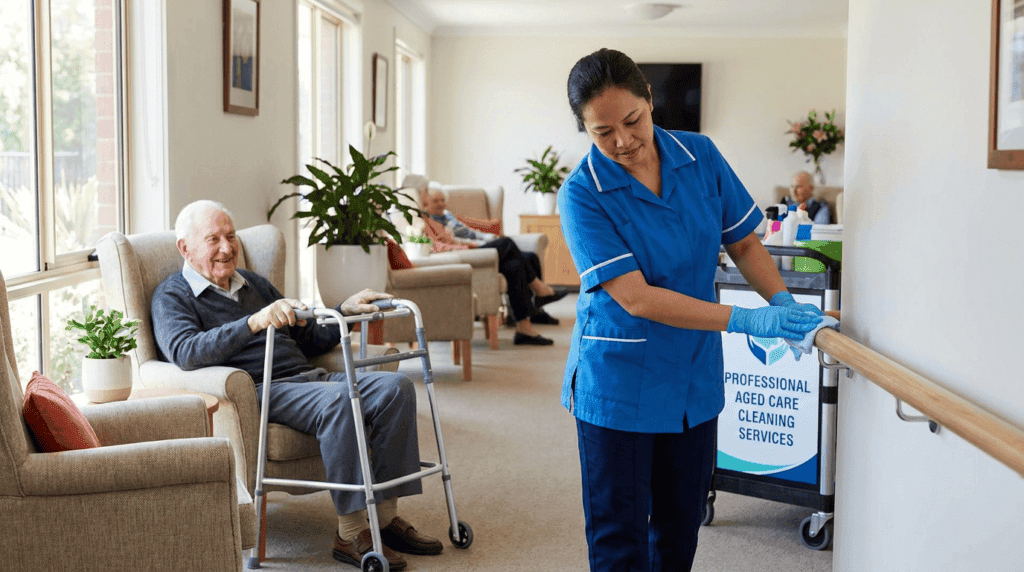
Under the strengthened Aged Care Quality Standards, cleaning is part of Standard 4 — The Environment — which requires the service environment to be clean, safe and comfortable, with equipment that is safe, appropriate and well maintained, and with infection prevention and control procedures covering equipment cleaning and disinfection, waste management, linen handling and outbreak management. In practice that means an aged care provider’s cleaning arrangements are assessable evidence, not a back-of-house arrangement.
For residential aged care homes and retirement living operators on the Sunshine Coast — a region with a substantially older population profile than the Queensland average — the practical question is what a compliant cleaning program looks like day to day, and what documentation an assessor will actually want to see.
Where cleaning sits in the strengthened Standards
The strengthened Aged Care Quality Standards place environmental expectations in Standard 4, alongside infection prevention and control requirements. The Aged Care Quality and Safety Commission’s guidance frames the expectation from the older person’s perspective: the environment is clean, safe and comfortable and enables them to move about freely, and equipment is safe, appropriate and well maintained.
Infection prevention and control obligations run alongside this and cover hand hygiene, equipment cleaning and disinfection, respiratory hygiene, waste management, linen handling, personal protective equipment and outbreak management. The Commission’s stated rationale is direct: IPC protects older people and workers by reducing the spread of infections and the development of antimicrobial resistance.
Two things follow for cleaning contractors and facility managers:
- Cleaning is not just presentation. It is an infection control measure and is assessed as one.
- The governing body has oversight responsibility for hygiene protocol compliance and equipment maintenance, which means the cleaning arrangement needs to produce evidence that reaches board level, not just a clean corridor.
Providers should work from the current Commission guidance for their registration category rather than from any summary, including this one — the guidance has been revised and reissued and is the authoritative source.
What separates aged care cleaning from ordinary commercial cleaning
It is someone’s home, not a facility
This is the difference that most affects how the work is done. Residents live in the rooms being cleaned, often have cognitive impairment, and may find an unfamiliar person in their room distressing. That drives a set of practical requirements: consistent staff rather than a rotating pool, knocking and announcing, working around the resident’s routine, respecting personal belongings, and knowing when to come back later rather than pushing through.
Higher clinical risk from the same tasks
Frequently touched surfaces in aged care — bed rails, call bells, over-bed tables, chair arms, door handles, handrails, lift buttons, remote controls, walking frame handles — carry more consequence than the same surfaces in an office, because the population is more susceptible. These need identified, scheduled and documented attention rather than being absorbed into ‘wipe surfaces’.
Outbreak capability
Gastroenteritis, influenza and COVID-19 outbreaks in residential aged care require an immediate escalation in cleaning: increased frequency on touch points, appropriate disinfectant selection and contact times, single-use or dedicated equipment for affected areas, isolation-room protocols, and documented records. A cleaning provider without a written outbreak procedure is a risk to the provider’s compliance position. Our guide to outbreak cleaning covers the general principles.
Documentation that survives an assessment visit
Cleaning schedules, completion records, chemical registers and safety data sheets, staff training records, and outbreak response records all form part of the provider’s evidence. If it is not written down, it is difficult to demonstrate.
Colour coding and equipment separation
A colour-coded system prevents cross-contamination between clinical, washroom, kitchen and general areas. The widely used convention in Australian healthcare and aged care settings is:
| Colour | Typical use |
|---|---|
| Red | Toilets, bathrooms, showers, sanitary areas |
| Blue | General areas — offices, corridors, lounges |
| Green | Kitchen and food handling areas |
| Yellow | Clinical and isolation areas |
Whatever convention a facility uses, the requirements are the same: it is documented, staff are trained in it, cloths and mop heads are laundered or disposed of rather than reused between zones, and equipment is visibly separated in the store. Microfibre systems where cloths and mop heads are changed per room are considerably safer than a bucket carried from room to room.
Disinfectant selection
Disinfectant claims in Australia are regulated by the Therapeutic Goods Administration. ‘Hospital grade disinfectant’ is a distinct regulatory category, and products making specific claims must be included in the Australian Register of Therapeutic Goods. Household and commercial grade disinfectants must not be labelled hospital grade or use wording implying they are.
Practical points for aged care:
- Clean before you disinfect. A disinfectant applied over visible soil does not work — the soil shields the organisms. See decontamination versus disinfection.
- Observe the contact time on the label. Wiping a surface and immediately drying it does not deliver the claimed efficacy.
- Match the product to the organism. Not all disinfectants are effective against non-enveloped viruses such as norovirus — an important distinction during a gastro outbreak.
- Keep the SDS accessible. Current safety data sheets must be readily accessible to workers at the workplace, and a hazardous chemicals register maintained. See cleaning chemical safety and SDS obligations.
A workable cleaning schedule for a residential aged care home
| Area | Frequency | Key focus |
|---|---|---|
| Resident rooms | Daily | Touch points, ensuite, floor; full detail clean weekly |
| Ensuites and shared bathrooms | Daily, plus reactive | Toilet, shower, grab rails, floor, drainage |
| Communal lounges and dining | Daily, plus after each meal service | Tables, chair arms, spills, floor |
| Corridors and handrails | Daily | Handrails as a specific touch point task |
| Nurses stations and clinical areas | Daily | Yellow-zone equipment; documented |
| Kitchen and servery | Per food safety program | Green-zone equipment; separate records |
| Laundry | Daily | Clean and dirty flow separation |
| Lifts, lobbies, entry | Daily | Buttons, handles, matting |
| Carpet steam cleaning | 6-monthly, plus reactive | Odour and spill management |
| Hard floor restoration | Annually to 2-yearly | Slip resistance and appearance |
| High dusting and vents | Quarterly | Respiratory considerations |
| External windows | Quarterly to 6-monthly | More often at coastal sites |
Floors: comfort, safety and odour
Flooring in aged care carries three competing demands: slip resistance, cleanability and a domestic rather than institutional feel.
- Slip resistance. AS 4586 classifies new pedestrian surface materials and AS 4663 addresses existing installed surfaces. Cleaning method directly affects slip performance — detergent residue and polish build-up in wet areas reduce it, and over-aggressive stripping can remove a slip-resistant treatment altogether.
- Vinyl in wet areas. Welded sheet vinyl with coved skirtings is standard. Maintain with appropriate vinyl care; strip and reseal on a defined cycle rather than only when it looks worn.
- Carpet in resident and communal areas. Needs a scheduled hot water extraction program and a rapid response for spills. Deferred carpet cleaning is the most common cause of persistent odour complaints. See commercial carpet cleaning.
Staff considerations that matter more here than elsewhere
- Police checks and screening. Non-negotiable for anyone working around older people. All Divine Commercial Cleaning cleaners hold police checks.
- Consistency of personnel. Residents with dementia respond very differently to a familiar face. Rotating relief staff through a memory support unit causes distress and complaints.
- Training in dementia-aware practice. Knowing not to move personal items, how to respond to resistance, and when to step away and return later.
- Reporting responsibilities. Cleaners are often the first to notice a skin tear, a fall risk, a resident in distress or a hazard. They need to know who to tell and be expected to tell them.
- Communication with clinical staff. Cleaning schedules must flex around care routines, meals and medication rounds.
Frequently asked questions
What do the strengthened Aged Care Quality Standards require for cleaning?
Cleaning sits within Standard 4 (The Environment), which requires the service environment to be clean, safe and comfortable and equipment to be safe, appropriate and well maintained. Infection prevention and control procedures covering equipment cleaning and disinfection, waste management, linen handling and outbreak management run alongside it. Providers should refer to the Aged Care Quality and Safety Commission’s current guidance for their registration category.
Do aged care cleaners need police checks?
Screening requirements apply to people working in aged care, and providers set their own requirements for contractors on top of the regulatory baseline. In practice, any reputable aged care cleaning provider will hold current checks for every cleaner attending site, including relief staff.
What is the difference between cleaning and disinfecting in aged care?
Cleaning physically removes soil and a large proportion of organisms using detergent and mechanical action. Disinfection uses a chemical or heat process to inactivate remaining organisms. Disinfection applied over soil does not work, so the order is always clean first, then disinfect, and observe the product’s stated contact time.
How should cleaning change during an outbreak?
Increase frequency on frequently touched surfaces, select a disinfectant effective against the specific organism, use dedicated or single-use equipment in affected areas, follow isolation-room protocols, and document everything. The provider’s outbreak management plan should already name who does what — the cleaning contractor needs to be in it.
Can a general commercial cleaning company clean an aged care home?
Only if they can demonstrate colour-coded systems, appropriate disinfectant selection, documented cleaning records, outbreak procedures, screened and consistent staff, and an understanding that they are working in people’s homes. Aged care is not a scaled-up office contract.
How often should aged care carpets be steam cleaned?
Six-monthly is a common baseline for resident and communal areas, with additional reactive attendance for spills and incidents. Odour complaints are almost always a sign that the interval is too long or that spill response is too slow.
Talk to us about your facility
Divine Commercial Cleaning works with health, medical and care facilities across the Sunshine Coast, with police-checked cleaners and documented quality assurance checklists on every site. Arrange a confidential site assessment and we will map a cleaning schedule and record set against your Standard 4 obligations.

Dianne, originally from Rockhampton, hails from a business-oriented family, with her father owning electrical stores and her uncle serving as Mayor. Moving to the Sunshine Coast at 13, she later pursued a rewarding real estate career and raised three children. As a single mom, she balanced university studies with domestic cleaning work. Armed with a Bachelor’s Degree in Business, majoring in Supply Chain Management, Dianne founded and grew Divine Commercial Cleaning into a thriving company. Her success is rooted in strong family mentorship, a positive attitude, and a solution-oriented approach, offering tailored cleaning services with integrity and strategic insight.