
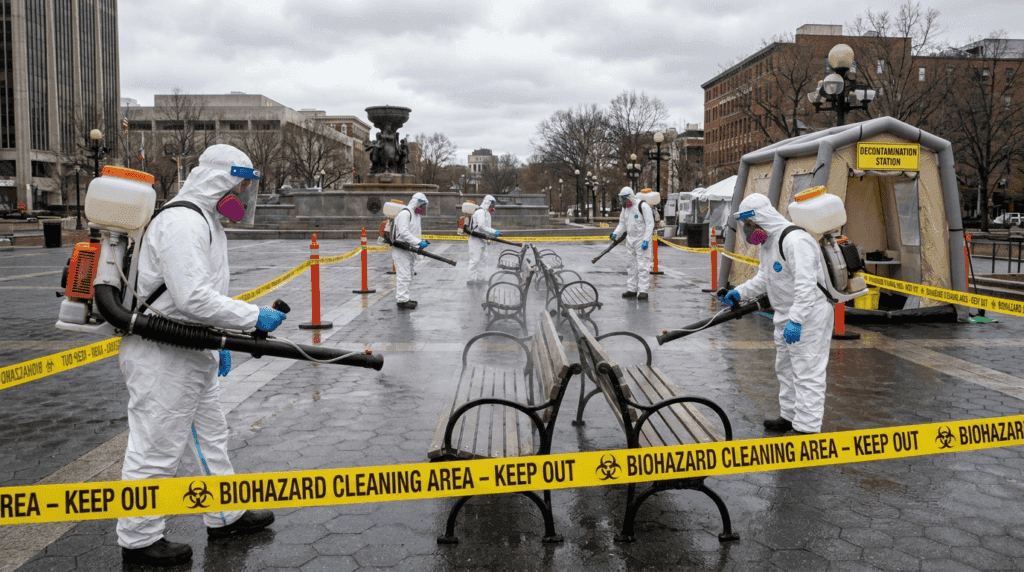
Outbreak cleaning is a temporary escalation of cleaning during an infectious disease outbreak: increased frequency on frequently touched surfaces, a disinfectant proven effective against the specific organism, dedicated or single-use equipment for affected areas, and documented records of what was cleaned and when. The most important technical point is that not all disinfectants work against all organisms — norovirus in particular resists many common products, which is why gastro outbreaks continue despite thorough-looking cleaning.
For Sunshine Coast childcare services, schools, aged care homes, medical practices and workplaces, an outbreak is not the time to work out what to do. The plan needs to exist beforehand, and your cleaning contractor needs to be in it.
The single most important principle: clean before you disinfect
A disinfectant applied over visible soil does not work. Organic matter physically shields organisms and, with chlorine-based products, chemically neutralises the active ingredient. The sequence is always:
- Remove gross contamination — vomit, faeces, spills — using absorbent material, and dispose of it as clinical or contaminated waste.
- Clean with detergent and mechanical action. This is where most of the organism load is physically removed.
- Disinfect with a product appropriate to the organism, applied at the correct dilution.
- Observe the contact time stated on the label. This is the step most often skipped — wiping a surface and immediately drying it does not deliver the claimed efficacy.
- Dispose of or launder equipment rather than carrying it to the next area.
Our article on decontamination versus disinfection covers the distinction in more detail.
Matching the disinfectant to the organism
This is where most outbreak cleaning fails, and it is worth being specific.
| Organism | Key characteristic | Cleaning implication |
|---|---|---|
| Norovirus (gastro) | Non-enveloped; resistant to many disinfectants including some alcohols and quaternary ammonium compounds | Requires a product with demonstrated efficacy against non-enveloped viruses; chlorine-based products at appropriate concentration are commonly used |
| Rotavirus | Non-enveloped; very low infectious dose | As above; heavy focus on nappy change areas and toilets |
| Influenza | Enveloped; relatively susceptible | Most standard disinfectants effective; focus on touch points and respiratory hygiene |
| COVID-19 | Enveloped; relatively susceptible | Standard disinfectants effective; ventilation matters as much as surface cleaning |
| Hand, foot and mouth | Non-enveloped enterovirus; persists on surfaces | Requires appropriate virucidal product; heavy focus on toys and shared equipment |
| Clostridioides difficile | Spore-forming | Requires a sporicidal agent; standard disinfectants are inadequate |
Two practical checks: read the product label for the specific claim, and confirm the required contact time. In Australia, disinfectant claims are regulated by the TGA, and ‘hospital grade disinfectant’ is a distinct category whose products must be included in the Australian Register of Therapeutic Goods. Household and commercial grade products must not be labelled hospital grade. If a product’s label makes no claim about the organism you are dealing with, assume it does not work against it. See cleaning chemical safety and SDS obligations.
Frequently touched surfaces: the priority list
During an outbreak, frequency on these matters far more than a general increase in cleaning effort:
- Door handles, push plates and door edges
- Light switches and power points
- Handrails and grab rails
- Lift buttons, both inside and at each landing
- Taps, soap dispensers, hand towel dispensers and flush buttons
- Shared keyboards, mice, phones and touchscreens
- Kitchen appliance handles, kettle, fridge door and microwave keypad
- Meeting room table edges, chair arms and remote controls
- Reception counters and EFTPOS terminals
- In childcare: toys, mats, cots, nappy change surfaces, highchairs, sleep mats
- In gyms: equipment handles, benches, mats, weight plates — see gym cleaning and sanitisation
Increase touch point cleaning to at least twice daily during an outbreak in a workplace, and hourly or per-session in childcare and clinical settings.
Responding to a vomit or faecal incident
Norovirus is transmitted in aerosolised particles from vomiting, which can contaminate surfaces several metres away. Handle these incidents as a specific procedure, not a routine spill:
- Clear the area immediately and restrict access for the duration.
- Put on PPE — gloves, apron, and mask and eye protection where splashing or aerosolisation is possible.
- Cover with absorbent material and remove the bulk contamination without spreading it.
- Dispose of it as contaminated waste in a sealed bag.
- Clean the area with detergent, working from the outside in.
- Disinfect a generous radius — at least two metres in every direction, including vertical surfaces and anything at floor level.
- Observe contact time, then rinse where required by the product.
- Dispose of all cloths and mop heads. Do not launder and reuse them for other areas.
- Ventilate the area thoroughly.
- Wash hands with soap and water — alcohol-based sanitiser is not sufficiently effective against norovirus.
- Record the incident with time, location and actions taken.
Soft furnishings and carpet contaminated in an incident need hot water extraction with an appropriate treatment, not surface spraying. See commercial carpet cleaning.
Equipment and cross-contamination control
- Colour-coded equipment — red for sanitary, blue for general, green for kitchen, yellow for clinical — with no crossover.
- Single-use or dedicated equipment in affected areas during an outbreak.
- Microfibre changed per room rather than a bucket carried between spaces.
- Clean areas first, affected areas last, so the cleaning route does not spread contamination.
- Launder mop heads and cloths at an appropriate temperature, or dispose of them.
- Never mix chlorine and acid products. Chlorine bleach combined with an acidic cleaner releases chlorine gas — a genuine risk when disinfectant use is escalated in confined washrooms.
Ventilation and the limits of surface cleaning
For respiratory infections such as influenza and COVID-19, transmission is predominantly airborne. Surface cleaning is worthwhile but secondary. Increasing outdoor air supply, opening windows where practical, and avoiding recirculation are more effective controls. Do not let intensive surface disinfection substitute for ventilation.
For gastrointestinal infections such as norovirus, the reverse applies — surfaces, hands and food handling are the transmission routes, and surface cleaning is central.
Sector-specific considerations
Childcare and early learning
The National Quality Standard’s Quality Area 2 requires that effective illness and injury management and hygiene practices are promoted and implemented (Element 2.1.2). During an outbreak that means increased attention to nappy change areas, toilets and toys, exclusion periods observed, records kept, and cleaning that a regulatory authority can see evidence of. See daycare and school cleaning.
Aged care
Outbreak management sits within the infection prevention and control obligations that accompany the strengthened Aged Care Quality Standards, alongside equipment cleaning and disinfection, waste management and linen handling. Documentation is part of the provider’s evidence. See aged care cleaning under the strengthened Standards.
Medical and dental practices
Practices already operate to infection control protocols; the outbreak escalation applies to waiting rooms, reception, shared amenities and public touch points as much as to clinical areas. See infection control in medical and dental practices.
Offices and workplaces
Touch points twice daily, hand hygiene facilities stocked and working, kitchen and washroom attention increased, and a clear message that staff should stay home when unwell — which is more effective than any cleaning measure.
Have a plan before you need it
A one-page outbreak plan should name: who declares an outbreak and who they notify, what the escalated cleaning schedule is, which products will be used for which organisms, where PPE and supplies are held, who is responsible for records, and how the cleaning contractor is contacted outside normal hours. Confirm with your contractor now that they can escalate at short notice — during a regional outbreak, capacity is the constraint.
Frequently asked questions
What disinfectant works against norovirus?
Norovirus is a non-enveloped virus and resists many common disinfectants, including some alcohol-based and quaternary ammonium products. Use a product that specifically claims efficacy against non-enveloped viruses or norovirus; chlorine-based products at an appropriate concentration are commonly used. Always clean first and observe the stated contact time.
How often should touch points be cleaned during an outbreak?
At least twice daily in a workplace, and hourly or per-session in childcare, aged care and clinical settings. Frequency on the right surfaces matters more than a general increase in cleaning hours.
Is hand sanitiser effective against gastro?
Alcohol-based hand sanitiser is not sufficiently effective against norovirus. Soap and water with thorough mechanical washing is the appropriate hand hygiene measure during a gastro outbreak. Sanitiser remains useful for respiratory viruses.
How long does norovirus survive on surfaces?
Norovirus is notably environmentally persistent and can remain infectious on surfaces for extended periods, which is why thorough surface disinfection with an effective product and adequate contact time is central to controlling a gastro outbreak.
Do we need to close during an outbreak?
That depends on the setting, the organism and public health advice. Childcare services, schools and aged care homes should follow Queensland Health and their regulator’s guidance, which may include exclusion periods and notification requirements. Seek that advice early rather than deciding independently.
Should we use a fogging or misting service?
Fogging is sometimes used as an adjunct in specific settings, but it is not a substitute for cleaning. Disinfectant applied to a soiled surface does not work regardless of how it is applied, and fogging does not remove the soil. Physical cleaning followed by targeted disinfection of touch points is the reliable approach.
Get an outbreak response arrangement in place
Divine Commercial Cleaning provides escalated outbreak cleaning for childcare services, medical practices, aged care and workplaces across the Sunshine Coast, with police-checked cleaners and documented cleaning records. Talk to us about an outbreak response arrangement so the plan is in place before you need it.

Dianne, originally from Rockhampton, hails from a business-oriented family, with her father owning electrical stores and her uncle serving as Mayor. Moving to the Sunshine Coast at 13, she later pursued a rewarding real estate career and raised three children. As a single mom, she balanced university studies with domestic cleaning work. Armed with a Bachelor’s Degree in Business, majoring in Supply Chain Management, Dianne founded and grew Divine Commercial Cleaning into a thriving company. Her success is rooted in strong family mentorship, a positive attitude, and a solution-oriented approach, offering tailored cleaning services with integrity and strategic insight.