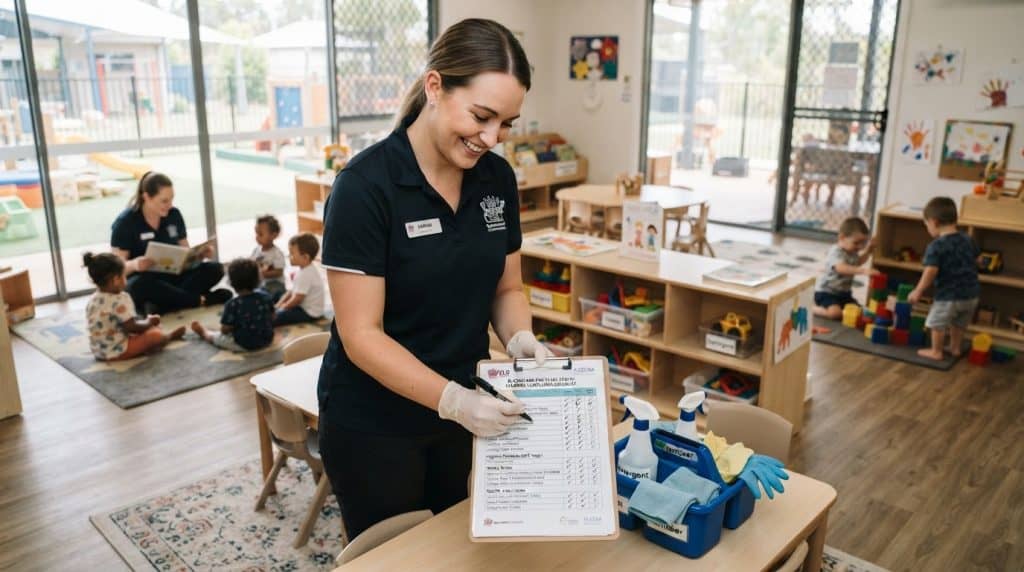
If you run an early childhood education and care service on the Sunshine Coast, cleaning is not housekeeping. It is a regulated obligation, and an authorised officer can form a view about it during an assessment and rating visit.
This checklist sets out what the rules actually require, what a cleaning schedule needs to cover to meet them, and what to ask a contractor before you sign anything. It is written for approved providers, nominated supervisors and centre directors who want the cleaning side of compliance settled rather than assumed.
What the regulations actually say about cleaning
Most of the obligation sits in one short line. Regulation 103 of the Education and Care Services National Regulations requires the approved provider to ensure that the service premises and all equipment and furniture used in providing the service are safe, clean and in good repair. It carries a penalty, and it is one of the more commonly cited regulations nationally.
Three further regulations put specific areas in scope:
- Regulation 106 — laundry and hygiene facilities. The service must have laundry facilities, or other arrangements for dealing with soiled clothing, nappies and linen including hygienic storage before disposal or laundering, adequate for the needs of the service.
- Regulation 109 — toilet and hygiene facilities. Adequate, clean and appropriately located toilet and hygiene facilities.
- Regulation 112 — nappy change facilities. An additional requirement for centre-based services.
Under the National Quality Standard, Regulation 103 maps to element 3.1.2 (upkeep) in Quality Area 3, Physical Environment. Hygiene practice sits in Quality Area 2, Children’s Health and Safety. In Queensland, the Early Childhood Regulatory Authority assesses and rates services against the NQS, giving a rating for each of the seven quality areas plus an overall rating.
The practical guidance behind all of this is the NHMRC’s Staying healthy. The sixth edition was released in 2024, the first update since 2012, and NHMRC has taken a digital-first approach, publishing it as interactive web pages rather than offering hard copies. If your cleaning schedule was built against the fifth edition, it is worth a review.
The checklist
Daily
- High-touch surfaces: door handles, light switches, tap handles, gate latches, handrails, sign-in tablets and bench edges at child height
- Toilets, potties, hand basins, and the floor around them
- Nappy change surfaces and the bin area
- Kitchen and bottle preparation surfaces, and the sink
- Hard floors in all rooms in use, vacuumed and mopped
- Bins emptied, including sanitary and nappy bins, with liners replaced
- Entry mats and foyer, the first thing a visiting officer sees
- Spot-clean glass at child height
Weekly
- Cot and mat storage areas
- Skirting boards, low walls and the underside of tables
- Storage shelving and art supply areas
- Staff room, office and staff toilet
- Outdoor hard surfaces: paths, verandahs, sandpit surrounds
- Detail clean of tap fittings, plugholes and waste outlets
Monthly to quarterly
- Carpet cleaning in sleep rooms and soft-floor areas
- Tile and grout cleaning in wet areas, where a visual inspection fails first
- Strip and seal vinyl flooring on the cycle the flooring manufacturer specifies
- Window cleaning inside and out, including the glass children see through
- Pressure washing of outdoor play areas, paths and shade sail posts
- High dusting: light fittings, air-conditioning vents, ceiling fans, door frames
Documentation, the part most services under-do
- A written cleaning schedule that names each task, its frequency and who performs it
- A signed record showing the schedule was followed, kept for the period your record-keeping policy specifies
- Safety Data Sheets for every chemical on site, current and accessible
- A chemical register, with all products stored inaccessible to children
- Your cleaning arrangements reflected in the health and hygiene policies you are required to maintain
- Evidence of rectification where something was found not clean and put right
That last one matters more than it sounds. Regulation 103 is about the state of the premises, so a schedule on its own proves intent. A record showing you identified a problem and fixed it proves a system.
Blue cards: the question contractors get wrong
This trips up a lot of services, and the answer is more specific than most people assume.
A tradesperson or contractor needs a blue card when working within an education and care service while children are present. Queensland Government guidance names cleaners, cooks and maintenance people among those who require one. But the trigger is the presence of children. The example the Government itself gives of a case where no blue card is required is an electrician contracted to fix lights at a childcare centre on a weekend when no children are present.
So the practical position is:
- Cleaning performed after hours, with no children on the premises, does not by itself put a contractor into regulated employment
- Any cleaning during operating hours does
- So does entering the premises to consult with staff before doing the work, if children are present
- Separately, the approved provider has responsibilities for employing suitable staff under the National Law (Queensland), including checking a person’s prohibition status
Two things follow. Ask any contractor when they intend to be on site, not just whether they hold a card. And if your schedule ever shifts a task into operating hours, whether that is a spill, an emergency or a mid-term deep clean, the blue card requirement shifts with it.
Chemicals and work health and safety
Cleaning products in a childcare centre sit under work health and safety law as well as the education and care regulations. Keep Safety Data Sheets current and on site, maintain a register of what is held, and store everything where children cannot reach it.
Ask your contractor what they use in child-occupied spaces and whether there is a dwell time before a room can be reoccupied. A disinfectant that needs ten minutes of wet contact to work is doing nothing if it is wiped off in thirty seconds, and it is doing something you do not want if children return before it is dry.
What is changing in Queensland
A new Queensland regulation takes effect on 1 September 2026, with one-month and three-month transition periods applying to some requirements. It applies to services regulated under Queensland’s Education and Care Services Act 2013 rather than services under the National Quality Framework, and introduces requirements covering transportation, sleep and rest, and child safe environments, including policies and procedures addressing a culture of child safety and wellbeing.
If your service is NQF-approved, this one is not yours. If you operate a QEC-approved service, check which transition dates apply to you. Either way, a child safe environment policy that covers who is on your premises and when is the kind of document that now gets read closely, and contracted cleaning is part of that picture.
What to ask a cleaning contractor
- Can you give me a written schedule mapped to Regulations 103, 106, 109 and 112?
- What record do I get showing each clean was completed?
- Will anyone be on site while children are present, and if so, do they hold a blue card?
- Which products will you use in child-occupied rooms, and can I see the Safety Data Sheets?
- Who cleans the nappy change area and the bins, you or my staff?
- How do you handle a gastro or hand, foot and mouth outbreak?
- What happens if an assessment visit is scheduled and I need something brought forward?
If a contractor cannot answer the second and third questions immediately, the rest of the conversation is not worth having.
Getting it right
Cleaning that holds up under assessment is never cleaning that was improvised. It is a schedule someone wrote down, tied to the regulations it exists to satisfy, with a record behind it.
Divine Commercial Cleaning provides daycare and school cleaning across the Sunshine Coast. If you would like a cleaning schedule built against this checklist for your centre, get in touch.
This article is general information and not legal advice. Check your obligations against the current National Regulations and your service approval conditions.

Dianne, originally from Rockhampton, hails from a business-oriented family, with her father owning electrical stores and her uncle serving as Mayor. Moving to the Sunshine Coast at 13, she later pursued a rewarding real estate career and raised three children. As a single mom, she balanced university studies with domestic cleaning work. Armed with a Bachelor’s Degree in Business, majoring in Supply Chain Management, Dianne founded and grew Divine Commercial Cleaning into a thriving company. Her success is rooted in strong family mentorship, a positive attitude, and a solution-oriented approach, offering tailored cleaning services with integrity and strategic insight.