
Biohazard and Contamination Cleanup Services in Sunshine Coast and Brisbane: Professional Solutions for Businesses
Biohazard and contamination cleanup refers to specialised cleaning and remediation services that remove biological hazards, chemical contaminants, and other unsafe materials from commercial properties to protect health, ensure legal compliance, and minimise business disruption. This article explains what constitutes biohazard and contamination cleanup, why commercial property managers and business owners on the Sunshine Coast and in Brisbane should rely on trained professionals, and how the process works from initial assessment through final validation. Readers will learn the common contaminants encountered in workplaces, the triggers that require emergency response, the technical remediation methods used in commercial settings, and how to evaluate providers for reliability and compliance. The guide also outlines specific specialised services — including crime scene cleanup, unattended death remediation, medical facility decontamination, and hazardous waste removal — while clarifying responsibilities for disposal and documentation. Finally, practical checklists, EAV-style comparison tables, and FAQs will help decision-makers prepare for incidents and coordinate rapid, lawful remediation with minimal operational impact.
What Are Biohazard and Contamination Cleanup Services?
Biohazard and contamination cleanup services are professional environmental remediation and decontamination procedures designed to neutralise biological hazards and hazardous substances so spaces are safe to occupy again. These services combine assessment, containment, targeted remediation methods (chemical, thermal, filtration, or UV-C where appropriate), and compliant waste disposal to reduce infection risk and legal liability. Businesses benefit because qualified teams reduce downtime, provide documentation for insurers and regulators, and prevent secondary contamination that can spread through HVAC or foot traffic. Understanding what contaminants are typically handled helps managers decide when to call experts and what immediate steps to take on site to protect staff and customers.
Biohazard and contamination cleanup commonly addresses the following contaminants and hazards:
- Blood and bodily fluids: carry bloodborne pathogens and require specialised PPE and disposal.
- Infectious agents: bacterial or viral contamination that needs validated disinfection.
- Sewage and wastewater intrusion: can contain pathogens, chemical runoff, and require structural drying.
- Mould and fungal growth: persistent spores that need containment and remediation to prevent recurrence.
- Chemical spills and hazardous materials: require classification and specialised disposal methods.
These categories illustrate why DIY attempts are risky: inadequate containment or inappropriate disinfectants can leave residual hazards. The next subsection enumerates which specific types of biohazards and contaminants are typically handled and the business scenarios where they occur.
Which Types of Biohazards and Contaminants Do We Handle?
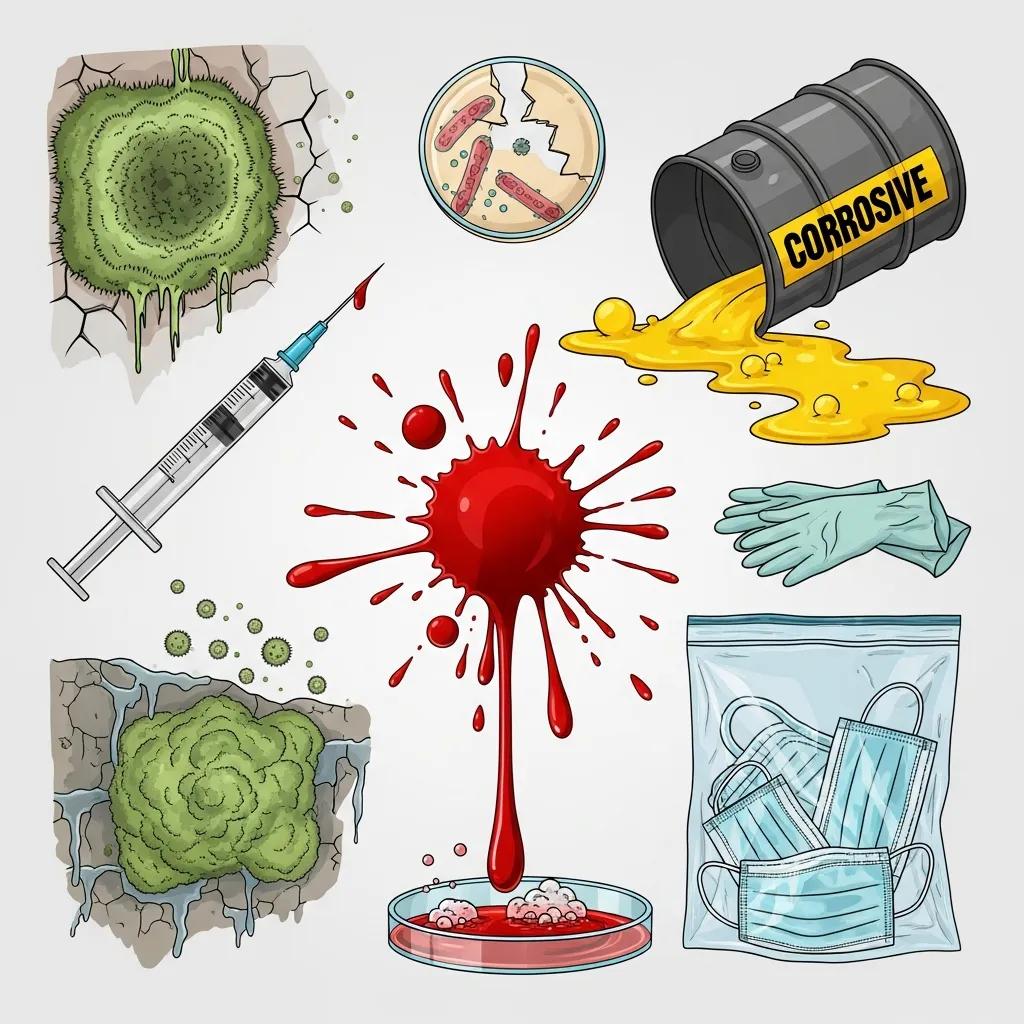
Biohazard cleanup covers a range of hyponymous services such as crime scene cleanup, unattended death remediation, infectious disease disinfection, mould remediation, and sewage overflow cleanup. Each contaminant type demands a distinct approach: blood and bodily fluids require bloodborne pathogen protocols; infectious disease incidents need validated disinfectants and dwell times; mould remediation includes containment and HEPA filtration; sewage events require decontamination and moisture control; and chemical spills require hazardous material classification and licensed disposal. Businesses affected include medical centres with patient-related infectious risks, offices and retail locations exposed to violent incidents, industrial sites dealing with chemical leaks, and hospitality venues experiencing sewage backups. Knowing these categories helps facility managers anticipate required response levels and documentation for compliance and insurance.
These classifications lead directly to practical signs that indicate a need for professional intervention, which are described in the following subsection to help decision-makers prioritise response actions.
When Should Businesses Call Professional Biohazard Cleanup Experts?
Businesses should call professional biohazard cleanup experts whenever there is visible blood or bodily fluids, a confirmed or suspected infectious disease exposure, a sewage overflow, a chemical spill that may be hazardous, or the discovery of an unattended death. Immediate triggers include acute contamination of workspaces, HVAC involvement spreading contaminants, or any situation where staff confidentiality or forensic evidence integrity might be affected. Until trained technicians arrive, on-site staff should isolate the area, restrict access, and avoid attempting cleanup with regular cleaning agents that may spread contaminants. Promptly notifying building management, insurers, and local health authorities as applicable helps coordinate remediation and ensures required documentation and legal steps are followed.
After recognising the trigger and isolating the area, the next step is understanding what specialised services providers can offer to address these incidents safely and discreetly.
What Specialized Biohazard Cleanup Services Does Divine Commercial Cleaning Offer?
Specialised biohazard cleanup services encompass targeted responses for trauma and crime scene remediation, unattended death cleaning, infectious disease disinfection, medical facility decontamination, hazardous waste removal, and related contamination tasks tailored to commercial clients. These services deploy certified PPE, methodical containment, industry-grade disinfectants, HEPA filtration, and documentation practices that align with regulatory expectations and insurer requirements. For business decision-makers, choosing a provider that outlines clear scopes of work, produces compliance paperwork, and coordinates hazardous waste transport is essential for rapid reopening and risk reduction. Below is a quick comparison of common specialised services and which business types typically need them, designed to help managers match an incident to the right remediation approach.
| Service | Typical Contaminants Addressed | Typical Business Types Served |
|---|---|---|
| Crime Scene Cleanup | Bloodborne pathogens, bodily fluids | Retail stores, offices, hospitality venues |
| Unattended Death Cleanup | Decomposition fluids, bacterial contamination | Residential complexes, staff facilities |
| Medical Facility Decontamination | Pathogens, biofluids, high-touch equipment | Clinics, dental practices, allied health centres |
| Hazardous Waste Removal | Chemical residues, industrial fluids | Manufacturing sites, laboratories, warehouses |
This comparison helps agencies and managers prioritise responses and prepare appropriate notifications to stakeholders. After matching service types to incidents, readers will want to know how providers ensure safety, discretion, and coordination with authorities during crime scene work.
How Does Crime Scene Cleanup Ensure Safety and Discretion?
Crime scene cleanup combines strict PPE protocols, scene containment, and sensitivity to privacy and evidence integrity to restore spaces safely while respecting affected people and legal processes. Technicians follow bloodborne pathogen procedures, use disposable containment barriers, and employ air management tools to prevent cross-contamination, while maintaining discretion through private scheduling and minimal on-site visibility. Staff vetting and police checks are employed to ensure trustworthy teams carry out work, and coordination with law enforcement or forensic personnel occurs only when required to protect evidentiary requirements. The process balances rapid remediation with compassion and legal awareness to reduce operational disruption and reputational risk for businesses.
These protective and procedural measures lead naturally into the equally sensitive area of unattended death cleanup, which emphasises both technical remediation and compassionate communication with stakeholders.
What Is Involved in Unattended Death Cleanup Services?
Unattended death cleanup is a methodical process that combines emotional sensitivity, biohazard containment, and documentation to make spaces safe for reoccupation while supporting business continuity. Teams secure the area, perform a detailed assessment of fluid spread and porous material contamination, and apply targeted removal or deep-cleaning techniques alongside appropriate hazardous waste handling. Documentation of actions and waste manifests supports insurance claims and regulatory compliance, and technicians communicate discreetly with property managers or family representatives to coordinate access and timing. Ensuring staff privacy and maintaining a respectful presence are central to this service, as is restoring the environment to a condition suitable for normal operations.
After establishing service offerings, businesses often need technical clarity on remediation methods and local compliance, which the next section addresses in detail.
How Does Divine Commercial Cleaning Perform Contamination Remediation in Brisbane and Sunshine Coast?
Contamination remediation in commercial contexts uses a mix of validated disinfectants, HEPA filtration, targeted surface cleaning, and, where applicable, thermal or UV-C interventions to remove pathogens and hazardous residues while documenting outcomes. The methodological approach begins with risk-based assessment, selecting remediation techniques suited to the contaminant and substrate, and employing environmental controls to protect adjacent areas. Quality assurance includes post-remediation inspection, swab testing or ATP monitoring when requested, and clear reporting so businesses can satisfy regulators and insurers. Local considerations for Sunshine Coast and Brisbane clients include coordinating with regional waste transport and disposal partners and scheduling work to minimise impact on peak trading periods or clinical hours.
Below is a technical EAV table that aligns contaminant types with typical remediation methods and essential disposal or compliance notes to guide procurement and planning decisions.
| Contaminant Type | Remediation Methods Used | Disposal / Compliance Notes |
|---|---|---|
| Blood and Bodily Fluids | Bloodborne pathogen protocols, chemical disinfection, absorbent removal | Seal and label biohazard waste; manifest for licensed disposal |
| Infectious Agents | Hospital-grade disinfectants, contact time validation, HEPA air filtration | Provide verification documentation; liaise with health authorities if required |
| Sewage/ wastewater | Structural drying, antimicrobial treatment, odour control | Wastewater may require licensed removal; document extent for insurers |
| Mould | Containment, HEPA negative pressure, removal of contaminated materials | Follow building codes for mould waste; provide remediation reports |
| Chemical residues | Neutralisation, specialised absorbents, hazardous waste classification | Coordinate with licensed hazardous waste transporters and disposal facilities |
This technical mapping clarifies method selection and legal responsibilities, and it assists facility managers in preparing scopes of work and compliance checklists. The following subsections provide more detail for medical facility scenarios and hazardous waste management for commercial clients.
What Are the Steps in Medical Facility Decontamination?
Medical facility decontamination follows strict zoning, use of hospital-grade disinfectants, and workflow controls to protect patients and staff while meeting healthcare standards. Initial steps include scheduling off-peak times where possible, isolating treatment zones, and securing medical equipment so disinfection methods do not damage sensitive devices. Technicians use validated products with specified contact times, focus on high-touch surfaces and shared equipment, and perform documentation for each cleaned area to support clinical governance. Final validation may include surface swabbing or visual inspection and a clearance report that enables safe resumption of clinical activities.
These clinical-grade controls are closely connected to the regulatory and disposal challenges that arise when hazardous waste is generated during remediation, which the next subsection examines.
How Is Hazardous Waste Removal Managed for Commercial Clients?
Hazardous waste removal for commercial clients involves classification, segregation, secure packaging, and transfer to licensed disposal partners with full manifesting and record-keeping to meet legal obligations. The process begins by identifying the waste streams generated by remediation — for example, sharps, contaminated PPE, chemical absorbents, or biohazardous materials — and sourcing the appropriate containers and transportation. Licensed carriers transport waste under regulated chains of custody, and clients receive documentation that supports compliance and insurance claims. Maintaining accurate records and coordinating scheduled pickups reduces storage time on-site and helps businesses demonstrate due diligence in incident response.
Having explained remediation methods and disposal handling, the next H2 outlines reasons to choose a reliable local provider and the specific value propositions that matter to businesses evaluating vendors.
Why Choose Divine Commercial Cleaning for Biohazard and Contamination Cleanup?
Choosing a biohazard remediation partner should prioritise trust, reliability, and clear operational safeguards that protect people and property while enabling rapid business recovery. Divine Commercial Cleaning positions itself as a family-owned, locally focused provider on the Sunshine Coast and in Brisbane that emphasises experienced, professional cleaners, police checks for staff, fully insured operations, environmentally conscious practices, no lock-in contracts, and a money-back guarantee. For businesses, these attributes translate into predictable scheduling, reduced vetting overhead, and assurance that the provider will coordinate documentation and disposal as part of a comprehensive service. Evaluating providers against these criteria helps facilities managers select a partner who reduces operational risk and supports regulatory and insurer requirements.
Below is a short list summarising key unique value propositions to look for when choosing a provider.
- Family-owned and operated with local knowledge that supports fast mobilisation and community awareness.
- Experienced professional cleaners trained in biohazard protocols and the use of industry-grade remediation methods.
- Fully insured services and staff police checks that provide assurance for sensitive or high-liability incidents.
These attributes directly benefit business clients by combining accountability, rapid response capability, and environmental responsibility. The subsection that follows lists the UVPs and clarifies what certification details should be verified when available.
What Are Our Unique Value Propositions and Certifications?
Divine Commercial Cleaning’s listed unique value propositions include family ownership, experienced professional cleaners, no lock-in contracts, same cleaner every time, reliable service, full insurance coverage, environmentally conscious practices, police checks, and a money-back guarantee. These points should be presented to clients alongside any verified certifications or industry accreditations, which must be confirmed before being listed or claimed. When assessing providers, businesses should request evidence of insurance limits, staff vetting policies, and examples of documented remediation reports that align with the provider’s stated guarantees. Clear verification helps translate marketing claims into practical assurances for decision-makers.
These reliability claims lead into operational practices that demonstrate environmental responsibility and dependable service delivery, which the next subsection discusses.
How Do We Ensure Environmentally Conscious and Reliable Service?
Environmentally conscious and reliable service is achieved through careful product selection, waste minimisation, and consistent operational models that prioritise the same trained personnel for repeat engagements. Practices include using low-VOC or biodegradable cleaning agents where appropriate, segregating waste to reduce unnecessary landfill, and partnering with licensed disposal facilities to ensure lawful handling of hazardous materials. Reliability is enhanced by offering consistent staffing models (same cleaner where feasible), no lock-in contracts to maintain transparent client relationships, and robust documentation practices that support business continuity and insurance processes. Combined, these measures reduce environmental footprint while delivering predictable outcomes for commercial clients.
After discussing provider selection and operational practices, decision-makers will want a clear, step-by-step walkthrough of the cleanup process from assessment to final validation, which follows next.
What Is the Biohazard Cleanup Process from Assessment to Validation?
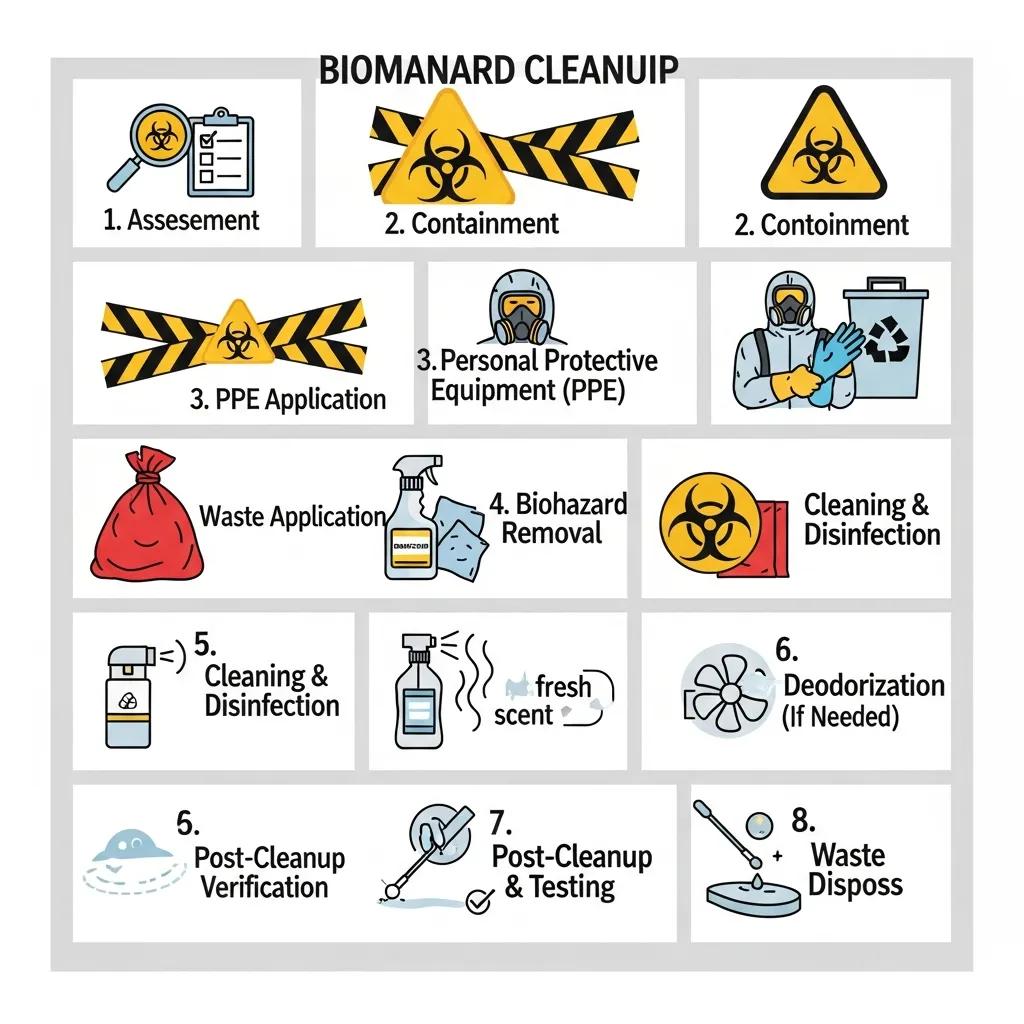
The biohazard cleanup process follows a structured workflow: assessment, containment, remediation, hazardous waste disposal, and final validation with documentation. Each step is designed to reduce immediate health risks, prevent cross-contamination, and provide evidence that the site meets reoccupancy standards. A clear chain of actions and deliverables helps businesses plan downtime, coordinate with insurers, and meet any regulatory reporting obligations. The numbered steps below provide a concise roadmap suitable for inclusion in an emergency response plan or procurement brief.
- Assessment: Identify contaminant type, extent, and risk level, and generate a scope-of-work and safety plan.
- Containment: Isolate affected zones using barriers and HVAC controls to prevent spread to clean areas.
- Remediation: Apply targeted cleaning, disinfection, or removal techniques using validated products and PPE.
- Disposal: Segregate and transfer hazardous waste via licensed carriers with proper manifests.
- Validation: Conduct inspection, swab testing or ATP readings if required, and provide a clearance report for reoccupation.
These steps guide operational planning and clarify expected deliverables. The EAV-style table below provides a concise view of each process step, the activities performed, and the expected documentation provided to clients.
| Process Step | What We Do (Entity) | Expected Outcome / Documentation |
|---|---|---|
| Assessment | Site inspection, risk classification, scope of work | Written assessment report and safety plan |
| Containment | Zoning, barriers, HVAC controls, PPE deployment | Containment log and access restrictions |
| Remediation | Chemical/thermal/filtration treatments, material removal | Cleaning records and product labels used |
| Disposal | Segregation, packaging, licensed transport | Waste manifests and disposal receipts |
| Validation | Visual inspection, swab/ATP testing where applicable | Clearance certificate and final report |
This table clarifies responsibilities and the tangible documentation businesses receive after remediation. The next subsection explains assessment and containment in more detail to help facility managers understand early response priorities.
How Do We Assess and Contain Biohazards Safely?
Assessment and containment begin with a methodical checklist that records contaminant type, spread, surface porosity, and risk to occupants, enabling technicians to choose the correct PPE level and containment strategy. Immediate containment measures include restricting access, establishing negative-pressure zones where required, and isolating HVAC systems to prevent aerosolised spread. Assessment timelines are documented and communicated to clients so decisions about temporary closures or phased re-openings can be made confidently. Clear containment reduces cross-contamination risks and forms the basis for accurate remediation scopes and efficient resource allocation.
The containment step naturally precedes remediation and disposal activities, which are described in the following subsection along with validation expectations.
What Methods Are Used for Remediation, Disposal, and Final Validation?
Remediation methods include targeted chemical disinfection using hospital-grade products with validated contact times, removal of irreparably contaminated porous materials, HEPA-filtered air changes, and selective use of thermal or UV-C treatments where safe and appropriate. Hazardous waste is then segregated, packaged, and transferred to licensed disposal partners with a documented chain of custody and manifests provided to the client. Final validation may involve visual inspection, swab testing, ATP bioluminescence readings, or third-party verification depending on client needs and regulatory expectations. Clients receive a final report and clearance documentation that supports safe reoccupation and insurer requirements.
Having covered the process and validation, the final H2 provides common questions and practical answers that help businesses make informed decisions in emergency and non-emergency scenarios.
What Are Common Questions About Biohazard and Contamination Cleanup?
Decision-makers frequently ask about insurance coverage, the main categories of biohazard cleanup, response times, cost drivers, and how to request emergency service and quotes. Concise, actionable answers help managers assemble procurement paperwork, communicate with insurers, and set expectations for stakeholders. The subsections below address two high-priority questions: insurance coverage considerations and the commonly referenced five types of biohazard cleanup.
Many businesses also need clarity on next steps for requesting service, which is covered alongside insurance guidance to support rapid mobilisation when incidents occur.
Are Biohazard Cleanup Services Covered by Insurance?
Insurance coverage for biohazard cleanup varies by policy, but many commercial property and business interruption policies cover cleanup when contamination results from insured perils, such as a covered event or sudden accidental release. Policy language, exclusions for pollution or intentional acts, and limits for environmental or hazardous waste removal can affect coverage, so businesses should consult their insurer and provide detailed remediation reports and manifests. Promptly documenting the incident with photos, assessment reports, and service invoices helps when filing claims, and some providers supply the necessary documentation to support the insurer’s assessment. Businesses should also obtain a written quote and scope before work begins to avoid disputes about coverage limits during claims processing.
This guidance leads into a checklist of practical steps businesses should follow when filing a claim related to a biohazard incident.
- Notify your insurer promptly and provide initial incident details.
- Secure the scene and document damage with photos before remediation begins.
- Request a written scope of work and cost estimate from the remediation provider.
- Keep all remediation reports, waste manifests, and invoices for the claims process.
These actions improve the likelihood of smooth claims handling and ensure remediation meets insurer requirements. The following subsection lists the five commonly referenced types of biohazard cleanup to help managers classify incidents quickly.
What Are the Five Types of Biohazard Cleanup?
The five commonly referenced types of biohazard cleanup include trauma and crime scene cleanup, unattended death cleanup, infectious disease disinfection, mould and sewage remediation, and chemical or hazardous material response. Trauma and crime scene cleaning focuses on bloodborne pathogen removal and discreet, evidence-aware procedures; unattended death cleanup involves decomposition fluid removal and sensitive communication; infectious disease disinfection targets pathogens with validated disinfectants and dwell times; mould and sewage remediation addresses microbial growth and contaminated water intrusion with drying and removal; and chemical/hazardous material response requires hazardous waste classification and licensed disposal. Each type demands different equipment, expertise, and documentation levels, which guides procurement and insurer discussions.
This classification helps businesses decide which specialised service to engage and prepares managers for the different timelines and compliance obligations each type entails. The final FAQ answer explains how to request service and emergency contact procedures.
For emergency assistance or to request a tailored quote for biohazard or contamination cleanup on the Sunshine Coast or in Brisbane, businesses may contact Divine Commercial Cleaning directly by phone at 0459 949 969 or by email at info@divinecleaning.com.au. The company is family-owned and offers local mobilisation, documented scope-of-work estimates, and coordination of licensed hazardous waste disposal for commercial clients.

Dianne, originally from Rockhampton, hails from a business-oriented family, with her father owning electrical stores and her uncle serving as Mayor. Moving to the Sunshine Coast at 13, she later pursued a rewarding real estate career and raised three children. As a single mom, she balanced university studies with domestic cleaning work. Armed with a Bachelor’s Degree in Business, majoring in Supply Chain Management, Dianne founded and grew Divine Commercial Cleaning into a thriving company. Her success is rooted in strong family mentorship, a positive attitude, and a solution-oriented approach, offering tailored cleaning services with integrity and strategic insight.