
How Often Should Commercial Carpets Be Cleaned: Your Complete Guide to Optimal Cleaning Frequency and Maintenance
Commercial carpet cleaning frequency defines how often routine maintenance and restorative services are applied to carpeted areas to protect indoor air quality, appearance, and asset life. Establishing the right commercial carpet maintenance schedule balances daily tasks like vacuuming and spot treatment with periodic interim cleaning and restorative deep cleaning to minimise wear, odour and health risks.
This guide shows why frequency matters, the factors that change recommended intervals, and a practical schedule mapped to traffic tiers and business types. You will also find method comparisons—hot water extraction versus encapsulation—actionable daily and weekly checklists, and decision tools to tailor plans for offices, medical centres, retail and daycare facilities.
Finally, we explain how local conditions on the Sunshine Coast and in Brisbane affect recommended cadence and how a local commercial cleaner can implement a custom plan to meet operational and environmental goals. Throughout, targeted keywords such as carpet cleaning frequency and commercial carpet maintenance schedule are used to help you find practical answers and implementable steps.
Why Does Commercial Carpet Cleaning Frequency Matter?
Commercial carpet cleaning frequency matters because it directly influences indoor air quality, visible cleanliness and carpet lifespan through the removal of soil, allergens and microbial load. Regular maintenance prevents particulate buildup that degrades HVAC performance and increases allergy triggers, while preserving the carpet’s appearance that shapes customer and tenant perception. A consistent schedule reduces the need for premature replacement, producing measurable savings in lifecycle cost compared with reactive replacement after heavy soiling. Recent studies and industry practice indicate that proactive maintenance paired with targeted deep cleaning yields better outcomes than infrequent aggressive treatments, which can damage fibres and void manufacturer recommendations. Understanding these benefits leads naturally into specific mechanisms—how cleaning improves air quality and the economic rationale for maintaining appearance and longevity.
How Does Regular Cleaning Improve Indoor Air Quality and Hygiene?
Regular cleaning improves indoor air quality by removing dry particulates, pollen, dust mites and other allergens that carpets trap, reducing respirable particulate concentrations in occupied spaces. Mechanisms include vacuuming with high-efficiency filters to capture fine dust, followed by professional treatments that remove embedded soils and microbial reservoirs that vacuuming alone cannot reach. For higher-risk facilities such as medical centres and daycares, reducing microbial load through scheduled carpet care lowers the potential for fomite transfer and contributes to overall workplace hygiene. Practical outcomes include fewer sick days, reduced allergen complaints and a healthier environment for staff and visitors. These hygiene benefits set up the next discussion about appearance and economic longevity considerations.
What Are the Benefits of Maintaining Carpet Appearance and Longevity?
Maintaining carpet appearance through timely cleaning preserves professional presentation, supports brand perception and delays capital replacement costs by slowing fibre breakdown. Regular interim maintenance protects pile structure, prevents matting in walkways, and mitigates staining that becomes costly to reverse, producing a superior return on investment compared with early replacement cycles. From an operational perspective, well-maintained carpets reduce incremental repair actions and keep leased spaces rentable and presentable. Financially, scheduled maintenance converts unpredictable replacement expenses into planned service costs, making budgeting more predictable. These appearance and lifespan advantages lead into the factors that determine how frequently cleaning should actually occur.
What Factors Influence How Often Commercial Carpets Should Be Cleaned?
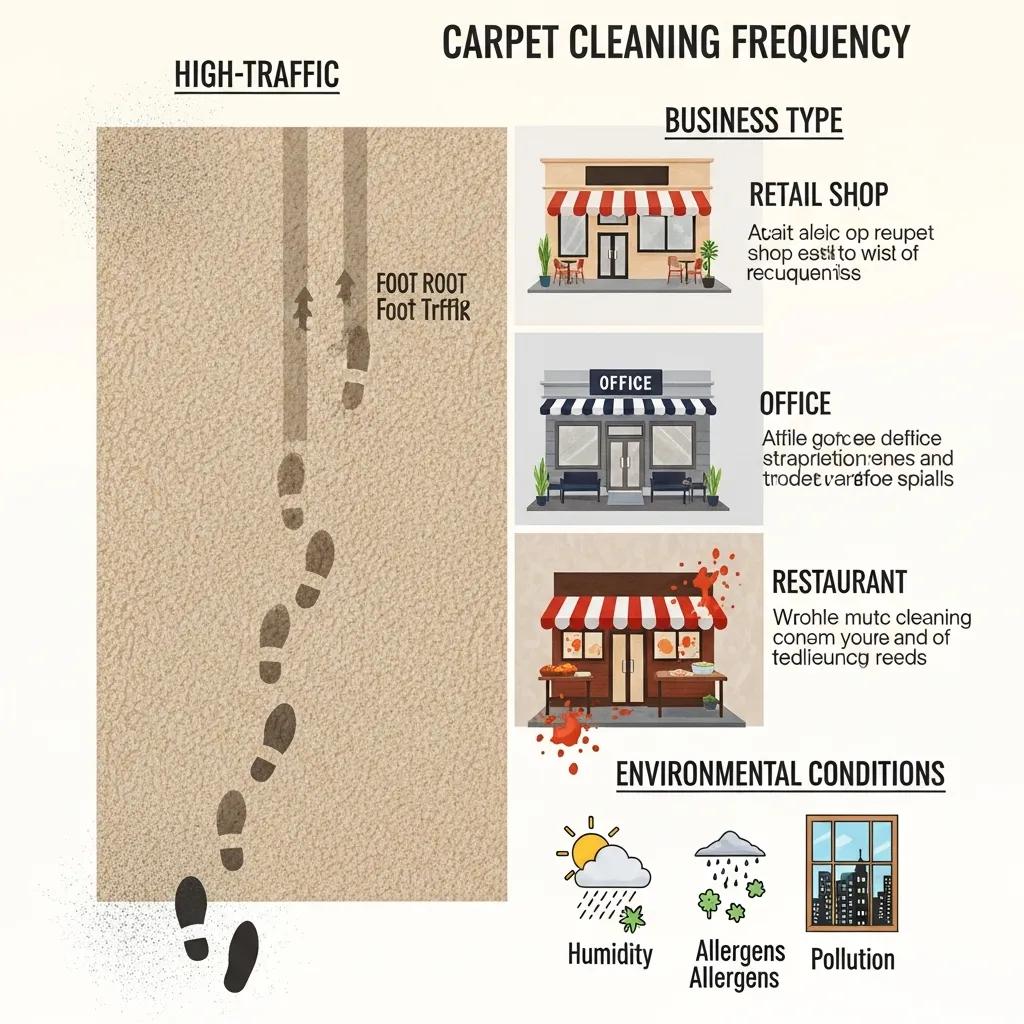
Several key factors influence carpet cleaning frequency: foot traffic intensity, business type and hygiene requirements, carpet fibre and construction, manufacturer warranty and local environmental conditions such as humidity and pollen. Each factor alters the balance between daily maintenance and restorative cleaning; for example, loop-pile carpets in high-traffic lobbies need more frequent interim care than dense low-pile office carpets. Facility managers must evaluate these attributes collectively to set a commercial carpet maintenance schedule that protects warranties, health and aesthetics. Below is a compact comparison showing how principal factors affect recommended frequency and practical implications for scheduling.
Different facility attributes change recommended cleaning cadence and operational responses.
| Factor | Effect on Frequency | Practical Implication |
|---|---|---|
| Foot traffic | Increases required maintenance and deep-clean cadence | High-traffic zones need daily vacuuming and more frequent interim cleaning |
| Business type / hygiene standard | Higher hygiene needs demand shorter intervals | Healthcare/daycare require stricter schedules and documented cleaning |
| Carpet material | Fibre and backing affect soil retention and cleaning tolerance | Sensitive fibres may need gentler methods and manufacturer-aligned care |
| Environmental conditions | Humidity, pollen, salt air increase soiling and drying time | Coastal or high-pollen areas need more frequent checks and entry-zone focus |
How Does Foot Traffic Level Affect Cleaning Frequency?
Foot traffic level dictates both the type and cadence of cleaning: high-traffic areas accumulate abrasive grit and oils faster, accelerating fibre wear and visible soiling. Define traffic tiers—high (lobbies, main corridors), medium (open-plan offices, retail aisles), low (private offices, storage)—and apply matching actions: daily spot checks and vacuuming for high-traffic paths, weekly whole-area vacuuming for medium zones, and monthly inspections for low-traffic rooms. Mitigation strategies such as coarse walk-off matting, zoning, and directional routing reduce grit migration and extend intervals between deep cleans. These practical steps reduce load on restorative methods and help maintain a predictable commercial carpet maintenance schedule.
Why Does Business Type Determine Carpet Cleaning Needs?
Business type determines acceptable cleanliness levels, regulatory obligations and the relative importance of appearance versus microbial control, all of which influence frequency. Healthcare and childcare facilities require more frequent, documented cleaning to manage infection control and respond to spills, while retail operations prioritise appearance and may schedule frequent interim cleans during trading downtimes. Industrial or warehouse settings often use different floorings where carpet is limited to offices and therefore follow a lower cadence. Understanding the business-specific drivers enables tailored schedule recommendations that balance hygiene, aesthetics and operational disruption, and prepares managers to choose appropriate cleaning methods.
What Is the Recommended Commercial Carpet Cleaning Schedule by Traffic and Business Type?
Recommended commercial carpet cleaning schedules map daily to annual activities across traffic tiers and business types to keep carpets clean, healthy and durable. A practical commercial carpet maintenance schedule begins with daily vacuuming and spot treatment, progresses to weekly whole-area vacuuming and interim encapsulation quarterly for high-traffic sites, and reserves hot water extraction for deep restorative cleaning on a semi-annual or annual basis depending on use. The table below summarises typical maintenance frequencies tied to business type and traffic level, giving managers a quick-reference plan to implement or adapt.
| Business Type / Traffic Level | Maintenance Type | Recommended Frequency |
|---|---|---|
| High-traffic retail / lobby | Daily vacuuming and spot treatment | Daily |
| Corporate open-plan (medium) | Whole-area vacuuming and weekly inspection | Weekly |
| Medical centre (high hygiene) | Interim encapsulation + documented spot remediation | Monthly to quarterly |
| Low-traffic private offices | Routine vacuuming and annual deep extraction | Monthly to annual |
This schedule provides a baseline; site-specific factors and manufacturer guidance should refine final intervals.
For organisations that prefer an external partner to implement these schedules, Divine Commercial Cleaning can design and execute plans that mirror these recommendations while fitting operational constraints.
Based in Maroochydore, QLD, Divine Commercial Cleaning is a family-owned business providing premier cleaning services across the Sunshine Coast and Brisbane, with experienced professional cleaners who deliver tailored results.
They emphasise reliability, customised solutions without lock-in contracts, a satisfaction guarantee and environmentally conscious practices, making them suited to translate a commercial carpet maintenance schedule into reliable on-site execution.
Facility managers can request a site survey and custom quote to align frequencies with traffic mapping and business needs.
What Daily and Weekly Maintenance Practices Are Essential?
Daily and weekly maintenance tasks form the first line of defence against soil accumulation and staining, minimising the need for disruptive restorative cleaning. Daily practices should include targeted vacuuming of entry points and high-traffic paths, immediate spot treatment of spills using manufacturer-approved cleaners, and routine inspection of mats and transition areas. Weekly actions expand to whole-area vacuuming with high-efficiency filtration, grooming of pile in problem zones and scheduled stain pre-treatment to prevent permanent damage. Roles can be divided between in-house staff for immediate actions and contracted cleaners for weekly maintenance to ensure consistency and compliance with warranty recommendations.
- Daily tasks focus on prevention and rapid response to spills.
- Weekly tasks address whole-area soil removal and stain management.
- Staff and contractors should coordinate to maintain consistent standards.
These checklists reduce restoration frequency and lead into when interim and deep cleaning should occur.
When Should Monthly, Quarterly, and Annual Deep Cleaning Occur?
Monthly, quarterly and annual deep-cleaning cadences aim to remove embedded soils and restore carpet appearance based on traffic and business needs rather than calendar dates alone. High-traffic retail and hospitality zones often benefit from interim deep treatments such as encapsulation every 1–3 months to control soil build-up, while corporate low-traffic areas may only require hot water extraction every 6–12 months. Medical and childcare facilities typically use shortened intervals with documented restorative cleaning cycles to meet hygiene expectations. Trigger signs—persistent odour, visible matting, or increased allergy complaints—should prompt unscheduled restorative cleaning regardless of the planned cadence.
- Monthly/quarterly deep cleanings serve as interim restorative measures for busy areas.
- Bi-annual or annual hot water extraction provides deep soil and contaminant removal.
- Unscheduled deep cleaning is warranted by odour, staining, or health incidents.
These interval rules feed directly into the selection of cleaning methods that suit each cadence.
Which Commercial Carpet Cleaning Methods Are Best for Different Cleaning Frequencies?
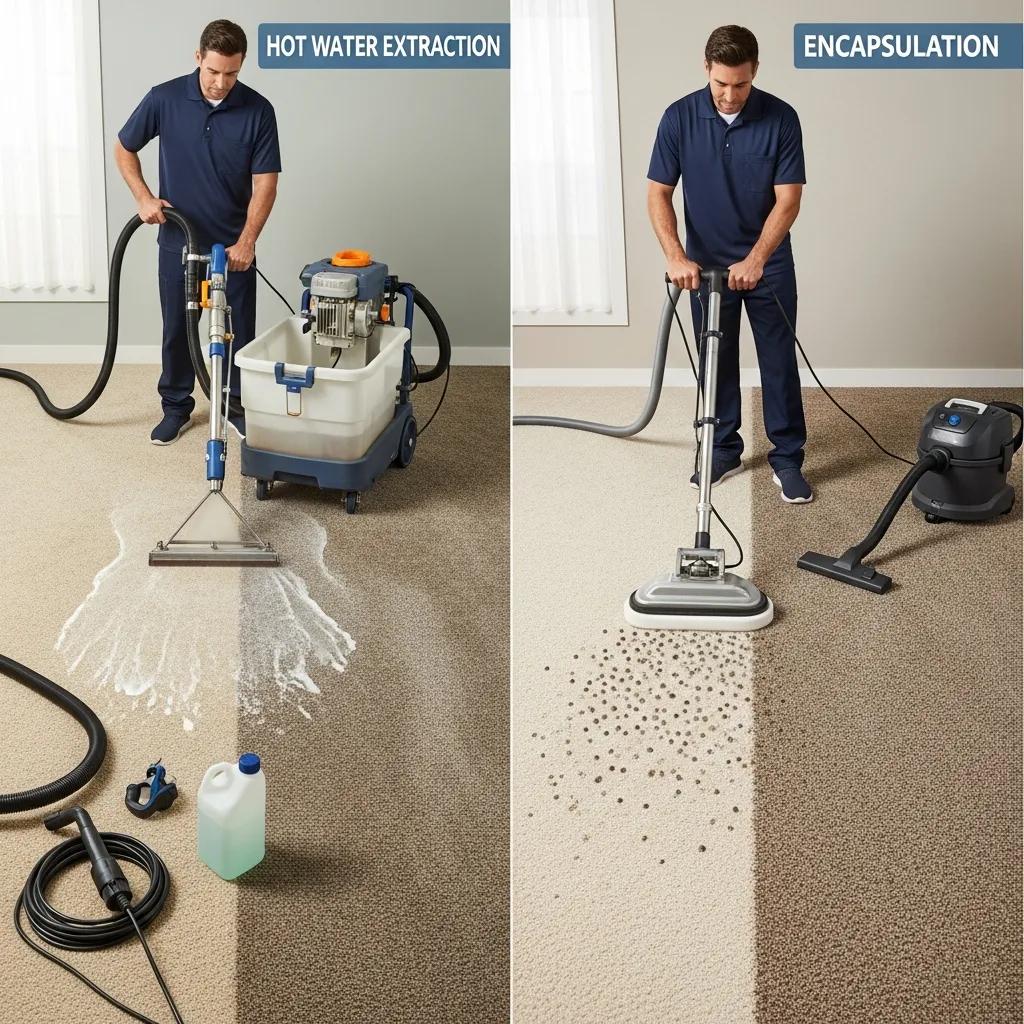
Choosing the right cleaning method depends on desired frequency, downtime tolerance, water use and carpet construction; method selection aligns with the commercial carpet maintenance schedule to maximise effectiveness while minimising disruption. Vacuuming and spot cleaning are daily maintenance hyponyms that preserve the fibre between restorative treatments, whereas encapsulation and hot water extraction serve as interim and deep-restorative methods respectively. Environmental considerations favour low-water, fast-dry methods in humid regions, while some fibres necessitate low-moisture approaches to protect backing and adhesives. The table below compares common methods by dry time, water use and recommended frequency so managers can select the optimal approach.
| Method | Best use-case / Dry time / Water use | Recommended frequency / Business fit |
|---|---|---|
| Hot water extraction | Deep restorative cleaning; longer dry time (6–12 hours); higher water use | Annual to bi-annual for office; more frequent for heavy traffic |
| Encapsulation cleaning | Interim soil control; fast dry time (1–2 hours); low water use | Quarterly for high-traffic retail and offices |
| Dry compound / bonnet | Low moisture; quick turnaround; moderate soil removal | Monthly to quarterly in hotels/retail for top-surface care |
| Vacuuming & spot treatment | Daily maintenance; no dry time; negligible water use | Daily to weekly across all business types |
How Do Hot Water Extraction and Encapsulation Cleaning Compare?
Hot water extraction (steam cleaning) and encapsulation represent two different restorative strategies: hot water extraction uses heated water and detergent to flush deep soils and contaminants from fibres, providing the most thorough soil removal but requiring longer dry times and higher water use. Encapsulation employs polymer chemistry to encapsulate soils for easy removal, offering faster drying and lower water consumption with effective interim maintenance for visible cleanliness. Choice depends on traffic and downtime: high-traffic retail may favour quarterly encapsulation with annual hot water extraction, while healthcare settings usually prioritise extraction for deeper contaminant removal. Understanding these method differences guides scheduling and preserves carpet warranties by matching intensity to need.
What Role Do Spot Cleaning and Vacuuming Play in Maintenance?
Spot cleaning and vacuuming are meronomic parts of a holistic maintenance regime: vacuuming removes surface and sub-surface dry particles that abrade fibres, and immediate spot treatment prevents stains from setting and reduces odour risk. Best practice is daily vacuuming with HEPA or high-filtration vacuums in key paths, complemented by approved spot cleaners applied promptly according to manufacturer instructions. These basic actions extend the interval between restorative services and protect warranty coverage by preventing chemical or mechanical damage from inappropriate treatments. Implementing staff training and clear response protocols ensures these measures consistently reduce the need for aggressive restorative cleaning.
How Can You Customise a Commercial Carpet Cleaning Plan for Your Business?
Customising a commercial carpet cleaning plan begins with a structured assessment: a site survey documenting traffic patterns, carpet materials, entry points and environmental pressures followed by mapping maintenance roles, SLA expectations and frequency tiers. From that foundation, managers select appropriate methods (vacuuming schedules, interim encapsulation, restorative extraction) and incorporate reporting and quality checks to measure effectiveness. Considerations include aligning with manufacturer care recommendations, specifying acceptable dry times, and including contingency triggers for unscheduled deep cleaning. The following checklist outlines steps to convert assessment findings into a tailored schedule and performance agreement.
- Conduct a site survey: Record traffic, materials and problem zones for data-driven scheduling.
- Map maintenance tasks: Define daily, weekly and periodic actions and responsible parties.
- Specify methods and SLAs: Assign methods (encapsulation, extraction) with frequency targets and performance metrics.
A clear assessment-to-plan process enables consistent execution and prepares the organisation to engage a qualified service provider for implementation.
What Tailored Solutions Does Divine Commercial Cleaning Offer?
Divine Commercial Cleaning offers tailored commercial cleaning solutions designed to implement custom maintenance schedules and restorative plans for offices, medical centres, daycares and amenity spaces across the Sunshine Coast and Brisbane. As a family-owned business based in Maroochydore, QLD, Divine emphasises experienced professional cleaners who deliver tailored results with reliability and a satisfaction guarantee. Their approach includes environmentally conscious cleaning practices, customised solutions without lock-in contracts, and services that align with facility-specific hygiene and appearance objectives. For managers seeking local execution of a commercial carpet maintenance schedule, Divine can provide site surveys, documented cleaning plans and flexible agreements that reflect operational realities.
How Do Local Environmental Factors in Sunshine Coast and Brisbane Affect Cleaning?
Local environmental factors—subtropical humidity, seasonal pollen and coastal salt air—affect soiling patterns, drying times and the choice of cleaning methods, often increasing the need for vigilant entry-zone maintenance and quicker interim cleanings after high-pollen periods. Humidity lengthens drying times for hot water extraction, making low-moisture encapsulation or dry compound methods preferable during wet seasons to reduce microbial risk. Coastal locations may require more frequent inspections of transition areas where salt and sand enter buildings, and entry mat programs become especially important to limit abrasive wear. Adapting frequency to seasonal and regional conditions preserves carpet performance and supports a resilient commercial carpet maintenance schedule.
What Are Common Questions About Commercial Carpet Cleaning Frequency?
Facility managers frequently ask concise, actionable questions about deep-clean intervals, risks of over-cleaning and how to respond to signs that require immediate attention; short answers help with quick decisions and trigger follow-up actions where needed. Below are targeted Q&A items addressing common concerns and providing straightforward guidance that complements a written maintenance plan.
How Often Should Commercial Carpets Be Deep Cleaned?
Commercial carpets should be deep cleaned based on traffic level: high-traffic areas often require deep or interim restorative cleaning every 3–6 months, moderate-traffic areas every 6–12 months, and low-traffic zones annually or as indicated by inspections. Choices of method influence timing—encapsulation can be scheduled more frequently as an interim measure, while hot water extraction serves deeper restorative needs less often. Signs such as persistent odour, visible soiling or allergy complaints should prompt unscheduled deep cleaning regardless of the planned cadence. Following this tiered approach balances cleanliness, downtime and lifecycle cost.
Is It Harmful to Clean Carpets Too Often?
Cleaning carpets too often with aggressive restorative methods can be harmful: frequent abrasive treatments, excessive moisture or inappropriate chemicals can accelerate fibre wear and may void manufacturer warranties. However, regular light maintenance—vacuuming, spot treatment and low-moisture interim cleaning—benefits longevity and is not harmful when done correctly. The balance is to reserve intensive restorative methods for when they are necessary and to prioritise manufacturer-approved products and professional techniques. Adhering to recommended frequencies, documenting procedures and choosing suitable methods prevent damage while keeping carpets hygienic and presentable.

Dianne, originally from Rockhampton, hails from a business-oriented family, with her father owning electrical stores and her uncle serving as Mayor. Moving to the Sunshine Coast at 13, she later pursued a rewarding real estate career and raised three children. As a single mom, she balanced university studies with domestic cleaning work. Armed with a Bachelor’s Degree in Business, majoring in Supply Chain Management, Dianne founded and grew Divine Commercial Cleaning into a thriving company. Her success is rooted in strong family mentorship, a positive attitude, and a solution-oriented approach, offering tailored cleaning services with integrity and strategic insight.