
Commercial Cleaning Costs in Birtinya: What your Business Should Know
Pricing for commercial cleaning can feel confusing. Knowing the main cost drivers makes it easier for Birtinya businesses to budget and pick the right partner. This guide explains what affects commercial cleaning prices in Birtinya, compares common pricing models, and shows how facility type, scope and local access create real cost differences. You’ll see how frequency, specialised services and sustainability choices change marginal rates, how hourly and per-square-metre pricing stack up, and what to expect in a clear, itemised quote. Later sections give 2024 market ranges for the Sunshine Coast, explain how accessibility and logistics influence labour and equipment charges, and outline how transparent, tailored pricing works in practice.
Choosing a provider isn’t just about price — research shows outsourcing can affect service quality, so assess both cost and likely outcomes.
Outsourcing Cleaning: Cost, Quality & Provider Choice
An empirical study of cleaning services in the English NHS tests how contracting out ancillary services affects core service quality, using hospital-acquired infection rates as the outcome measure. The authors report that, in their sample from 2010/11–2013/14 covering 130 trusts, private contractors tended to be less costly but delivered lower cleanliness outcomes than in-house teams.
Cheap and dirty: The effect of contracting out cleaning on cost and quality in English hospitals, S Elkomy, 2019
What are the main factors that drive commercial cleaning costs in Birtinya?

The primary cost drivers for commercial cleaning in Birtinya are facility size and layout, scope and specialised requirements, cleaning frequency and contract length, labour and supervision, site accessibility and travel, and any eco-friendly product choices. Each item affects labour time, equipment needs, consumables and supervisory overhead, and together they determine whether pricing sits in a low, medium or high impact band. Understanding how these pieces interact helps you see which line items will dominate your budget and where you can trim costs without compromising hygiene. Below is a short, practical list of the top local price drivers and what they mean.
The table below summarises how each main factor typically affects pricing for Birtinya sites.
| Factor | How it adds cost | Typical impact |
|---|---|---|
| Facility size & layout | More square metres and complicated layouts increase staff time | High |
| Scope & specialised services | Medical-grade or deep cleans require extra training and kit | High |
| Cleaning frequency & contract length | Regular schedules reduce per-clean costs through efficiency | Medium |
| Labour & supervision | Skilled teams and supervision increase hourly rates | High |
| Accessibility & travel | Travel time, parking and restricted access add labour minutes | Medium |
| Eco-friendly products | Green products and processes can add a modest premium | Low–Medium |
This overview shows which elements typically move your price the most and leads into how facility type and size map to time and cost estimates for common business categories.
How do facility size and type affect cleaning prices?
Square metres set the baseline for most quotes because area usually maps to labour time and consumable use. A compact open-plan office generally needs fewer staff-hours per 100 m² than a medical clinic of the same size, where treatment rooms, clinical zones and infection-control steps add time per m². Complex layouts with many rooms, stairwells or partitioned displays increase setup and movement time and raise effective hourly cost. For budgeting, many contractors use a base number of hours per 100 m² and then apply multipliers for complexity or special requirements.
For example, a standard office usually requires routine surface cleaning and floor care, while a medical centre needs extra disinfection cycles, PPE changes and record-keeping — altering both staff mix and supervision. Knowing these differences helps you choose the right service tier and anticipate likely add-ons in an itemised quote. Next we look at how cleaning frequency and contract structure affect unit price.
What role do cleaning frequency and contract length play?
Frequency and contract length change the per-clean price because regular schedules create routing efficiencies and predictable workloads that providers often reflect with lower unit rates. Daily or multiple-times-weekly cleans spread fixed setup and travel costs across more visits, cutting the cost per clean compared with infrequent deep cleans that need larger crews and longer sessions. Longer contracts can stabilise pricing and include fixed monthly fees or graduated discounts; one-off and emergency cleans usually carry premiums for rapid response and extra resources.
For instance, two identical offices might save 20–30% per clean when switching from monthly deep cleans to weekly routine visits because crews work more predictably and intensity per visit drops. That consistency also helps quality control and reduces corrective cleans over the year, lowering total spend. Knowing how frequency affects discounts helps you pick a cadence that balances hygiene and budget certainty.
How do scope and specialised services change commercial cleaning rates?
Scope and specialised services increase rates by adding tasks, training, consumables and equipment hire to a routine contract. Basic cleaning covers everyday tasks like wiping surfaces, emptying bins and maintaining restrooms. Deep cleaning adds more intensive floor care, hidden dirt removal and carpet treatment. Specialised services — for example, medical-grade disinfection, hazardous spill response or electrostatic sanitisation — need certified staff, specialist chemicals and documented compliance, which raises cost. Below are common service tiers and when businesses usually require them.
- Basic cleaning: Day-to-day upkeep — surface wiping, waste removal and restroom maintenance for offices and non-clinical retail.
- Deep cleaning: Periodic, intensive work such as carpet steam cleaning, grout restoration and machine floor work.
- Specialised cleaning: Regulated protocols for clinical, aged-care or controlled environments with certification and documentation.
Bundling services often lowers incremental charges by consolidating labour and travel. The next subsection defines each tier more clearly and gives typical scenarios.
What’s the difference between basic, deep and specialised cleaning?
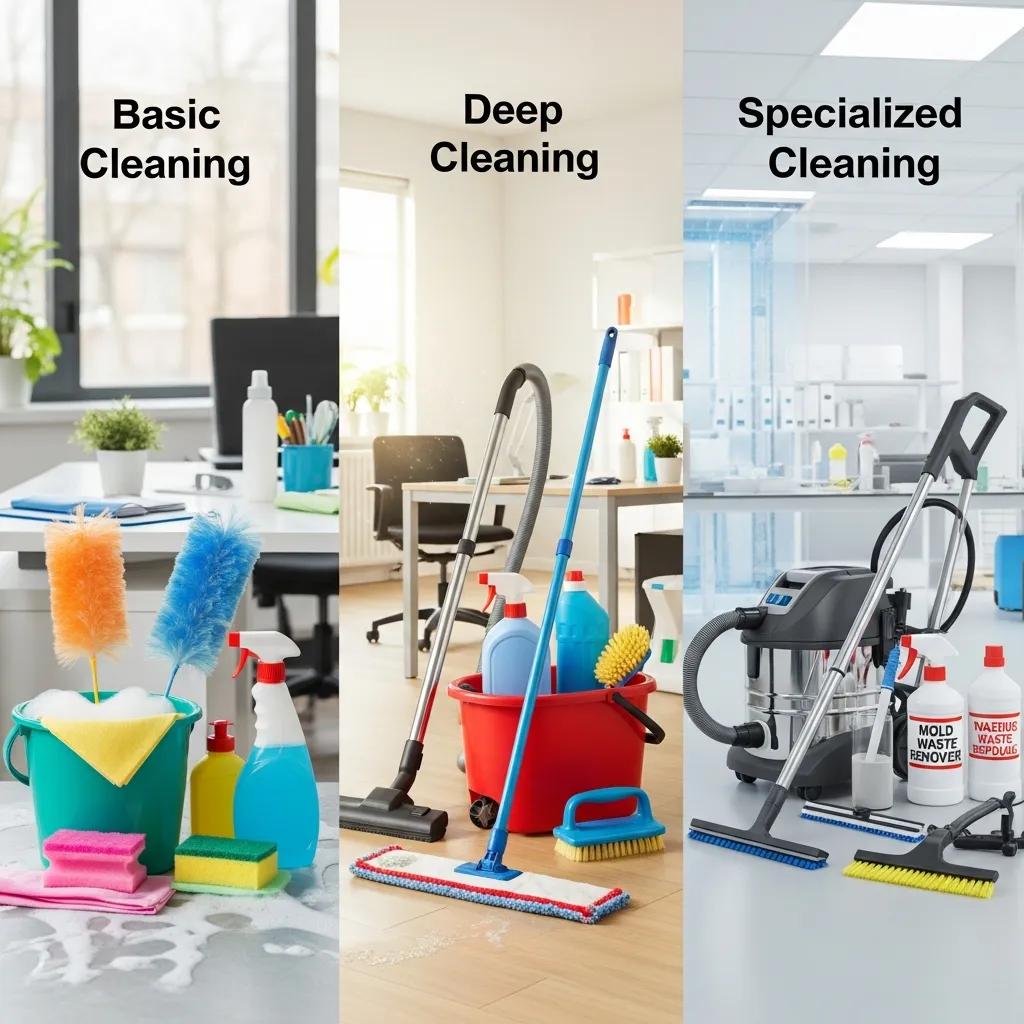
Basic cleaning focuses on daily upkeep: dusting, emptying bins, sanitising bathrooms and light floor care to keep spaces presentable and hygienic. Deep cleaning is periodic and thorough — it tackles hidden dirt, steam-cleans carpets, restores grout and uses floor machines to bring surfaces back to standard. Specialised cleaning serves regulated environments: clinic sterilisation, lab clean-downs or hazardous spill remediation that require certified procedures, specialist chemicals and verification. Each tier adds time, equipment and oversight in steps; specialised services often also need extra certification and insurance.
Choose a tier based on risk profile, client expectations and regulation. An office may be fine with basic cleaning plus quarterly deep cleans, while a medical facility will need specialised protocols included regularly. This helps you focus spending on services that deliver measurable compliance and health benefits. Next we cover common add-ons and how they’re priced.
How do add-on services affect overall cost?
Add-ons are priced separately because they require extra labour, materials or equipment beyond the base scope and are usually ordered as needed. Typical add-ons include carpet steam cleaning, window washing, high-level dusting, kitchen deep cleans and medical-grade sanitisation. These can be charged per m², per job or hourly depending on complexity. Equipment hire (floor machines, steamers, lifts) and specialist chemicals increase unit costs and may have minimum charges for small jobs; bundling add-ons into a contract usually reduces per-item pricing through coordinated scheduling.
| Service type | How it’s usually priced | Typical incremental cost |
|---|---|---|
| Carpet steam cleaning | Per m² or per room | Moderate |
| Window cleaning (internal/external) | Per window or hourly | Low–Moderate |
| Medical-grade disinfection | Per visit or per m² with certification | High |
| High-level dusting / access work | Hourly with equipment hire | Moderate–High |
To avoid surprise charges, set add-on frequency and triggers in your quote — for example, specify quarterly carpet cleans or post-construction work. The next section compares average local rates to give context for Birtinya and the Sunshine Coast in 2024.
What are typical commercial cleaning rates in Birtinya and the Sunshine Coast (2024)?
In 2024, Sunshine Coast and Queensland commercial cleaning rates generally fall into common hourly and per-square-metre bands, with local variation based on the factors described above. Hourly rates typically range from about $35 to $60 per hour depending on skill level and service complexity. Per-square-metre pricing for routine commercial cleaning usually sits around $2.50 to $6.50 per m². Specialised medical cleaning or after-hours work pushes unit costs higher, while large-volume contracts can reduce rates toward the lower end of these bands.
To help with comparisons, the table below gives typical rate expectations by business type and the common pricing models used in 2024.
| Business type | Common rate model | Typical range |
|---|---|---|
| Office cleaning | Per m² or fixed monthly | $2.50–$5.00 per m² |
| Medical centres | Per visit or per m² with compliance fees | $4.50–$8.50 per m² (higher due to protocols) |
| Retail / shopping centres | Hourly or per m² with after-hours premiums | $35–$60 per hour or $3.50–$7.00 per m² |
These figures show why you must compare like-for-like scopes when asking for quotes: per m² assumes consistent scope, while hourly pricing suits variable or ad-hoc tasks. Divine Commercial Cleaning can provide tailored quotes within these local ranges after an on-site assessment so final pricing matches your Birtinya premises. The following subsections explore model trade-offs and sector differences in more detail.
How do hourly rates compare with per-square-metre pricing?
Hourly pricing works well for irregular or variable tasks and one-off jobs, while per-square-metre pricing is efficient for predictable, uniform areas cleaned on a regular schedule. Hourly models are flexible and you only pay for time used, but they can be harder to forecast for recurring budgets. Per m² gives predictable monthly costs and rewards efficiency, but it needs a clearly defined scope to avoid scope creep. For example, a 200 m² office at $4.00 per m² provides a straightforward per-visit figure, whereas an hourly quote requires accurate time estimates to project monthly spend.
Deeper analysis of pricing models for office cleaning can shed further light on cost drivers and procurement choices.
Office Cleaning Pricing Models & Cost Evaluation
A market analysis and pricing model for office cleaning services (case study: All‑Rounders Oy) examines pricing approaches and the business issues they address.
Market analysis and pricing model for the office cleaning services: case: All-Rounders Oy, 2025
When choosing a model, consider predictability, task variability and administrative simplicity. Many providers offer hybrids — a per-m² base with hourly billing for add-ons — which balances budget certainty and flexibility. Understanding these trade-offs helps you pick the model that fits your operations and financial planning. Next, we explain how rates differ by sector: medical, office and retail.
How do rates differ by business type: office, medical and retail?
Rates vary by sector because of different hygiene standards, regulatory needs and scheduling constraints. Office cleaning is the baseline — routine, predictable tasks often priced per m² or as a fixed monthly fee. Medical and clinical settings demand higher standards: specialised disinfectants, staff training and compliance paperwork — all of which raise rates. Retail spaces and shopping centres typically need after-hours work to avoid trading disruption, and mall or strata requirements can add logistical costs.
- Offices: predictable, cost-effective per m² pricing for regular schedules.
- Medical centres: higher rates because of compliance, documentation and specialist chemicals.
- Retail/shopping centres: variable costs driven by after-hours access and large common areas.
Being aware of sector-specific differences helps you benchmark proposals from local providers. The next section looks at how Birtinya’s local conditions affect these pricing bands.
How does location and accessibility in Birtinya affect cleaning costs?
Location and accessibility in Birtinya affect costs through travel time, parking and site access constraints, plus any building management rules that change scheduling and labour efficiency. Providers factor in travel distance and crew routing; peak traffic or restricted loading zones add on-site time and sometimes extra staff to move equipment. Building inductions, security checks and after-hours protocols also add administrative time that shows up in quotes. Knowing these factors lets businesses negotiate efficient schedules or consolidate visits to reduce travel premiums.
Here are the local issues that most often affect pricing in Birtinya and ways to mitigate them.
- Travel and distance from the service depot: increases crew time and cost.
- Site parking and loading access: limited access adds setup and handling time.
- Building induction, security or after-hours processes: add administration and labour charges.
Addressing these constraints in the quote stage lets providers propose mitigations — for example, staged cleaning windows or consolidated weekly visits — which lower incremental charges. The next subsections examine common local factors and how accessibility drives labour and equipment expenses.
What local factors most influence pricing for Birtinya businesses?
Local pricing factors include peak traffic patterns that affect crew travel windows, site rules from strata or shopping-centre managers, and the availability of loading zones or secure parking for vehicles and equipment. In busy precincts, crews may be scheduled outside peak hours or tasks consolidated to reduce travel time, which can affect after-hours premiums. If a site requires inductions, background checks or escorted access, those steps increase administrative overhead and appear in the final quote. Knowing these constraints helps create clearer scopes and more accurate budgets.
Because Divine Commercial Cleaning operates locally on the Sunshine Coast, we can often schedule efficiently and lower travel-related charges for nearby clients. Sharing access constraints early in the quoting process reduces surprises and improves price predictability. The following subsection explains how specific accessibility issues change labour and equipment costs.
How does accessibility impact labour and equipment expenses?
Restricted access or vertical transport needs raise labour and equipment costs because crews need extra set-up time, specialist tools, or additional staff to move gear safely. Tasks such as rooftop plant-room cleaning, high-rail window work or multi-level retail areas often require lifts, harnesses or elevated platforms — all of which carry hire and transport fees. Stair-only access increases manual handling time and fatigue, lengthening task durations and labour charges. Safety requirements and permits for certain access scenarios also add admin time and cost.
Catching accessibility issues in the initial assessment allows providers to specify equipment and safety steps up front, reducing mid-contract scope changes and premium charges. Clear site briefings therefore lower the risk of unexpected costs and help maintain consistent service. Next we outline how Divine combines transparency and sustainability into value-focused pricing.
How does Divine Commercial Cleaning deliver transparent, sustainable pricing?
We price work with clear, itemised quotes, tailored service plans and a practical commitment to sustainable methods that balance cost and long-term value. Our value points include customised cleaning solutions for different business types, trained staff and regular quality checks, flexible scheduling (including after-hours) and eco-friendly product options where clients prefer them. We show transparency in line-item quotes that separate base services from add-ons and explain how frequency and bundling affect unit costs. Below is a short summary of Divine’s core pricing commitments.
This approach follows industry best practice for tiered assessments and modern pricing strategies.
Optimizing Commercial Cleaning Pricing & Service
A tiered assessment model for commercial cleaning and organisational guidance supports using current pricing approaches when outsourcing external cleaning services.
Optimising commercial cleaning services based on customer expectations and their fulfilment: An empirical analysis with the means-end theory of complex …, 2022
- Tailored cleaning solutions: on-site assessments that define time and materials for each premises.
- Expertise and professionalism: trained teams and regular inspections to maintain standards.
- Commitment to sustainability: eco options offered with clear cost/value trade-offs.
These practices help clients understand immediate costs and long-term value, and they set clear service expectations. The next subsections describe Divine’s tailored process and how eco-friendly choices affect pricing and perceived value.
How does Divine Commercial Cleaning develop tailored cleaning solutions?
We start with an on-site assessment to scope time, materials and supervision needs, then design customised service bundles that match your business type and traffic patterns. The process usually begins with a walkthrough to note layout complexity, high-risk zones and preferred cleaning windows, followed by a written scope that separates routine tasks from periodic deep cleans and add-ons. Contracts are flexible so you can choose frequency and bundle services to lower marginal costs while keeping service levels. This ensures quotes reflect your operational reality, not a one-size-fits-all price.
A small example: for a medical clinic we might combine daily surface disinfection with weekly deep cleans and quarterly carpet care, each line item explained so you can see cost drivers and make informed choices. That transparency builds trust and predictable budgeting. Next we explain how eco choices influence cost and value.
How do eco-friendly practices affect pricing and value?
Eco-friendly products and sustainable methods can carry modest premiums because certified consumables are sometimes more expensive. Still, they provide measurable benefits in indoor air quality, staff and client wellbeing, and brand reputation. Techniques like concentrated dosing systems, microfibre technology and reduced-water processes can cut overall waste and, over time, reduce consumable costs despite slightly higher upfront prices. Many clients accept small premiums for clear environmental credentials, and we present eco options as optional line items so you can weigh immediate cost against long-term value.
Offering eco-options with transparent incremental pricing lets clients decide based on corporate sustainability goals or stakeholder expectations, and clear communication of expected benefits helps justify modest premiums. Next, we explain how Birtinya businesses can request a custom quote and what to expect.
How can Birtinya businesses request a custom commercial cleaning quote?
Getting a custom quote is straightforward: start with a contact request, schedule an on-site assessment, and receive an itemised proposal. The recommended steps below are concise and designed for clarity:
- Request an initial consultation: tell us about your premises and needs.
- Schedule an on-site assessment: we’ll walkthrough to record layout, surfaces and access constraints.
- Receive an itemised quote: a transparent proposal showing base services, add-ons and terms.
- Finalise schedule and contract: agree frequency, start date and quality checks.
This process keeps the quote aligned with the actual scope and avoids surprises from access requirements or specialised needs. Divine Commercial Cleaning follows these steps — request a custom commercial cleaning quote by calling 0459 949 969 or visiting our office at 5 Bluff St, Birtinya, QLD 4575 to arrange a site assessment.
What should you expect in a commercial cleaning quote?
A good commercial cleaning quote is itemised and includes the service scope, pricing model (hourly or per m²), recommended frequency, exclusions and standard terms such as notice periods and insurance. You should see baseline tasks (restroom servicing, floor care, waste removal), suggested periodic tasks (deep cleans, carpet care) and optional add-ons with their pricing model. The quote should also highlight any site-specific conditions that add cost, like after-hours access, inductions or equipment hire. Reviewing quotes with these elements in mind helps you compare offers fairly and negotiate bundling to lower per-item costs.
Ask for clarification on any line item and expected outcomes to avoid scope creep and keep budgets predictable. The next subsection explains how Divine customises pricing from assessment data and contract options.
How does Divine Commercial Cleaning customise pricing for your business needs?
We combine on-site assessment results with your preferences for scheduling, sustainability and contract flexibility to optimise cost and service outcomes. Assessment findings set time estimates, required equipment and supervision levels; bundling services and selecting suitable frequencies reduce marginal costs by consolidating travel and labour. We present clear incremental pricing for add-ons so you can see how choices like medical-grade disinfection or carpet steam cleaning change the total. This decision-focused method helps reduce unnecessary spend while keeping compliance and service quality.
By showing how different configurations affect the final price, we enable informed trade-offs between cost and service level so Birtinya businesses secure value-driven cleaning solutions that align with their priorities and budgets.
Frequently asked questions
Which businesses benefit most from commercial cleaning services?
Commercial cleaning suits a wide range of businesses: offices, medical facilities, retail stores and educational institutions. Each sector has different needs — medical facilities need strict hygiene regimes, while retail often needs after-hours work to avoid disrupting customers. Matching the service to industry requirements ensures compliance, a better customer experience and a healthier workplace.
How can businesses make sure they’re getting a fair quote?
Ask for itemised proposals that list the scope, pricing model and any extra fees. Compare several quotes using the same scope, and check the provider’s experience, training and quality-control processes. A low price is only a bargain if the service level and compliance meet your needs.
What are the benefits of using eco-friendly cleaning products?
Eco-friendly products improve indoor air quality, reduce chemical exposure for staff and clients, and support a greener brand image. They may cost a little more, but can reduce health-related issues and support productivity. Many customers prefer businesses that demonstrate environmental responsibility — an increasingly important reputational benefit.
How often should businesses schedule cleaning services?
Frequency depends on business type and foot traffic. High-traffic retail areas may need daily cleaning; many offices are fine with weekly or bi-weekly visits. Medical facilities usually require daily cleaning plus regular deep cleans. Consider operational hours, visitor numbers and hygiene standards when choosing a schedule that balances cleanliness and cost.
What should businesses do if they’re unhappy with their cleaning service?
Start by giving clear, specific feedback to the provider so they can address issues. If problems continue, review the contract for notice or termination clauses and consider other providers. Document recurring problems to ensure future agreements include measurable performance standards and accountability.
Are there hidden costs with commercial cleaning services?
There can be extra costs for specialised tasks, after-hours work or equipment rental. To avoid surprises, ask for a detailed quote that lists potential charges and conditions that trigger them (restricted access, special cleaning requirements, etc.). Regular communication with the provider also helps keep costs transparent.
How can businesses assess the quality of their cleaning service?
Use regular inspections and staff feedback to evaluate cleaning quality. Set clear performance metrics — cleanliness standards, response times and reporting — and monitor them. If standards slip, discuss corrective actions with the provider and consider a formal quality assurance program to keep service consistent.
Knowing the factors that influence commercial cleaning costs in Birtinya helps you make smarter decisions that match your budget and hygiene standards. Considering facility type, cleaning frequency and specialised services lets you optimise cleaning for efficiency and effectiveness. Working with a local provider like Divine Commercial Cleaning delivers tailored solutions and transparent pricing. Request your custom quote today to see how we can support your business’s cleaning needs.

Dianne, originally from Rockhampton, hails from a business-oriented family, with her father owning electrical stores and her uncle serving as Mayor. Moving to the Sunshine Coast at 13, she later pursued a rewarding real estate career and raised three children. As a single mom, she balanced university studies with domestic cleaning work. Armed with a Bachelor’s Degree in Business, majoring in Supply Chain Management, Dianne founded and grew Divine Commercial Cleaning into a thriving company. Her success is rooted in strong family mentorship, a positive attitude, and a solution-oriented approach, offering tailored cleaning services with integrity and strategic insight.