Laboratory Cleaning and Equipment Sanitation Services: Expert Solutions for Safe and Compliant Labs
Laboratory cleaning and equipment sanitation are specialised services that remove, inactivate and contain biological and particulate contaminants to protect patient safety, research integrity and regulatory compliance. This article explains why dedicated laboratory cleaning is different from general commercial cleaning, how targeted sanitation protocols reduce contamination pathways, and what managers should require to stay audit-ready in Sunshine Coast and Brisbane facilities. You will learn practical contamination-control mechanisms, the types of laboratories and equipment we serve, the standards that govern lab sanitation, and procedural checklists to implement immediately. The guide also maps specific cleaning actions to GLP, ISO 14644 and GMP expectations and provides equipment-specific sanitation steps for sensitive instruments such as fume hoods and centrifuges. Finally, readers will find a proven six-step lab cleaning process, quality-assurance measures, and clear local options for requesting a site assessment or quote.
Why Is Specialised Laboratory Cleaning Essential for Medical and Research Facilities?
Specialised laboratory cleaning is the focused application of validated cleaning and disinfection methods designed to control biological, chemical and particulate hazards specific to lab workflows. It works by removing contaminants from surfaces and instruments, inactivating pathogens with appropriate disinfectants, and containing particulate spread through HEPA filtration and controlled airflow, which together reduce sample cross-contamination and exposure risks. The specific benefit is measurable: better data integrity, fewer exposure incidents, and smoother regulatory audits. Recognising these mechanisms helps lab managers prioritise targeted protocols and verification methods over routine janitorial approaches. Below are the primary benefits and risks that illustrate why specialised lab sanitation matters.
Laboratory cleaning delivers distinct operational and safety advantages:
- Reduces cross-contamination between samples and tests, protecting data integrity and patient outcomes.
- Lowers occupational exposure risks for staff by removing biohazards and maintaining safe work surfaces.
- Improves audit readiness and regulatory compliance by producing documented cleaning actions and verification records.
These benefits lead directly to understanding how cleaning interrupts contamination pathways and which control points to prioritise.
Divine Commercial Cleaning can support these specialised needs with trained, police-checked staff, environmentally conscious products, and a satisfaction guarantee that aligns with lab managers’ audit and safety priorities. Their family-owned service model emphasises consistent personnel and customised cleaning plans without lock-in contracts, making it straightforward to match cleaning frequency and verification to laboratory risk profiles.
How Does Laboratory Cleaning Prevent Contamination and Ensure Safety?
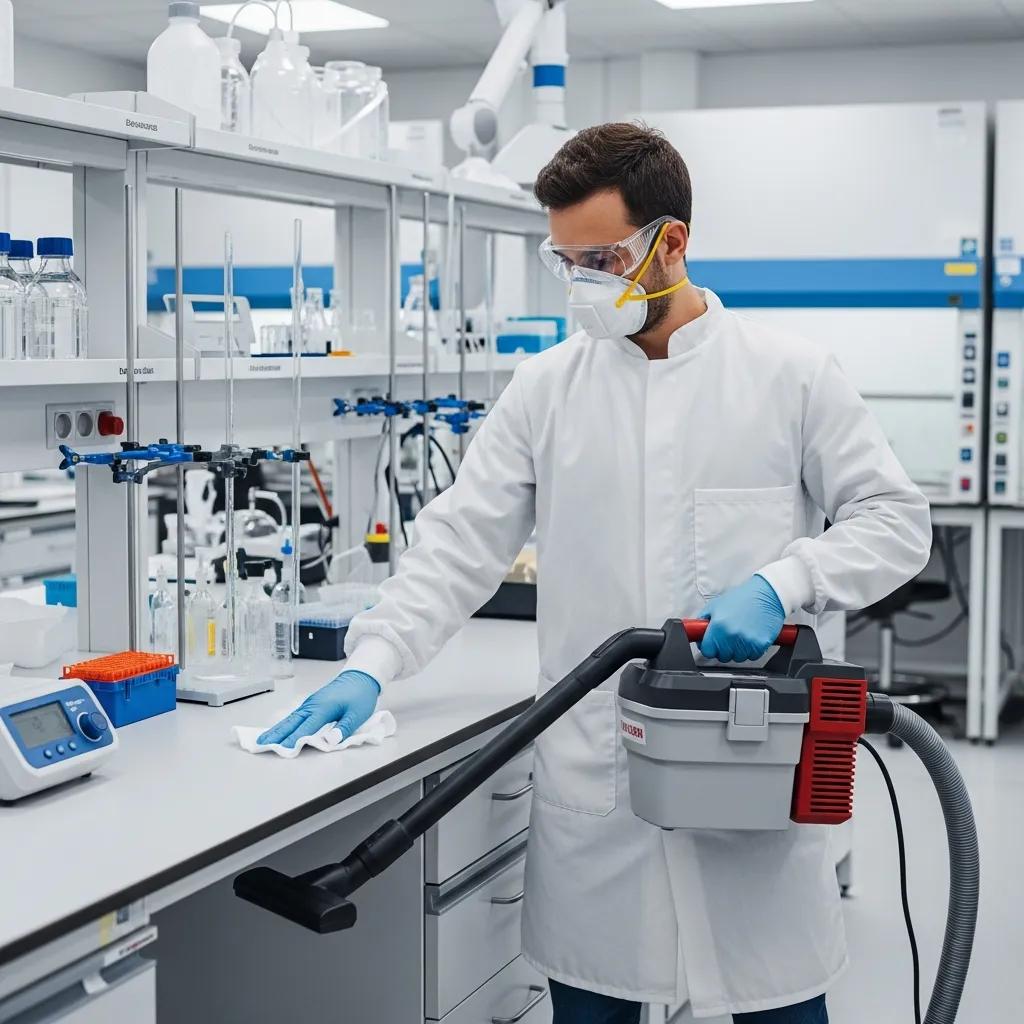
Laboratory cleaning prevents contamination through three core mechanisms: physical removal of debris and particulates, chemical inactivation of microbes, and engineering controls that contain airborne spread. Physical removal uses validated wipes and HEPA-filtered vacuuming to eliminate settled particles, while chemical disinfectants—selected for material compatibility and claim spectrum—neutralise viruses, bacteria and spores on critical surfaces. Engineering controls such as maintaining negative pressure, filtered exhausts, and proper airflow reduce the chance of aerosolised contaminants reaching clean zones. Verification methods like ATP surface testing, particle counts and visual inspections confirm effectiveness and close the loop on process validation. Understanding these mechanisms informs targeted cleaning schedules and equipment-specific techniques that protect both personnel and research outcomes.
What Are the Risks of Inadequate Lab Sanitation?
Inadequate laboratory sanitation produces direct consequences: compromised test results, increased exposure incidents, regulated non-compliance and reputational harm that can disrupt operations. Operationally, contamination can force retesting, sample loss or equipment downtime that delays research timelines and clinical decision-making. From a safety standpoint, insufficient decontamination increases the probability of staff exposure to infectious agents or hazardous chemistries, raising the likelihood of reportable incidents. Regulatory risks include failed audits, corrective actions and potential restrictions on facility operations when documentation, traceability and verification are absent. These risks underscore the necessity of documented cleaning logs, routine verification testing and rapid spill-response protocols that preserve both data integrity and safety.
Which Laboratory Types and Environments Do We Serve?
Laboratory cleaning services must be tailored to the lab’s function, contamination risks and regulatory environment; different lab types require distinct frequencies, methods and verification steps. Typical environments range from clinical and pathology labs with high sample throughput to microbiology, pharmaceutical and biotech facilities with strict aseptic requirements, plus research labs and controlled cleanrooms that demand particle-count validation. Matching cleaning scope to lab type ensures appropriate disinfectant selection, PPE use, waste segregation and validation sampling. The table below helps managers quickly associate lab types with common contamination risks and recommended cleaning cadence and methods.
| Laboratory Type | Typical Contamination Risks | Recommended Cleaning Frequency / Methods |
|---|---|---|
| Medical/Clinical | Bloodborne pathogens, high-touch surface contamination | Daily high-touch disinfection, end-of-day deep clean, traceable logs |
| Pathology | Sample cross-contamination, chemical residues | Point-of-use wipes, spill-response protocols, weekly bench decontamination |
| Microbiology | Aerosolised cultures, incubator residue | Daily surface disinfection, validated decontamination cycles, PPE controls |
| Pharmaceutical/Biotech | Particulate ingress, aseptic-area contamination | Cleanroom protocols, HEPA-cleaning, particle count verification after each cleaning |
This table highlights the need for task-specific controls and verification to reduce lab-specific risks.
To complement these technical services, Divine Commercial Cleaning offers coverage across the Sunshine Coast and Brisbane and can prepare customised task lists or conduct site-specific risk assessments to align cleaning frequency and methods with local regulatory expectations. Their local presence enables faster response to emergent cleaning needs while tailoring schedules to on-site workflows.
What Services Are Offered for Medical and Clinical Laboratories?
Medical and clinical laboratories require routine, traceable cleaning actions focused on sample areas, patient-contact surfaces and high-touch zones to prevent clinical errors and exposures. Routine tasks include scheduled benchtop disinfection after each shift, targeted cleaning of sample handling areas, managed spill response with documented steps, and secure waste segregation compliant with biomedical handling practices.
Traceability is key: cleaning logs, disinfectant batch records and verification checks support GLP-style documentation expectations and help during audits. Frequency recommendations often combine daily high-touch routines with weekly deep cleans and immediate response protocols for spills or contamination events. Clear task lists and documented verification ensure clinical labs maintain patient safety and test reliability.
How Do We Address Pharmaceutical, Biotech, and Cleanroom Cleaning Needs?
Pharmaceutical and biotech facilities plus classified cleanrooms require low-particulate methods, validated cleaning agents and gowning/entry controls to protect product integrity and meet GMP/ISO constraints. Cleaning in these spaces typically uses non-shedding wipes, validated disinfectants compatible with stainless steel and polymer components, and HEPA-filtered cleaning equipment that minimises particle generation. Validation steps include pre-clean risk assessments, post-clean particle counts, and documented acceptance criteria tied to the relevant ISO cleanroom class. Regular environmental monitoring and staff gowning audits reinforce contamination control and maintain compliance. These practices ensure that sterile processes and manufacturing workflows remain within required particulate and microbial limits.
How Do We Ensure Compliance with Australian and International Lab Cleaning Standards?
Compliance is achieved by mapping cleaning activities to the specific requirements of GLP, ISO 14644, GMP and national regulator guidance, and by producing auditable records that demonstrate consistent implementation. Practically, this involves documented cleaning protocols, staff training records, validation reports (particle counts/ATP), chemical safety data sheets and routine supervisory checks to confirm adherence. The table below links each major standard to its cleaning-related requirement and describes practical service actions that support audit readiness.
| Standard / Regulator | What it Requires | How Divine aligns / evidence to provide |
|---|---|---|
| GLP (Good Laboratory Practice) | Documented procedures and reproducibility | Standard operating procedures, cleaning logs, verification reports |
| ISO 14644 (Cleanrooms) | Particle and contamination control by class | Post-clean particle counts, validated cleaning methods, control limits |
| GMP (Pharmaceutical) | Controlled environments and contamination prevention | GMP-aligned cleaning protocols, staff training records, validation |
| TGA (Therapeutic Goods Administration) | Safety and quality for therapeutic products | Documented risk assessments, validated cleaning cycles, traceable records |
This mapping clarifies how specific cleaning actions produce the evidence required during audits and inspections.
Key actions that enhance audit readiness include maintaining up-to-date SOPs, keeping time-stamped cleaning logs, training records for personnel who perform lab cleaning, and regular verification testing. These elements combine to reduce regulatory risk and to streamline responses during inspections.
What Are the Key Standards: GLP, ISO 14644, GMP, and TGA Guidelines?
Each standard focuses on slightly different controls but converges on the need for documented, validated cleaning and verification. GLP emphasizes reproducibility and traceability through documented procedures and record-keeping that support scientific validity. ISO 14644 defines cleanroom classes and particle count thresholds, guiding how frequently and to what standard cleanroom cleaning must be validated. GMP requires contamination control across production environments and insists on validated procedures and trained personnel to protect product quality. TGA guidance for therapeutic products demands evidence of safety and quality controls that cleaning helps provide through verification records and risk assessments. Understanding these standards helps translate regulatory language into actionable cleaning activities.
How Does Compliance Enhance Lab Safety and Audit Readiness?
Compliance reduces incidents, shortens audit cycles and preserves data integrity by ensuring cleaning is both effective and verifiable. Immediate practical steps that support audit outcomes include keeping dated cleaning logs, preserving verification results (ATP or particle counts), storing staff training certificates, and maintaining SOPs that align with facility risk profiles. Below is a concise checklist managers can implement immediately.
- Maintain time-stamped cleaning logs for all routine and deep-clean events.
- Archive verification data such as ATP readings and particle count reports.
- Keep staff training and police-check documentation available for audits.
Implementing these items creates a defensible audit trail and demonstrates a proactive safety culture that inspectors and stakeholders recognise as reliable.
What Specialised Equipment Sanitation Protocols Do We Follow?
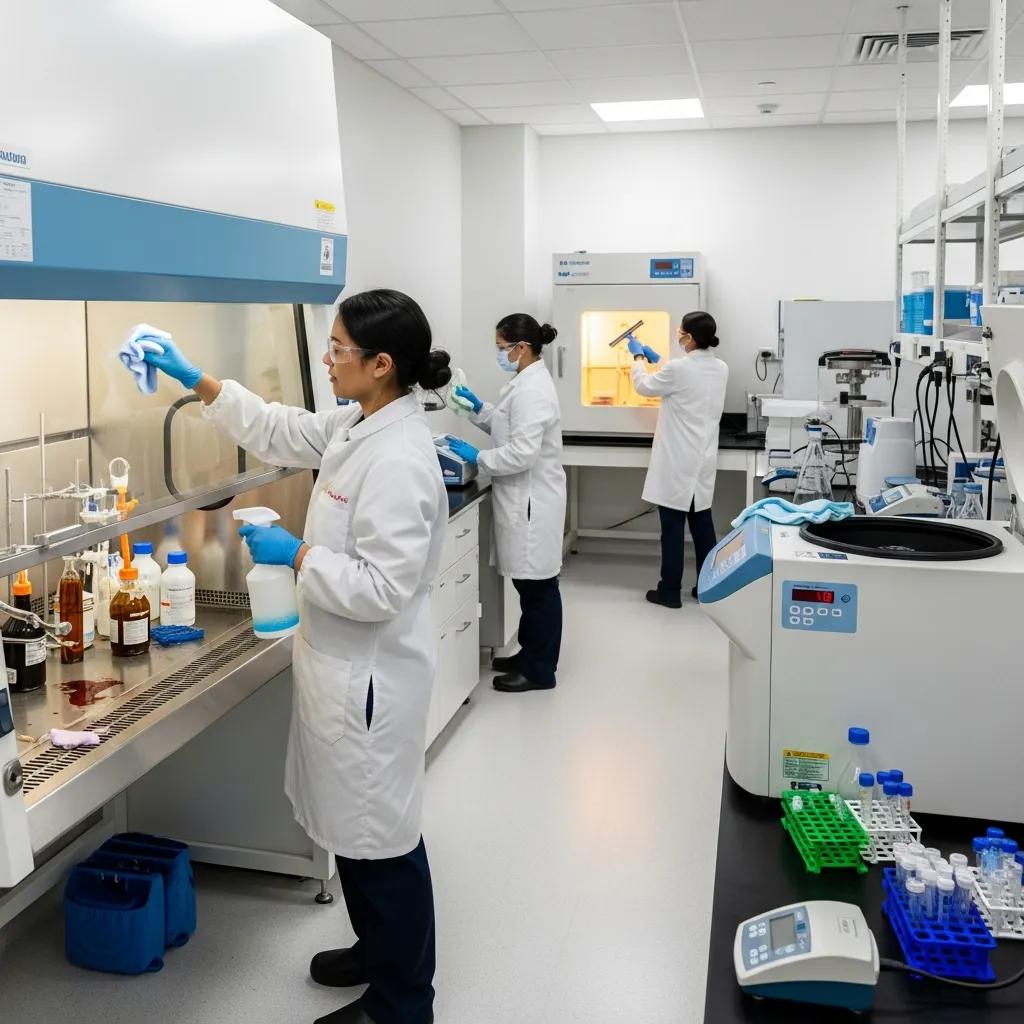
Equipment sanitation protocols are instrument-specific procedures that protect sensitive components and ensure accurate operation without damaging material surfaces or voiding warranties. Effective protocols start with a pre-clean risk assessment that identifies sensitive surfaces, compatible disinfectants and isolation needs, followed by validated cleaning steps and post-clean verification such as visual inspection or surface ATP testing. Material compatibility is critical: some disinfectants corrode electronics or degrade seals, so selection must balance biocidal efficacy with instrument preservation. The table below provides concise guidance for common laboratory instruments and recommended sanitation approaches.
| Equipment | Surface / Component | Sanitation Method & Notes |
|---|---|---|
| Fume hood | Interior sash, work surface | Wipe with compatible disinfectant; avoid aerosolising; check sash tracks |
| Centrifuge | Rotor chamber, rotors | Remove rotors, clean with mild disinfectant, dry thoroughly before reassembly |
| Incubator | Shelves, interior surfaces | Use validated sporicidal cycle if indicated; remove shelves for manual cleaning |
This equipment-specific guidance helps technicians perform safe, repeatable sanitation without compromising functionality.
A safe sanitation plan combines these instrument-level steps with overarching verification and documentation practices to ensure ongoing instrument reliability and compliance.
How Are Sensitive Instruments Like Fume Hoods and Centrifuges Cleaned?
Cleaning sensitive instruments begins with isolation and PPE followed by methodical removal of residues and validated disinfection. For fume hoods, technicians first ensure HVAC and sash positions are correct, then don appropriate PPE, remove loose debris, wipe surfaces using compatible disinfectants in a top-to-bottom motion, and confirm sash tracks and drains are clear. For centrifuges, staff unplug equipment, remove rotors and balance weights, clean chambers and rotors with non-corrosive disinfectants, dry all components and perform a functionality check before reuse. Post-clean verification includes visual inspection and, when required, ATP or culture-based sampling to confirm decontamination. These procedural steps both protect staff and preserve instrument integrity for consistent scientific outcomes.
What Are Best Practices for Biohazard Decontamination and Sterile Processing?
Biohazard decontamination follows BSL-specific procedures that emphasise containment, validated disinfectants and documented waste handling. Immediate spill response includes cordoning the area, donning appropriate PPE, applying spill kits with absorbent and neutralising agents, and collecting waste into designated biohazard containers for disposal. For sterile processing, validated cycles such as vaporised hydrogen peroxide (H₂O₂) fogging are used in combination with manual pre-cleaning to reduce load before fogging; each cycle is documented and followed by verification sampling. Waste segregation, transport and chain-of-custody records are maintained to demonstrate compliance with disposal regulations. These practices ensure biological risks are contained and that sterile environments meet validation criteria.
What Is Our Proven Laboratory Cleaning Process and Service Guarantee?
A structured, repeatable process improves cleaning consistency and provides the documentation auditors expect; our six-step protocol adapts validated methods to the lab’s specific risk profile and produces deliverables such as cleaning logs and verification reports. The six steps combine assessment, planning, trained execution, verification, documentation and continuous improvement to create a defensible cleaning program that aligns with GLP, ISO and GMP expectations. The numbered list below outlines each step and the expected deliverable that supports auditability.
- Assessment: Site-specific risk assessment and scope definition; deliverable — risk assessment report.
- Planning: Customised SOPs and schedule creation; deliverable — task list and materials matrix.
- Execution: Trained personnel perform cleaning with validated methods; deliverable — time-stamped cleaning log.
- Verification: Post-clean testing (ATP/particle counts) and visual checks; deliverable — verification report.
- Documentation: Archive SOPs, training records and logs; deliverable — audit pack.
- Follow-up: Review results and adjust frequency or methods; deliverable — updated cleaning plan.
These steps form a closed-quality loop that reduces contamination risk and creates evidence for compliance.
Divine Commercial Cleaning applies this six-step lab-specific protocol using police-checked staff, environmental practices and a same-cleaner model to maintain consistency. Their service guarantee and insurance coverage support labs that require dependable, documented cleaning; to request a free quote or site assessment, managers can contact the company directly to arrange a tailored proposal and on-site evaluation.
What Are the Six Steps of Our Lab-Specific Cleaning Protocol?
The six-step protocol translates risk into action by defining clear tasks and deliverables at each phase. First, an assessment identifies high-risk zones and instrument sensitivities and produces a risk profile. Second, planning converts that profile into SOPs and validated cleaning methods tailored to the lab type. Third, execution uses trained staff following PPE and material-compatibility rules to perform cleaning. Fourth, verification employs ATP testing, particle counts or visual checks to confirm outcomes. Fifth, documentation captures all records for auditability, and sixth, follow-up applies lessons learned to refine schedules and methods. Each step produces tangible outputs—reports, logs and verification data—that support continuous compliance.
How Do Our Experienced Cleaners Ensure Consistency and Satisfaction?
Consistency is achieved through focused training, competency checks, dedicated cleaner assignments and regular supervisory audits that verify adherence to protocols. Personnel receive role-specific instruction in contamination control, disinfectant compatibility and verification techniques, while police checks and insurance provide trust signals for sensitive sites. Quality assurance includes periodic supervisory inspections, random ATP or particle sampling, and a client feedback loop to address issues promptly. This blend of training, verification and local responsiveness helps ensure that services maintain both technical quality and client satisfaction over time.
How Can Sunshine Coast and Brisbane Laboratories Benefit from Our Services?
Local labs benefit from geographically proximate providers through faster response times, familiarity with state regulations and the ability to tailor schedules to local operational rhythms. Proximity reduces downtime when urgent decontamination is required and supports frequent supervisory visits that sustain high QA standards. Local knowledge also helps align cleaning plans with Queensland-specific waste disposal pathways and inspector expectations, delivering cost-effective compliance. The list below summarises the primary advantages for nearby laboratories.
- Faster response and emergency clean-up capabilities for local facilities in Sunshine Coast and Brisbane.
- Tailored scheduling and same-cleaner assignments that support consistent protocols and institutional memory.
- Local regulatory familiarity and site-specific assessments that streamline audit preparation.
These local advantages make it easier for labs to maintain continuous operations and to present auditable cleaning records during inspections.
What Makes Divine Commercial Cleaning the Trusted Choice Locally?
Divine Commercial Cleaning’s family-owned approach emphasises personalised service combined with professional safeguards that lab managers require. Key unique value propositions include fully insured operations, police-checked staff, environmental cleaning practices and the option for the same cleaner to attend on scheduled visits to preserve procedural consistency. These attributes map directly to lab needs: consistent personnel reduce protocol drift, police checks improve site security assurances, and environmentally conscious methods reduce chemical residues in sensitive areas. Together, these features support a reliable, audit-ready cleaning program for local laboratories.
How to Request a Free Quote for Laboratory Cleaning Services?
Requesting a free quote is a straightforward, three-step process designed to produce an accurate, site-specific proposal quickly. First, provide basic details about your facility type, approximate size and primary contamination concerns to initiate a scope discussion. Second, schedule an on-site assessment where a risk profile and task list are developed with documented deliverables. Third, receive a written proposal and cleaning plan that includes verification methods and recommended frequencies. Typical next steps after acceptance include onboarding, initial validation cleaning and handover of audit documentation.
- Provide facility details (lab type, size, peak operations).
- Book an on-site risk assessment and walkthrough.
- Receive a customised written quote and cleaning plan.
Divine Commercial Cleaning supports Sunshine Coast and Brisbane labs from offices at 5 Bluff St, Birtinya, QLD 4575, and can arrange site visits and tailored proposals for audit-ready laboratory sanitation services.

Dianne, originally from Rockhampton, hails from a business-oriented family, with her father owning electrical stores and her uncle serving as Mayor. Moving to the Sunshine Coast at 13, she later pursued a rewarding real estate career and raised three children. As a single mom, she balanced university studies with domestic cleaning work. Armed with a Bachelor’s Degree in Business, majoring in Supply Chain Management, Dianne founded and grew Divine Commercial Cleaning into a thriving company. Her success is rooted in strong family mentorship, a positive attitude, and a solution-oriented approach, offering tailored cleaning services with integrity and strategic insight.