Commercial Tile and Grout Cleaning Services Brisbane and Sunshine Coast: Professional Solutions for Businesses
Professional commercial tile and grout cleaning for Brisbane and the Sunshine Coast restores hygiene, safety and appearance in high-traffic business spaces while extending the service life of floors. This article explains why businesses should choose professional commercial tile and grout cleaning, how a systematic process delivers reliable results, and which restoration and sealing options preserve flooring investment over time.
Many commercial operators face persistent stains, odours, and slip hazards that DIY approaches cannot fully resolve; professional methods use targeted chemistry, mechanical extraction and protective sealants to remove embedded soils and reduce contaminants. Below we map the entire customer journey — from pre-inspection and advanced cleaning techniques through grout restoration, sealing, and industry-specific scheduling — so facilities managers can make informed decisions.
You will find practical checklists, step-by-step process guidance, industry comparisons, and tables that compare outcomes by business type, plus clear instructions on requesting a free quote for services in Brisbane and the Sunshine Coast. Throughout the guide we integrate relevant local service information so business owners can quickly connect operational needs with real-world cleaning solutions that prioritise hygiene, appearance and compliance.
Why Choose Professional Commercial Tile and Grout Cleaning?
Professional commercial tile and grout cleaning combines surface assessment, industrial-grade equipment, and specialised chemistry to remove embedded dirt, pathogens, and stains that ordinary cleaning cannot. The mechanism relies on agitation, heat or steam, and targeted emulsification to dislodge soils from grout interstices, followed by high-capacity extraction to remove contaminants and accelerate drying. The immediate benefit is improved slip resistance, visual appearance and reduced microbial load, which supports safer, more presentable business environments and lowers long-term replacement costs. Understanding these advantages helps facility managers prioritise cleaning frequencies and select treatments (restoration, sealing, recolouring) based on tile type and traffic patterns. The short list below summarises primary reasons businesses should prefer professionals over DIY approaches.
Professional tile and grout cleaning delivers distinct business benefits:
- Hygiene Improvement: Removes bacteria, mould and allergens from grout and porous tile surfaces.
- Brand Appearance: Restores original tile colour and grout contrast to enhance customer perception.
- Cost Efficiency: Extends tile life, reducing premature replacement and repair expenses.
These benefits translate into measurable outcomes for different facility types, as shown in the comparison table below. The table helps decision-makers match business priorities to expected impacts from professional cleaning.
| Business Type | Primary Benefit | Typical Outcome |
|---|---|---|
| Offices | Hygiene impact | Reduced bacterial levels and improved indoor air quality |
| Retail | Appearance impact | Enhanced storefront presentation and customer perception |
| Medical centres | Compliance impact | Lower infection risk and documented sanitation improvements |
This comparison highlights how targeted cleaning plans align with operational goals, and it sets up the next section on how a professional process produces these outcomes.
What Are the Benefits of Expert Tile and Grout Cleaning for Businesses?
Expert tile and grout cleaning reduces operational risk and supports brand presentation through deep extraction and restoration techniques tailored to commercial requirements. By addressing embedded soils and biofilms, professionals lower slip-and-fall risk and reduce odour sources, which can materially impact insurance risk profiles and customer experience. Operationally, scheduled professional cleaning minimises downtime because teams use fast-dry extraction methods and after-hours scheduling to avoid business disruption. Case-based examples commonly show restored grout contrast and smoother surfaces that are easier to maintain with routine cleaning. Understanding these outcomes encourages facilities managers to prioritise planned maintenance over reactive repairs, which in turn protects capital budgets and keeps premises welcoming.
This practical focus on outcomes naturally leads into the mechanics of how professional cleaning actually enhances hygiene and appearance.
How Does Professional Cleaning Enhance Hygiene and Appearance?
Professional cleaning enhances hygiene by combining mechanical agitation, chemical action and extraction to remove soils that host microbes and allergens rather than merely redistributing them across a surface. Heat-based methods such as high-pressure steam inactivate many pathogens while machine scrubbing and rotary agitation free deep-seated grime from grout joints; subsequent extraction removes contaminants and reduces residue. Appearance improves as stains lift, grout contrast returns, and surface finishes are refreshed by polishing or sealing steps designed for the tile material. These technical mechanisms produce quantifiable changes—reduced microbial counts and restored visual uniformity—that make floors both safer and more attractive. With this understanding of mechanism and benefit, the next section explains the step-by-step process commercial teams follow.
What Is Our Commercial Tile and Grout Cleaning Process?
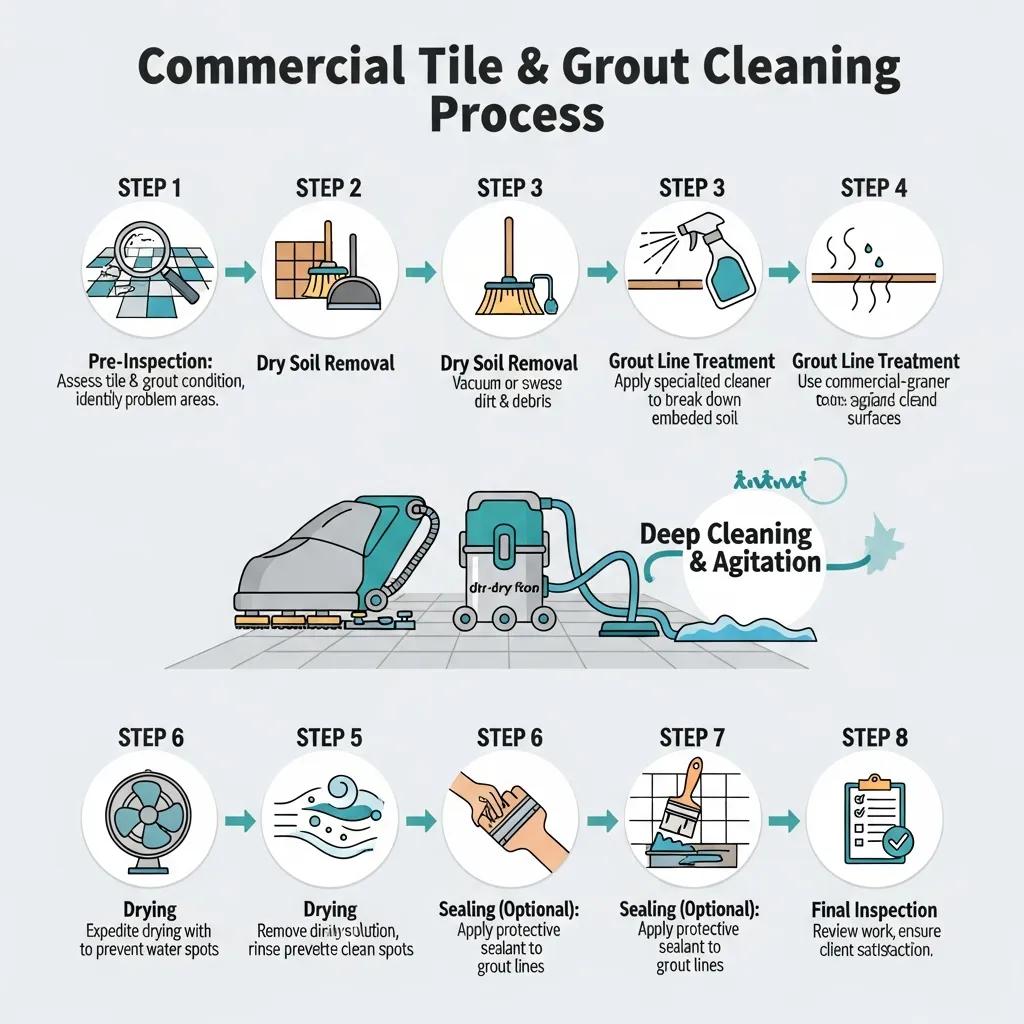
A reliable commercial tile and grout cleaning process follows a structured workflow: pre-inspection, targeted cleaning method selection, stain treatment and extraction, followed by restoration, sealing and quality assurance. The process begins with a material and contamination assessment that informs choice between steam cleaning, machine scrubbing or truck-mounted extraction and establishes safety and drying protocols. Equipment selection and chemical dosing are matched to tile substrate and traffic loads so cleaning removes soils without damaging surfaces, and final sealing or protective coatings are selected to suit maintenance schedules. The numbered steps below outline a typical professional workflow that facilities teams can adapt to their site conditions.
The core process in numbered form:
- Pre-inspection and assessment: Document tile type, grout condition and contamination.
- Surface preparation: Remove loose debris, perform spot testing and isolate work zones.
- Deep cleaning: Apply targeted chemistry and mechanical agitation (steam or rotary).
- Extraction and drying: Use high-capacity extractors and rapid-dry techniques.
- Restoration and sealing: Repair grout, apply sealant, allow cure and re-open.
This structured approach ensures predictable outcomes and supports service-level planning for commercial properties. The table below breaks down process steps with their purpose and expected outcome.
| Phase | Purpose | Expected Outcome |
|---|---|---|
| Pre-inspection | Identify materials and hazards | Tailored cleaning plan and accurate quote |
| Steam cleaning | Deep sanitisation and stain lift | Reduced microbial load, visual improvement |
| Extraction | Remove emulsified soils and moisture | Faster drying, no residue |
The process table clarifies the rationale behind each phase and prepares readers for more detail on pre-inspection and specific techniques in the subsections that follow.
How Do We Conduct Pre-Inspection and Assessment?
A thorough pre-inspection documents tile species (porcelain, ceramic, natural stone), grout composition, traffic patterns and any access constraints that will affect scheduling and method choice. Inspectors look for staining type (organic, oil-based, mineral), grout integrity (cracked, missing, discoloured), and substrate sensitivity to alkaline or acidic cleaners. This information determines whether low-moisture, steam, or aggressive mechanical extraction is appropriate and identifies any safety or compliance steps required for healthcare or food-service environments. Sample testing on a discrete area validates chemical compatibility and sets expectations for visible results and drying time. With a clear assessment, the team prepares the logistics, ensuring minimal disruption and predictable outcomes for the cleaning engagement.
A clear assessment leads directly to choosing the correct cleaning technology, which we discuss next.
Which Advanced Cleaning Techniques Do We Use?
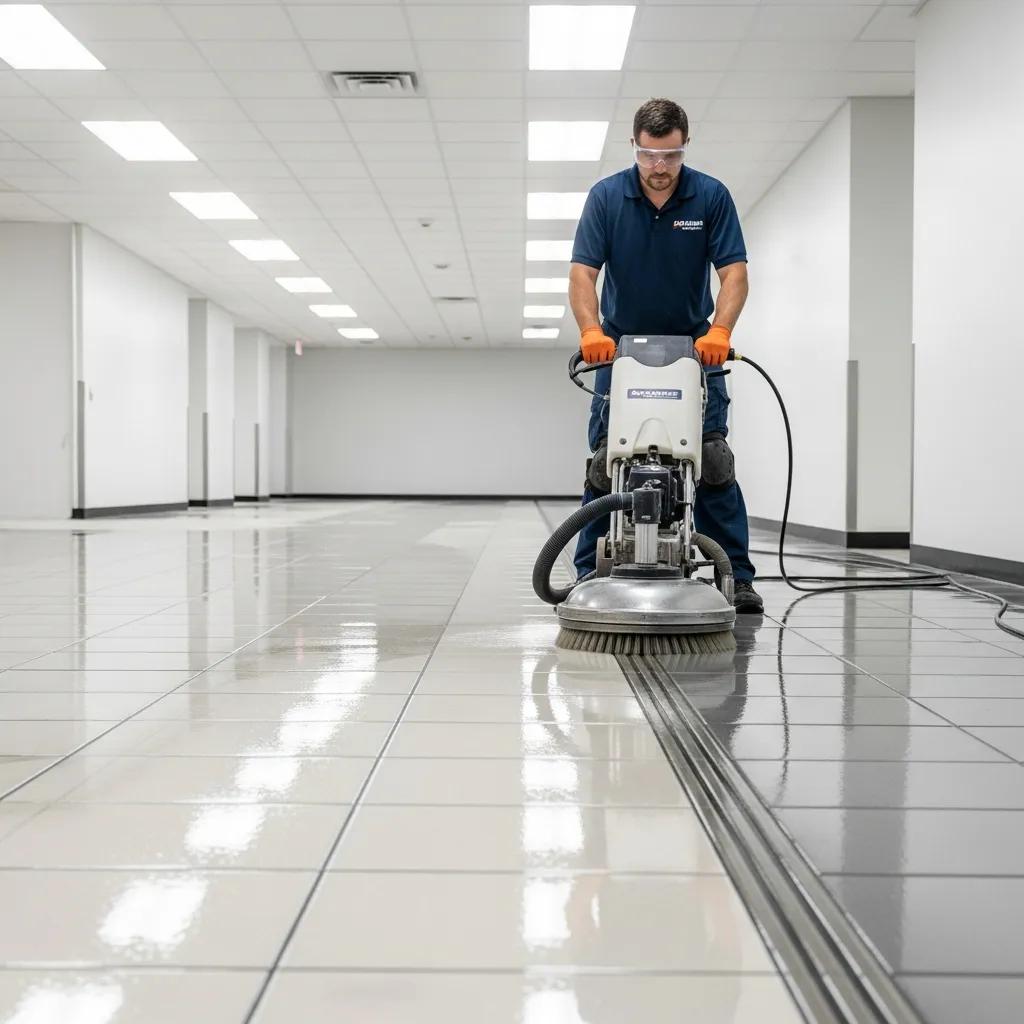
Advanced methods include high-pressure steam for sanitisation, rotary scrubbers with controlled-speed heads for heavy soils, truck- or van-mounted hot-water extraction for large areas, and oxygen-based bleach treatments for stubborn organic stains. Each technique has pros and cons: steam provides sanitisation without residue but may need containment; rotary scrubbing delivers mechanical action for textured tiles but requires careful operator control; truck-mounted systems offer powerful extraction and fast results for large facilities. Eco-friendly cleaning agents and controlled dosing minimise environmental impact while meeting occupational safety requirements. Choosing the right technique depends on tile type, stain profile and operational constraints, and combining methods often yields the best balance of hygiene and appearance restoration.
These method choices guide the following section on restoration and sealing to protect cleaned surfaces long-term.
How Do We Restore and Seal Tile and Grout for Longevity?
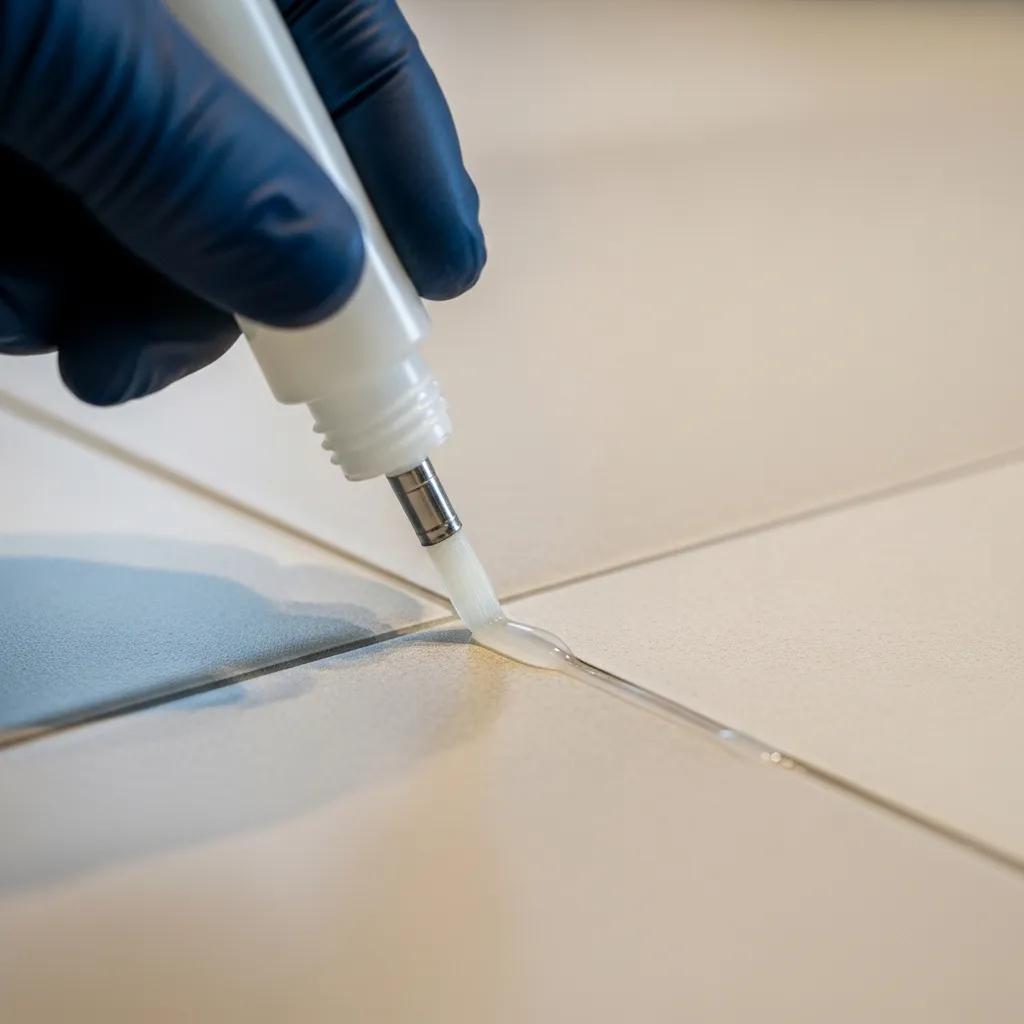
Restoration and sealing focus on repairing degraded grout, correcting colour and applying protective sealants that repel stains and simplify maintenance. Restoration begins with deep cleaning to reveal the true condition of grout, followed by repair or regrouting where joints are missing or badly damaged; recolouring or grout sealer application restores visual uniformity. Sealants—penetrating or topical—create barriers against liquid ingress and staining, reducing frequency of deep cleans and lowering lifecycle costs. Expected lifespan extension varies with traffic; however, a proper restoration plus sealing program typically adds years to tile service life and reduces the need for replacement. The numbered steps below summarise a typical restoration and sealing workflow for commercial floors.
Key restoration and sealing steps:
- Deep clean: Remove contaminants to expose true grout condition.
- Repair/regrout: Replace or patch damaged grout joints as needed.
- Colour correction: Apply grout recolouring if uniformity is required.
- Sealant application: Use penetrating or topical sealant matched to tile.
- Cure and handover: Allow proper cure time and provide maintenance guidance.
A brief product/benefit comparison helps facilities managers decide between sealant types and maintenance intervals.
| Sealant Type | Characteristic | Benefit |
|---|---|---|
| Penetrating | Absorbs into grout | Long-lasting protection without surface film |
| Topical | Forms surface layer | Easier to renew, may enhance sheen |
| Colour-enhancing | Alters grout tone | Restores visual uniformity quickly |
This comparison clarifies trade-offs so decision-makers can balance aesthetics, longevity and maintenance needs when selecting a sealing strategy.
What Are the Steps in Grout Restoration and Repair?
Grout restoration follows a sequence of assessment, deep cleaning to remove embedded contaminants, mechanical or chemical grout removal where needed, precision regrouting or patching, and colour correction or recolouring if desired. Timing considerations are important: cleaning and repairs require dry times between steps, and full cure times for new grout or sealants typically dictate when areas can return to service. For busy commercial sites, phased repairs or after-hours scheduling reduce operational impact while ensuring thorough workmanship. After restoration, a short maintenance schedule and recommended cleaning protocols preserve results and prolong sealant effectiveness. Proper sequencing minimises rework and secures consistent outcomes across large floor areas.
The final step — sealing — protects the investment, which we describe in the next subsection.
How Does Grout Sealing Protect Commercial Floors?
Grout sealing creates a barrier that limits liquid penetration, prevents oil and dirt binding, and simplifies routine cleaning; this leads to fewer deep-cleans and longer intervals between restorative services. Penetrating sealants work within grout pores to maintain a natural appearance and typically last longer, while topical sealants create a surface film that can enhance sheen but requires periodic reapplication. For high-traffic commercial areas, resealing intervals are commonly shorter—often annually—while lower-traffic zones may extend reseal cycles to multiple years depending on product performance. Regular inspection and spot testing reveal when reseal is required, and integrating sealant maintenance into a facility’s cleaning schedule ensures consistent protection and reduced lifecycle cost.
These protective measures support tailored services across industries, explored in the next section.
Which Specialised Tile and Grout Cleaning Services Do We Offer for Different Industries?
Different industries require customised cleaning protocols: offices prioritise aesthetics and fast turnaround, retail focuses on appearance and customer safety, and medical facilities require documented infection-control procedures and health-safe chemistries that meet regulatory expectations. Scheduling considerations vary: after-hours cleaning is typical for retail and office locations to avoid disruption, while medical centres may need phased closures and documented sanitisation reports for compliance. Equipment and chemical selection are adjusted for substrate and regulatory needs—for example, non-residue disinfectants for healthcare and rapid-dry systems for retail concourses. The table below compares industry requirements and the typical commercial solutions that meet them.
| Industry | Requirement | Typical Solution |
|---|---|---|
| Medical centres | Regulatory hygiene | Enhanced disinfection and documentation |
| Retail | Aesthetics and uptime | Fast-dry extraction and cosmetic restoration |
| Offices | Low disruption | After-hours scheduling and quiet equipment |
This comparison clarifies how cleaning programs differ by sector and sets up the industry-specific descriptions that follow. At the end of this section we provide a short note on how businesses can request a quote for tailored industry services.
How Is Tile Cleaning Customised for Offices and Retail Spaces?
Office and retail cleaning emphasises fast turnaround, appearance restoration and minimising customer or employee disruption by using scheduled after-hours work and rapid-dry extraction. Techniques include light polishing, rapid-extraction cleaning for glossy tiles, and grout recolouring or spot repair to restore uniformity in high-visibility zones. Anti-slip treatments or textured-surface maintenance improve safety in entryways and aisles without sacrificing look. Work is coordinated to minimise business interruption, with prioritised areas like lobbies, showrooms and high-traffic corridors scheduled during low-occupancy periods. These practical adaptations ensure that cleaning enhances both safety and the customer experience while fitting into operational needs.
For businesses that require a formal quote or tailored plan, see the service-request guidance at the end of this section.
What Are the Cleaning Requirements for Medical and Healthcare Facilities?
Medical and healthcare facilities require cleaning protocols that prioritise infection control, documented processes, and use of health-safe chemistries that meet regulatory expectations. Cleaning frequency is higher in clinical zones, and disinfection steps use validated products compatible with tile substrates to avoid surface degradation. Documentation—before-and-after notes, chemical usage records and scheduling logs—is often required for audits and compliance, and teams are trained to restrict cross-contamination during procedures. Scheduling typically includes phased closures or targeted zone treatment to maintain patient care continuity. These protocols support both patient safety and facility accreditation needs while preserving the integrity of tiled surfaces.
Industry-specific offerings like these can be quoted based on floor area and operational constraints; the next section explains where services are provided and how to request a free quote.
Where Do We Provide Commercial Tile and Grout Cleaning Services?
Services are offered across Brisbane and the Sunshine Coast, with flexible scheduling to accommodate local business hours and minimise operational disruption. Coverage includes commercial districts, retail centres, medical facilities and office parks within these broad regions, and businesses outside listed zones are encouraged to enquire about availability. Response times and scheduling depend on scope and access constraints; typically, site inspections and quotes are arranged within a business day or two for urban locations. For local verification and reviews, businesses can consult the company’s local business profile. The short list below summarises typical coverage and response expectations.
Service coverage summary:
- Primary areas: Brisbane and Sunshine Coast commercial zones.
- Scheduling: After-hours and weekend options to reduce downtime.
- Response: Prompt inspection scheduling for accurate quotes.
This local focus ensures that cleaning teams understand regional traffic patterns, environmental considerations and client logistics when planning work, and it leads into a clear checklist for requesting a free quote.
What Areas in Brisbane and Sunshine Coast Do We Serve?
The service area focuses on the broader Brisbane and Sunshine Coast regions and accommodates commercial properties within those zones, acknowledging variation in suburb-level availability. Facility managers in these regions can confirm “specific suburb coverage” by requesting an inspection; providers commonly clarify travel, access and scheduling during the quote stage. For organisations outside the stated areas, enquiries are welcomed to determine feasibility and to arrange site-specific proposals where possible. This conservative service description aims to set realistic expectations while encouraging direct contact for precise availability information.
Confirming availability for a particular suburb typically precedes formal quoting and scheduling so operations can plan around service windows and access requirements.
How Can Businesses Request a Free Quote for Our Services?
To request a free quote, businesses should supply core details that allow accurate assessment: approximate floor area, tile and grout types, photographs of affected zones, typical foot traffic patterns and preferred access times for inspections or work. Providing clear images and notes about stain history or prior treatments speeds the estimate process and improves quote accuracy. Typical response times after a request involve scheduling a pre-inspection and delivering a written proposal with recommended methods, timelines and maintenance suggestions. Below is a brief checklist to prepare for a quote request.
Quote request checklist:
- Floor area estimate: Square metres or dimensions of zones.
- Tile/grout type: Porcelain, ceramic, textured or natural stone.
- Photos: Clear images of problem areas and overall floor.
- Access windows: Preferred inspection and work times.
Supplying these details enables a prompt, tailored proposal and helps operators plan for minimal disruption while achieving the hygiene, safety and appearance outcomes described earlier. For local businesses in Maroochydore, Brisbane and the Sunshine Coast, Divine Commercial Cleaning provides tailored commercial tile and grout cleaning solutions with an emphasis on exceptional results, reliability and eco-conscious practices that align with the needs outlined across this guide.

Dianne, originally from Rockhampton, hails from a business-oriented family, with her father owning electrical stores and her uncle serving as Mayor. Moving to the Sunshine Coast at 13, she later pursued a rewarding real estate career and raised three children. As a single mom, she balanced university studies with domestic cleaning work. Armed with a Bachelor’s Degree in Business, majoring in Supply Chain Management, Dianne founded and grew Divine Commercial Cleaning into a thriving company. Her success is rooted in strong family mentorship, a positive attitude, and a solution-oriented approach, offering tailored cleaning services with integrity and strategic insight.