How Bells Creek Commercial Cleaning Quickly Resolves Complaints and Keeps Quality Consistent
When cleaning outcomes don’t match expectations, businesses lose time and confidence. Resolving those issues fast takes a clear intake process and a quality workflow that keeps your operations moving. This page walks through a practical complaint-resolution system — intake, triage, remediation, verification and follow-up — designed to minimise downtime for Bells Creek businesses while protecting reputation and compliance. You’ll find simple steps for reporting problems, the actions our teams take to investigate and fix them, how proactive quality checks stop repeats, and the trust signals that reduce client risk.
Examples are tailored for offices, medical centres, schools and strata properties across the Sunshine Coast and Brisbane so facility managers can see how consistent teams, documented processes and guarantees work together. Read on for straightforward processes, tables that clarify roles and timing, and checklists that make reporting and escalation easy.
What Is Divine Commercial Cleaning’s Complaint Resolution Process in Bells Creek?
Our complaint resolution process sets out how we receive, assess and respond to service issues so standards are restored with minimal disruption. In practice that means we acknowledge reports quickly, triage by severity, investigate and assign remedies, then verify the fix and close the case with documentation. Clear timelines at each stage reduce uncertainty and create measurable service expectations for both parties. The sections below explain how you can report issues and the exact steps our cleaners, supervisors and quality staff take when an incident happens — so decision-makers know what to expect at every touchpoint.
Handled properly, complaints become opportunities to fix immediate problems and prevent them from happening again.
Effective Complaint Handling in Cleaning Services
Research in the sector focuses on building complaint-handling systems that deliver timely responses or solutions to customers and identify why complaints occur.
Complaints Management in Cleaning Services, 2015
How Can Clients Report Commercial Cleaning Service Issues?
We keep reporting simple and fast so issues are acknowledged and evidence is gathered early. When you report, please include date and time, the exact area on-site, a short description and photos if possible — these details help our team triage remotely and prepare the right response. The usual channels are a phone call to your account manager for urgent matters, an email or online form for documented issues, and a note left with a supervisor or on-site cleaner for routine observations. You can expect an initial acknowledgement within one business day and guidance on whether we’ll do an on-site assessment; clear details and photos reduce back-and-forth and speed corrective action.
What Are the Step-by-Step Actions Divine Takes to Resolve Complaints?
We follow a consistent sequence so every complaint shows measurable progress. First, we acknowledge and log the report in our system. We then triage to decide severity and whether same-day attendance is needed. The assigned cleaner or supervisor will perform a targeted re-clean or corrective action; if the issue is more complex, a quality manager will visit, document findings and recommend fixes such as rework, schedule changes or a credit where policy allows. We only close a case after client verification, keeping a full record to support audits and continuous improvement.
- Consistent steps ensure the same approach across site types and make escalation transparent.
- Clear role definitions — cleaner, supervisor, quality manager — reduce duplication and speed repairs.
- Logging every complaint creates trend data we use to reduce repeat problems through training or scope changes.
Those procedures lead directly into how proactive quality management reduces the number of complaints overall.
How Does Divine Commercial Cleaning Ensure Service Quality Through Proactive Management?
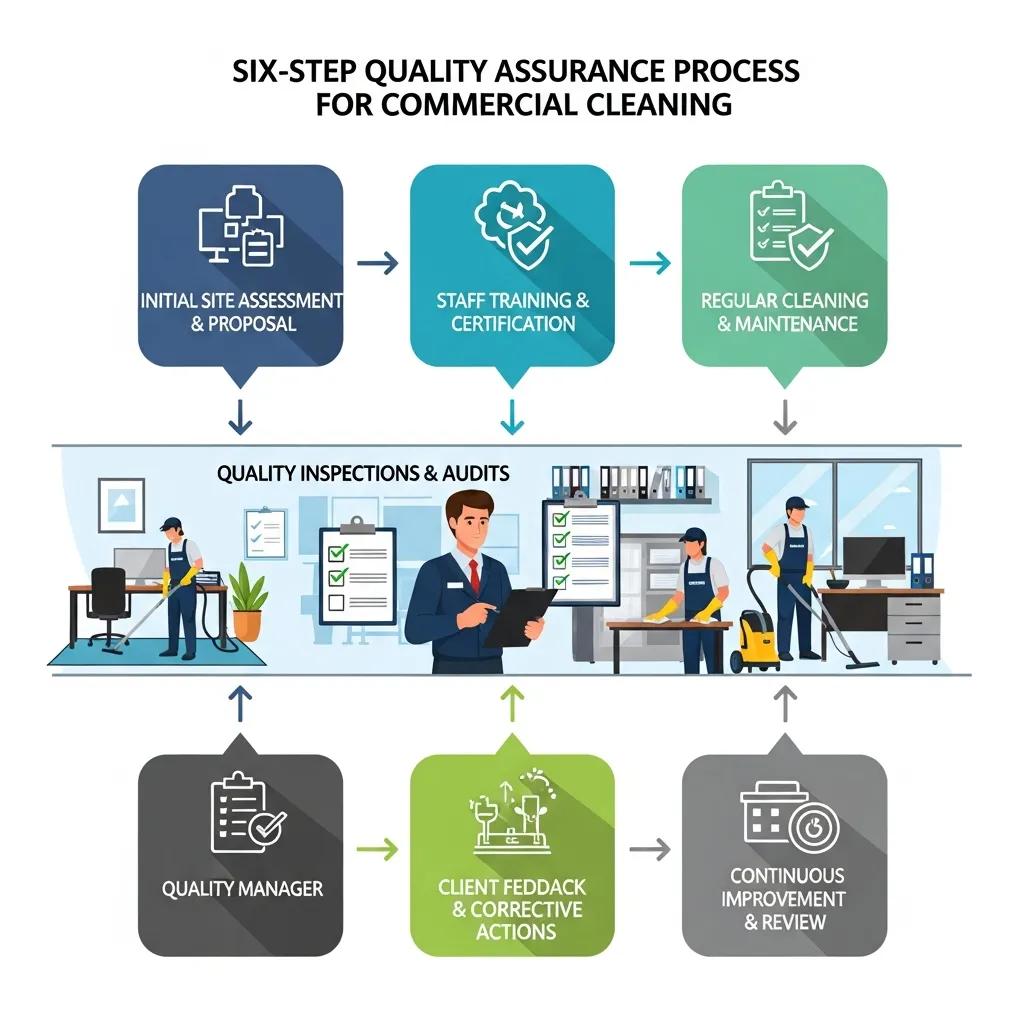
Proactive quality management cuts down complaints by combining regular monitoring, consistent staffing and scheduled reviews that pick up issues before clients raise them. Our six-step quality assurance process structures onboarding and ongoing delivery, finishing with a 90-day quality manager review to check performance against agreed checklists. Preventative site visits, cleaner walkthroughs and KPI tracking provide multiple detection points for service drift and let us act early. The table below summarises the core elements so facility managers can see responsibilities and timing at a glance.
A proactive stance — spotting problems early — reduces service failures and the disruption they cause.
Proactive Complaint Prevention in Service Management
Guidance for implementing preventive systems emphasises managing complaint prevention operations to avert service malfunctions and their consequences.
Preventive service management: Towards pro-active improvement of service quality, O Barkai, 2011
The table below organises the quality process by activity, who owns it and when it typically occurs.
| Process Element | Responsibility | Typical Timing |
|---|---|---|
| Initial Contact and Scope Confirmation | Sales / Account team | At contract start |
| Site Visit and Quotation | Operations | Within initial engagement week |
| Cleaner Walkthrough and Handover | Supervisor / Cleaner | Before first scheduled service |
| Regular Service Delivery with Checklists | Cleaners | Ongoing per schedule |
| Routine Site Visits and Spot Checks | Supervisors | Weekly to monthly |
| 90-Day Quality Manager Review | Quality Manager | Around day 90 after start |
This layout shows how defined responsibilities and timing create a layered quality approach. With clear tasks, teams catch small variances before they become formal complaints.
What Is the 6-Step Quality Assurance Process Including the 90-Day Review?
The six-step process turns onboarding and monitoring into repeatable actions that protect service consistency. Step one confirms contact and scope. Step two is a site visit to note specific needs. Step three delivers a written quote and agreed checklist. Step four is a cleaner walkthrough to align staff. Step five is regular service using the documented checklists. Step six is a formal quality review — including a 90-day manager check-in — to confirm compliance and address any lingering issues. The 90-day review is carried out by our quality manager, includes checklist verification, staff performance checks and client feedback, and results in an action plan if gaps are found. That cadence helps us spot patterns early and apply targeted training or scope adjustments.
How Does Consistent Staffing Improve Customer Satisfaction and Issue Prevention?
Assigning the same cleaner or small team to a site builds familiarity with site needs and reduces variability that causes complaints. Consistent staffing improves institutional knowledge so cleaners recognise recurring trouble spots, follow client-specific protocols and notice new issues faster — which speeds detection and fix. Relationship continuity also increases accountability and trust because the cleaner understands preferences and expectations, so small problems are less likely to escalate. It also simplifies day-to-day communication with a single point of contact, shortening resolution times and lowering administrative load for facility managers.
- Consistency enables on-site tweaks and minor fixes that stop repeated complaints.
- Repeat assignments allow focused coaching when patterns emerge.
- Familiar teams reduce onboarding time and speed quality alignment for new sites.
How Does Divine Commercial Cleaning Use Client Feedback to Improve Service in Bells Creek?
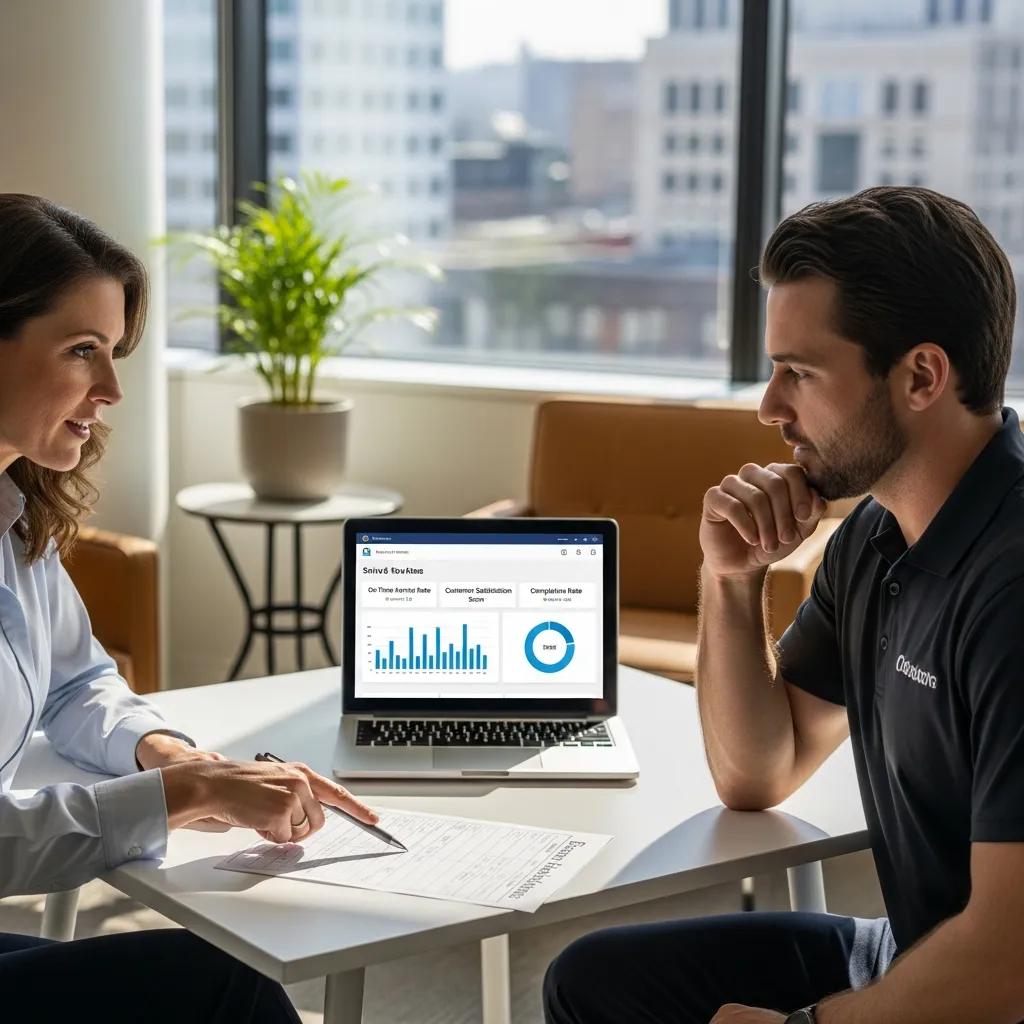
Client feedback is central to continuous improvement. We collect feedback consistently and act on trends so individual complaints drive systemic change. Feedback channels capture both reactive reports and scheduled evaluations, and all responses are logged centrally for operations and quality teams to analyse. Trends inform updates to checklists, staff training and schedules, which lowers repeat issues. The subsections below describe the channels and the lifecycle from intake to action so clients can see how their input shapes service changes.
Closing the loop on feedback turns one-off fixes into lasting improvements.
Proactive Quality Management for Problem Resolution
Traditional systems often lack proactive steps for identifying problems; a proactive quality approach uses feedback to prevent repeat failures and drive continuous improvement.
Continuous improvement of systems in maintenance using a proactive quality management, 2018
Which Feedback Channels Are Available for Commercial Cleaning Clients?
We offer multiple channels so you can give feedback based on urgency and formality: call your account manager for urgent issues, use email or our online form for documented reports, leave notes with a supervisor for routine matters, and take part in periodic surveys for performance reviews. Each channel serves a purpose: phone for immediate action, email/form for an audit trail, supervisor notes for day-to-day observations and surveys for trend signals. Tip: include photos and exact timestamps when reporting operational problems — this shortens diagnosis time and lets us triage remotely before scheduling an on-site visit.
How Is Customer Feedback Integrated into Continuous Service Improvement?
Feedback follows a clear lifecycle: intake and categorisation, root-cause analysis, corrective action assignment, implementation and follow-up verification with the client. Our operations team triages by severity and frequency, logs items in the quality system and assigns corrective tasks to supervisors or the quality manager. Recurring issues trigger checklist updates or focused training. Regular review meetings pull together feedback trends and prioritise process improvements; outcome metrics — like fewer repeat visits or better survey scores — show whether changes worked. This closed loop makes feedback a tool for operational learning rather than a one-off response.
- Intake: capture details and evidence.
- Analysis: find the root cause and identify systemic issues.
- Action: assign, implement and verify changes.
- Follow-up: confirm with the client and close the loop.
What Guarantees and Professional Standards Build Trust in Divine’s Bells Creek Cleaning Services?
Trust comes from clear guarantees, staff screening, insurance and transparent contract terms that lower risk for decision-makers. Key trust signals we provide include a money-back guarantee, police-checked staff, full insurance cover, no lock-in contracts and environmentally conscious practices — all designed to reduce the perceived risk when trying a new provider. The table below summarises these trust signals so procurement and facilities managers can quickly assess protections and recourse options.
| Trust Element | Characteristic | How It Protects Clients |
|---|---|---|
| Money-back Guarantee | Scope and applicability | Provides rework or refund for qualifying service failures |
| Police-checked Staff | Background screening | Reduces risk for sites with sensitive access requirements |
| Fully Insured Cleaners | Liability and accidental damage coverage | Ensures repair or compensation if accidental damage occurs |
| No Lock-in Contracts | Contract flexibility | Allows businesses to change providers without long-term penalties |
| Environmentally Conscious Practices | Use of eco products and methods | Lowers environmental and regulatory risk for clients |
This summary highlights practical protections that ease procurement concerns and reduce operational and reputational risk for your organisation.
How Does the Money-Back Guarantee Support Customer Satisfaction?
Our money-back guarantee gives clients a clear remediation route when services fall short of the agreed scope. In practice, the guarantee applies after a documented investigation shows a shortfall and we’re unable to deliver an acceptable rework within the agreed remediation window. To invoke the guarantee you start with a logged complaint, we inspect the issue (supervisor or quality manager), and we document whether rework, a partial credit or a refund is appropriate under the policy. Having a guarantee reduces the risk of trial for new clients and shortens contract discussions by clarifying financial recourse.
What Role Do Police Checks and Insurance Play in Service Reliability?
Police checks and insurance are practical risk-management measures that protect both client and provider, especially for sensitive sites like medical centres, schools and strata properties. Police checks reassure stakeholders that staff are suitable to access controlled areas, while public liability and accidental damage insurance provide financial pathways for repair or compensation when incidents happen. These protections reduce operational disruption by allowing swift remediation and clear liability outcomes, helping site stakeholders feel confident authorising access. Together, vetting and insurance make reliability a measurable promise rather than a guess.
How Are Tailored Cleaning Solutions Designed to Prevent Service Issues for Bells Creek Businesses?
Tailored cleaning solutions lower disputes by matching scope, frequency and protocols to each business’s operational needs. Custom options include infection-control for medical settings, secure-entry procedures for imaging centres, child-safe products for daycares and flexible after-hours shifts for retail or gyms. Local knowledge of Bells Creek and the Sunshine Coast enables faster remedial attendance and better regulatory alignment, reducing the time from report to resolution. The table below compares custom measures for common commercial sectors so facility managers can see how tailored options reduce complaint risk.
| Business Type | Customisation | Sample Measures |
|---|---|---|
| Medical Centre | Infection control | Clinical-grade disinfectants and trained workflows |
| Office | Flex scheduling | After-hours cleaning to avoid workplace disruption |
| Strata / Body Corporate | Communal area focus | Checklist items for lifts, foyers and shared facilities |
| Daycare / School | Child-safe protocols | Non-toxic products and secure access procedures |
| Gym / Studio | Equipment-safe cleaning | Protocols for high-touch equipment and ventilation checks |
These examples show how sector-specific measures proactively address common complaint drivers by aligning services with operational realities.
What Customisation Options Are Offered for Different Business Types?
Different sectors need targeted scope, timing and product choices to avoid service drift. Medical centres usually require stricter disinfection checklists and documentation; offices often prioritise flexible timing and secure access; strata properties need clearly defined scopes for shared areas. Custom options can include frequency changes, exclusion lists, documented handover checklists and staff training for specific risks. Clear written scopes and checklists reduce ambiguity and create measurable performance criteria that speed dispute resolution.
How Does Localised Service Support Enhance Issue Resolution?
Local presence shortens remedial visits and uses area knowledge to reduce time from report to action — a real advantage for Bells Creek and Sunshine Coast clients who need prompt on-site fixes.
What Are Common Customer Questions About Complaint Handling and Service Quality in Bells Creek?
Facilities and procurement teams often ask about response times, accidental damage handling, escalation paths and the documentation provided during resolution. Clear SLAs for acknowledgement, attendance and final resolution reduce uncertainty and help clients plan around remedial work. Typical documentation includes a logged complaint record, investigation notes, photos, corrective actions taken and a client-signed closure statement when satisfaction is confirmed. The sections below give practical answers about accidental damage and expected timelines so you can set realistic expectations.
How Does Divine Handle Accidental Damage or Service Complaints?
Accidental damage should be reported immediately. We’ll contain the area if necessary, photograph the damage and log the incident so we can investigate quickly. A supervisor or quality manager will assess liability and recommend remediation — repair, replacement or insurance claim — depending on the findings. Clear procedures and insurance reduce dispute time and make outcomes transparent for all parties.
What Are the Expected Timelines for Complaint Resolution?
Our typical service-level timeframes are: acknowledgement within 24 business hours, triage and a decision on remedial action within 48–72 hours, and an on-site remedial visit scheduled based on severity — often within 1–5 business days for non-critical issues and sooner for urgent safety or health concerns. Complex cases involving third parties or insurers may take longer, but we provide interim updates and an estimated final timeline so you’re not left guessing. These SLAs create predictable expectations and let clients plan while we work to restore standards.
- Acknowledgement: We’ll confirm receipt and initial triage within one business day.
- Triage and Plan: We’ll advise next steps and whether on-site attendance is needed within 48–72 hours.
- Remediation and Verification: Corrective actions are applied and verified with you; timing ranges from same-day re-clean to several days for repairs depending on severity.
If you manage facilities in Bells Creek or the Sunshine Coast and want a low-risk cleaning partner, these processes show how structured intake, layered QA and clear trust signals work together to resolve complaints and prevent repeats. If you’d like a formal quote or a site-specific scope that includes these complaint-handling and QA features, Divine Commercial Cleaning can prepare a tailored proposal and a documented quality plan before work begins.
Frequently Asked Questions
What should I do if I am not satisfied with the cleaning service?
If you’re not satisfied, contact your account manager or use our online feedback form. Provide the date, time, location and a short description of the issue, and attach photos if you can. That information helps our team assess the situation quickly and arrange the appropriate corrective action.
How often are quality checks conducted on cleaning services?
We conduct routine checks with supervisors performing weekly to monthly site visits and spot checks. Additionally, a full quality review by the quality manager takes place about 90 days after service begins. This schedule helps us identify and fix issues early, keeping standards high.
Can I request changes to my cleaning schedule or scope of work?
Yes. Contact your account manager or supervisor to discuss changes. We’ll review operational feasibility and propose options to align services with your needs. Customisation helps prevent service issues and improves satisfaction.
What happens if a cleaning staff member is unable to attend a scheduled service?
If a staff member can’t attend, we’ll arrange a replacement so your service continues with minimal disruption. We’ll notify you of any changes and work to maintain quality and consistency.
How does Divine Commercial Cleaning handle feedback from clients?
We capture client feedback through phone, email, forms and surveys, and log it centrally for analysis. Operations and quality teams review trends and implement improvements, ensuring feedback leads to measurable service changes.
What are the benefits of using eco-friendly cleaning products?
Eco-friendly products reduce environmental impact, improve indoor air quality and are safer for staff and building users. They’re especially suitable for schools and medical facilities and support your sustainability goals.
How can I ensure that my specific cleaning needs are met?
Clear communication during the initial consultation and ongoing feedback are key. Tell your account manager about special protocols, timing or product preferences. Regular check-ins and documented scopes help us tailor services and meet your expectations.
A clear, structured complaint resolution process improves service quality and client confidence for commercial cleaning in Bells Creek. By combining proactive quality checks, consistent staffing and open communication, we reduce issues and build lasting trust. If you’d like a tailored cleaning solution that includes these complaint-handling and QA practices, contact Divine Commercial Cleaning for a personalised proposal. Let us show you the difference a responsive, professional team makes for your business.

Dianne, originally from Rockhampton, hails from a business-oriented family, with her father owning electrical stores and her uncle serving as Mayor. Moving to the Sunshine Coast at 13, she later pursued a rewarding real estate career and raised three children. As a single mom, she balanced university studies with domestic cleaning work. Armed with a Bachelor’s Degree in Business, majoring in Supply Chain Management, Dianne founded and grew Divine Commercial Cleaning into a thriving company. Her success is rooted in strong family mentorship, a positive attitude, and a solution-oriented approach, offering tailored cleaning services with integrity and strategic insight.