
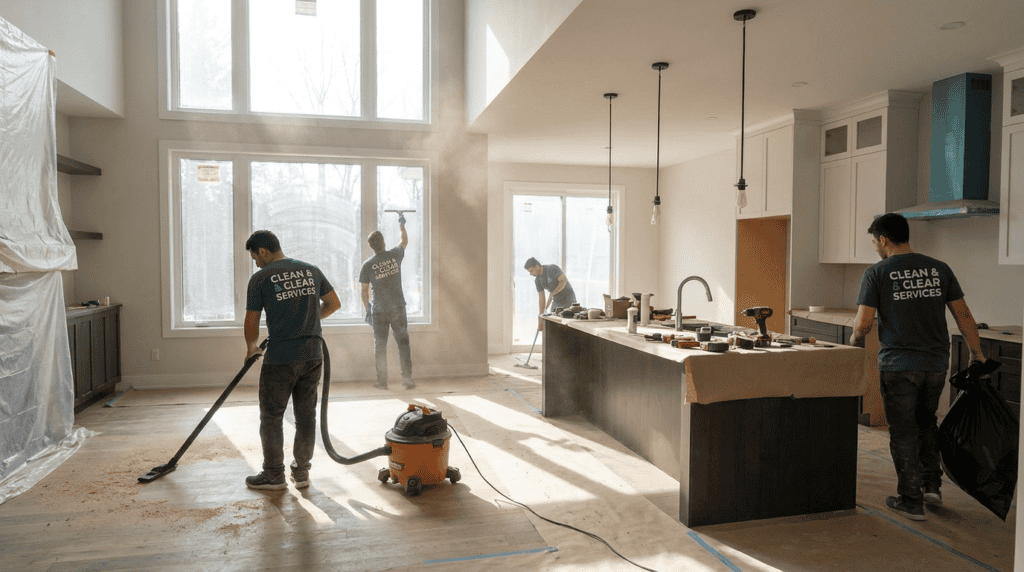
A builders clean is the final trade on a construction or fitout project: the process of removing construction dust, debris, adhesive residue, paint spots, protective films and stickers so the space can be handed over. It is usually delivered in two or three stages — a rough clean during construction, a builders clean at practical completion, and a detail or sparkle clean immediately before handover.
With sustained commercial construction and fitout activity across the Sunshine Coast — the Maroochydore City Centre development, the health precinct at Birtinya, Aura at Caloundra South, and a steady stream of tenancy fitouts across the region — builders cleaning is one of the more consistently underestimated line items on a project. It is scheduled last, compressed when the program slips, and then blamed when handover is delayed.
The three stages of construction cleaning
Stage 1 — Rough clean
Carried out during construction, typically after the main structural and framing trades and before finishing trades start. Removes bulk debris, offcuts, packaging and gross dust so the finishing trades can work safely and the site passes inspections. Not about presentation — about access, safety and dust control.
Stage 2 — Builders clean
The main event, at or near practical completion. This is where construction residue is removed from every surface:
- Fine construction dust from all horizontal and vertical surfaces, including ceiling tiles, ledges, door tops and skirtings
- Plaster, render, grout and adhesive residue from floors, glazing and hardware
- Paint spots and overspray from glass, hardware, tiles and flooring
- Protective film from glazing, benchtops, appliances and hardware
- Manufacturer stickers, barcodes and labels from windows, fixtures and appliances
- Silicone smears from glazing and wet areas
- Initial floor clean — vacuuming, scrubbing, and initial sealer application where specified
- Internal and external glazing, both faces
- Full clean-out of cupboards, drawers, cabinetry and joinery interiors
- Light fittings, diffusers, air-conditioning grilles and exhaust registers
- Washroom and kitchen fixtures, tapware and mirrors
Stage 3 — Detail or sparkle clean
Immediately before handover or the client walkthrough, after all trades and defect rectification are complete. Removes the dust that inevitably settles after the builders clean and addresses the fingerprints, footprints and marks generated by defect works. Short, but the one the client actually sees.
The most common project mistake is skipping stage 3. Defect rectification always generates new mess, and a builders clean done a week before handover will not present well on the day.
Why construction dust is a specific problem
Construction dust is not ordinary dust. It is fine, abrasive, alkaline and extremely mobile. Three consequences follow:
- It resettles. Dust disturbed in a ceiling void or behind cabinetry will settle on cleaned surfaces for days. This is why builders cleans are worked top-down and why a final detail clean is necessary.
- It scratches. Silica-bearing dust dragged across new glazing, polished floors or stainless steel causes permanent micro-scratching. Surfaces must be flushed or vacuumed before any wiping, never dry-wiped first.
- It is a health hazard. Respirable crystalline silica from concrete, tile and masonry cutting is a serious respiratory risk with specific WHS controls. Dry sweeping of silica-bearing dust is the wrong method — vacuum with appropriate filtration, or use wet methods, with appropriate respiratory protection.
It also means HVAC systems should not be run during heavy construction cleaning unless filters are protected, and filters should be replaced after the builders clean rather than before it.
The surfaces that go wrong most often
| Surface | Common damage | Correct approach |
|---|---|---|
| New glazing | Scratches from blade work over grit; metal-marking from scaffold | Flush thoroughly first; blade only at a shallow angle with lubrication; test in a corner |
| Polished concrete | Etching from acidic residue removers | pH-neutral cleaning; mechanical rather than chemical removal |
| Vinyl and resilient flooring | Adhesive residue smeared rather than lifted; sealer applied over dust | Solvent appropriate to the adhesive; full dust removal before sealing |
| Stainless steel | Scratching and directional marks | Clean with the grain; no abrasives |
| Powder-coated frames | Coating dulled by aggressive solvents | Mild solvent, soft cloth, test first |
| Engineered stone benchtops | Etching and dulling from acidic products | pH-neutral only; silicone removed mechanically |
| Timber floors | Water damage from over-wet cleaning | Damp mop only; see hardwood floor care |
| Tile and grout | Grout haze left to cure | Remove within the tiler’s recommended window; see tile and grout cleaning |
Sequencing: where builders cleans go wrong on program
The builders clean is dependent on every other trade, which makes it the first thing squeezed when a program slips. A few sequencing rules save considerable rework:
- Clean top-down, always. Ceilings, then walls, then joinery, then floors. Cleaning floors first guarantees doing them twice.
- Glazing after external works. Cleaning glass before facade, render or landscaping works finish means cleaning it again.
- Floor sealing after all trades. Sealer applied before the last trade finishes will be marked, and repair means a full re-strip.
- Protective film removal late, not early. Film protects the surface. Removing it at the start of the clean exposes benchtops and glazing to the rest of the works.
- Allow drying time. Sealers, floor finishes and grout treatments need cure time before traffic. Compressing this is the most common cause of a failed floor finish.
- Book the detail clean separately. After defects, not before.
What to include in a builders clean scope
Vague builders clean scopes cause more disputes than any other cleaning contract. Specify:
- Which stages are included, and whether the detail clean is priced separately
- Whether external glazing is included, and how it will be accessed at height
- Whether protective film and sticker removal is in scope
- Whether the initial floor seal or finish is included, and to what specification
- Who removes bulk waste and provides the skip
- Whether ceiling voids, plant rooms, roof spaces and risers are included
- Whether the car park, walkways and external hardstand are included — usually pressure washing is needed
- Site access hours, power and water availability, lift access and parking
- Whether the cleaning contractor’s staff need site inductions and what tickets are required
Our guide to writing a commercial cleaning scope of works applies here too — the more precisely the handover condition is defined, the fewer arguments at practical completion.
Fitouts and refurbishments in occupied buildings
A tenancy fitout inside an operating building adds constraints that a greenfield project does not have:
- Dust migration. Construction dust travels through shared air-conditioning, lift shafts and stair cores into neighbouring tenancies. Negative pressure containment and sealed hoardings matter, and the common areas need daily attention while works are underway.
- Common area protection. Lift lobbies, corridors and lift car interiors take heavy traffic and damage during a fitout. Protection plus a daily clean of the trade route is cheaper than repairing the finishes.
- Noise and hours. Building rules generally restrict noisy work to specific hours; cleaning often has to happen after them.
- Waste routes. Agree the path from tenancy to skip and keep it clean daily.
For strata and body corporate properties, the body corporate is responsible for maintaining common property in good condition, so damage and soiling to common areas during a lot owner’s fitout is worth addressing in writing before works begin.
Frequently asked questions
What is the difference between a builders clean and a final clean?
The builders clean removes construction residue — dust, adhesive, paint, film, stickers — at practical completion. The final, detail or sparkle clean happens immediately before handover, after defect rectification, and addresses the dust and marks generated since. Most projects need both.
How long does a builders clean take?
It depends on area, finish complexity and how much residue the trades have left. As a rough guide, a straightforward commercial tenancy fitout of a few hundred square metres takes one to three days for the builders clean with an appropriate crew, plus a short detail clean before handover. Heavily glazed or highly finished spaces take considerably longer.
Who is responsible for the builders clean — builder or tenant?
It depends on the contract. In most head contracts the builder is responsible for delivering the premises clean at practical completion. In fitout works the tenant or their project manager often arranges it directly. Check what ‘clean’ is defined as in your contract, because the definition is frequently thin.
Can our regular office cleaner do a builders clean?
Usually not. Builders cleaning needs different equipment (industrial vacuums with appropriate filtration, scrubbers, blades, solvents), knowledge of which products damage which new finishes, working-at-heights capability for glazing, and site induction compliance. It is a distinct service, and damage to new finishes is expensive.
When should floor sealing happen?
After all trades are complete and after the builders clean, with adequate cure time before traffic. Sealing early virtually guarantees damage and a full re-strip. See our strip and seal flooring service.
Is external window cleaning included in a builders clean?
Only if it is specified. External glazing above ground level requires height access — EWP, rope access or a water-fed pole system — and is commonly quoted separately. Confirm it explicitly rather than assuming it is covered.
Planning a project handover?
Divine Commercial Cleaning provides staged construction and fitout cleaning across the Sunshine Coast, and we can quote the rough clean, builders clean and detail clean separately so they sit correctly in your program and your budget. Talk to us about your project — and if you need ongoing cleaning once the space is occupied, we can carry the site straight through into a routine contract.

Dianne, originally from Rockhampton, hails from a business-oriented family, with her father owning electrical stores and her uncle serving as Mayor. Moving to the Sunshine Coast at 13, she later pursued a rewarding real estate career and raised three children. As a single mom, she balanced university studies with domestic cleaning work. Armed with a Bachelor’s Degree in Business, majoring in Supply Chain Management, Dianne founded and grew Divine Commercial Cleaning into a thriving company. Her success is rooted in strong family mentorship, a positive attitude, and a solution-oriented approach, offering tailored cleaning services with integrity and strategic insight.