If hazardous cleaning chemicals are used at your workplace, Queensland work health and safety law requires that current safety data sheets are readily accessible to workers, that containers are correctly labelled, and that a hazardous chemicals register is maintained. That obligation does not disappear because a contractor brings the chemicals in — as the person conducting the business or undertaking at that site, you share a duty for what happens there.
This is one of the most common gaps we see when taking over a Sunshine Coast site: a cleaner’s cupboard containing half a dozen unlabelled spray bottles of decanted product, no SDS folder, and nobody who can say what is in them. It is a straightforward thing to fix, and worth fixing before a workplace incident or an insurer makes it urgent.
What a safety data sheet is, and who has to have one
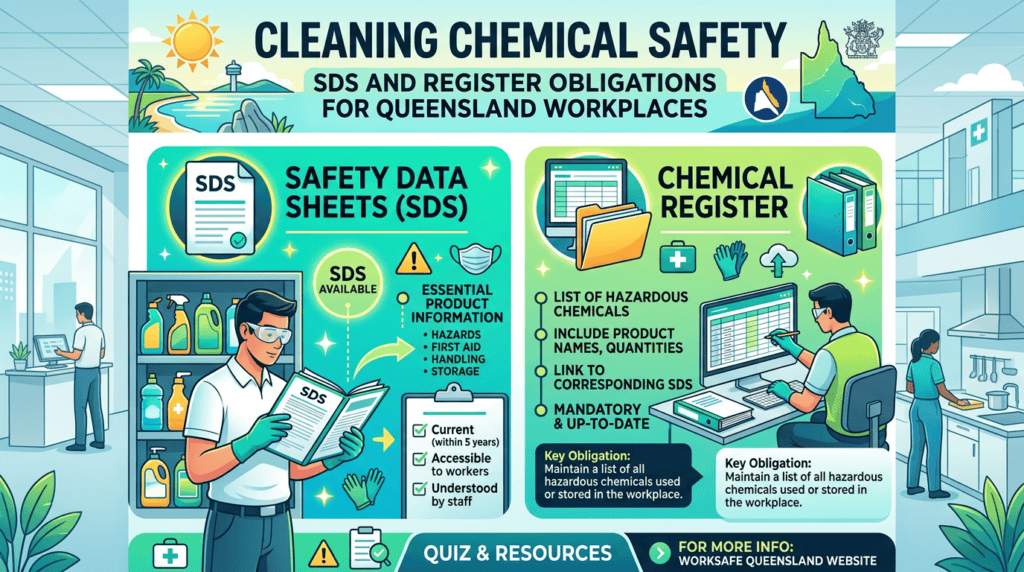
A safety data sheet (SDS) is a document prepared by the manufacturer or importer that sets out a chemical’s identity, hazards, safe handling and storage requirements, first aid measures and emergency procedures.
Under the model WHS Regulations as applied in Queensland:
- Manufacturers and importers must prepare an SDS and review it at least once every five years, amending it whenever necessary to keep the information current.
- A supplier must provide the current SDS to any person likely to be affected by the chemical, or to anyone who asks for it.
- The person conducting the business or undertaking must ensure the current SDS is readily accessible to workers who use or handle the chemical, and to anyone else likely to be affected.
- A hazardous chemicals register must be maintained — a list of the hazardous chemicals at the workplace with the current SDS for each, readily accessible to workers.
‘Readily accessible’ means available in the work area. A paper folder in the cleaner’s store or a computer or internet-based SDS database are both acceptable; an SDS pack sitting in a contractor’s head office two suburbs away is not.
The register: what it is and what goes in it
The hazardous chemicals register is deliberately simple. It is a list of the hazardous chemical products used or stored at the workplace, with the current SDS attached or linked for each one.
For a typical commercial site the register covers items such as:
- Washroom acid cleaners and descalers
- Chlorine-based disinfectants and bleaches
- Quaternary ammonium disinfectants
- Alkaline degreasers and oven cleaners
- Floor strippers (often highly alkaline)
- Floor sealers and finishes
- Alcohol-based sanitisers (also a flammability consideration)
- Graffiti removers and solvent-based products
Neutral detergents, general purpose cleaners and glass cleaners may or may not be classified as hazardous depending on their formulation — the SDS tells you. When in doubt, list it.
Labelling: the decanting problem
The single most common breach on cleaning sites is decanted chemical in an unlabelled bottle. Concentrates are routinely diluted into spray bottles, which is normal and necessary. What is not acceptable is the bottle carrying no product name, no dilution rate and no hazard information.
A workable standard for every secondary container:
- Product name matching the SDS
- Dilution rate as mixed
- Hazard pictogram and signal word carried over from the concentrate label
- Basic first aid direction
- Date decanted, where the product has a short in-use life
Ask your cleaning contractor to show you their spray bottles. It takes thirty seconds and it is remarkably diagnostic.
The chemicals most likely to cause an incident on a commercial site
Chlorine bleach mixed with acid
Mixing a chlorine-based product with an acidic washroom cleaner releases chlorine gas. This is the most common serious chemical incident in cleaning, and it almost always happens because two products were used in quick succession in a confined, poorly ventilated toilet cubicle. Never store the two in the same caddy, and never use them in sequence without a thorough rinse and ventilation.
Ammonia-based products with chlorine bleach
Produces chloramine vapours. Some glass cleaners are ammonia-based; some toilet products are chlorine-based. Segregate them.
Floor strippers
Typically strongly alkaline, and the highest-risk product most cleaning contractors carry. Requires eye protection, gloves, ventilation and slip management. Strip and seal work should be done outside occupied hours — see our strip and seal flooring service for how the process is staged.
Acid descalers
Used on hard water scale and urinals. Can damage grout, chrome, natural stone and some sealed surfaces if left to dwell, quite apart from the personal exposure risk.
Disinfectants: what the labels actually mean in Australia
Disinfectant claims in Australia are regulated by the Therapeutic Goods Administration. Two categories matter for commercial cleaning:
- Household/commercial grade disinfectant — for general surfaces.
- Hospital grade disinfectant — a distinct regulatory category. Products making specific claims must be included in the Australian Register of Therapeutic Goods, and household or commercial grade products must not be labelled ‘hospital grade’ or use wording implying they are.
If a supplier or contractor describes a product as ‘hospital grade’, it should be identifiable in the ARTG. This matters most for medical and health centres, imaging centres, dental practices and aged care, where the disinfectant category is part of your own compliance evidence.
It is also worth understanding the difference between cleaning and disinfecting: a disinfectant applied over soil does not work, because the soil shields the organisms. Clean first, then disinfect. Our article on decontamination versus disinfection goes into the distinction in more detail.
Storage on a commercial site
- Lockable, ventilated store. Particularly where the public, children or clients can access the building.
- Segregate incompatibles. Acids away from chlorine products; flammables away from oxidisers.
- Bund or contain concentrates. A spill tray under decanting stations prevents a small mistake becoming a floor damage claim.
- Keep quantities small. There is rarely a reason to hold bulk drums at a routine commercial site.
- Never store chemicals in food areas. This is a specific requirement in food businesses and simply good practice everywhere.
What to ask your cleaning contractor
- Can I see the SDS pack for every chemical brought onto this site?
- Are all your SDS current within five years?
- Is there a hazardous chemicals register for this site, and where is it kept?
- Are all secondary containers labelled with product name, dilution and hazard information?
- How are your cleaners trained in chemical handling, and is that training documented?
- What PPE is issued, and is it actually on site?
- How are incompatible products segregated in the store?
- What is your spill response procedure?
These questions sit alongside the broader due-diligence list in our guide to questions to ask a commercial cleaning company.
Reducing chemical risk without reducing cleaning quality
Most commercial sites can cut their chemical inventory substantially without any loss of result:
- Rationalise the range. Many sites carry eight products where four would do. Fewer products means fewer incompatibilities and a shorter register.
- Use dilution control systems. Wall-mounted proportioners remove guesswork, reduce over-concentration and cut both cost and exposure.
- Match the product to the soil. Neutral detergent handles most routine soil. Reserve acids and strong alkalis for the jobs that need them.
- Use mechanical action where you can. Microfibre, hot water extraction and machine scrubbing do work that would otherwise require stronger chemistry.
- Consider lower-hazard alternatives deliberately. Where a lower-hazard product performs, it reduces both risk and your register. Our piece on sustainable office cleaning covers the trade-offs honestly.
Frequently asked questions
Do I need SDS for chemicals my cleaning contractor brings in?
You need current SDS readily accessible at the workplace for hazardous chemicals used there. In practice, the contractor supplies the SDS pack and you keep a copy on site. Both parties have duties; neither can rely on the other to have handled it.
How current does a safety data sheet have to be?
Manufacturers and importers must review an SDS at least once every five years. A sheet older than five years should be replaced with the current version from the supplier.
Where should the SDS folder be kept?
In the work area where the chemicals are used or stored — typically the cleaner’s store — or accessible through a computer or internet-based SDS system that staff can actually reach. It must be usable in an emergency, at the time of the emergency.
Does a small office really need a hazardous chemicals register?
If hazardous chemicals are used or stored there, yes. The register for a small office may be a single page listing four or five products, with the SDS attached. The size of the obligation scales with the site.
Can cleaners decant chemicals into spray bottles?
Yes — dilution is normal. The requirement is that the container is correctly labelled with the product identity and hazard information so anyone handling it knows what it is.
What should happen if two chemicals are accidentally mixed?
Evacuate and ventilate the area immediately, do not attempt to neutralise or clean up the mixture, and seek medical advice for anyone exposed. Then report it — a near miss that goes unrecorded is a repeat incident waiting to happen.
Want your cleaner’s chemical practices checked?
Whether or not we clean your building, we are happy to walk your cleaner’s store, review the SDS pack and labelling, and tell you what needs tightening. Get in touch with Divine Commercial Cleaning to arrange a site visit.

Dianne, originally from Rockhampton, hails from a business-oriented family, with her father owning electrical stores and her uncle serving as Mayor. Moving to the Sunshine Coast at 13, she later pursued a rewarding real estate career and raised three children. As a single mom, she balanced university studies with domestic cleaning work. Armed with a Bachelor’s Degree in Business, majoring in Supply Chain Management, Dianne founded and grew Divine Commercial Cleaning into a thriving company. Her success is rooted in strong family mentorship, a positive attitude, and a solution-oriented approach, offering tailored cleaning services with integrity and strategic insight.