
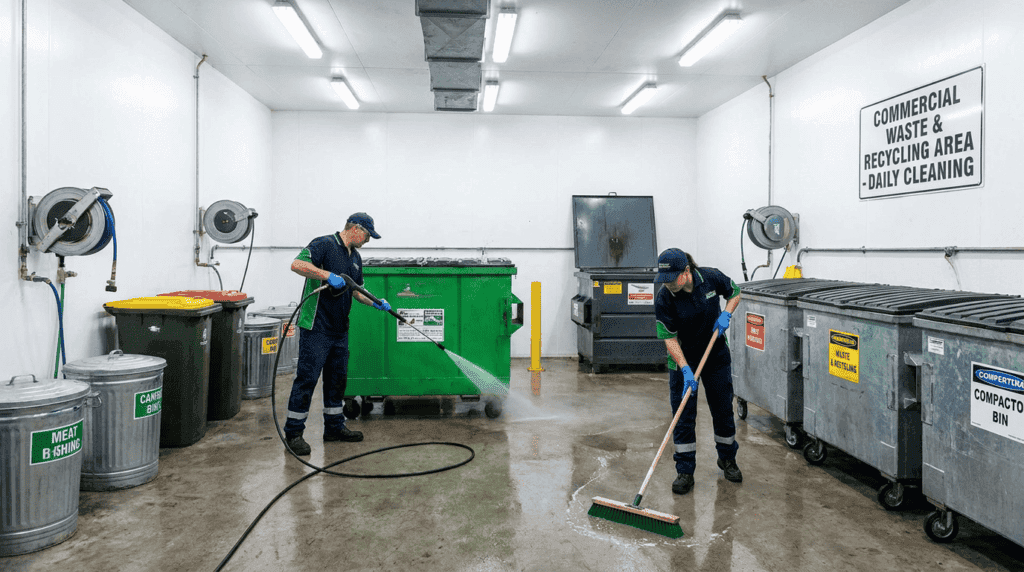
Bin rooms and waste areas are the most neglected part of most commercial and strata properties, and the one most likely to generate odour complaints, pest activity and health concerns. A workable bin room program covers scheduled washing of the room and the bins themselves, drainage maintenance, pest management, correct bin sizing and collection frequency, and clear signage so waste ends up in the right stream.
Nobody puts the bin room in the cleaning scope because nobody wants to think about it. Then it becomes a problem, and the problem is always more expensive than the program would have been.
Why bin rooms deteriorate so quickly in a subtropical climate
Warmth accelerates decomposition, humidity keeps surfaces damp, and the Sunshine Coast supplies both for most of the year. An enclosed bin room in February is a very different environment from the same room in July.
The compounding factors are usually structural:
- Poor ventilation. Many bin rooms are sealed for security or amenity, which traps odour and moisture.
- No floor waste, or a dry trap. Without drainage, the room cannot be washed properly. With a dry trap, sewer gas comes back into the room.
- Undersized bins or infrequent collection. Overflow means waste on the floor, which means leachate, odour and vermin.
- Bins never washed. The bin interior is the actual odour source in most cases, not the room.
- Unsealed concrete. Porous floors absorb leachate and hold odour permanently.
- No responsibility assigned. The waste contractor empties bins; the cleaner cleans the building; nobody cleans the bin room.
What a bin room cleaning program should include
Weekly to fortnightly
- Sweep and remove loose waste from the floor and around bins
- Wash the floor with a suitable degreaser and deodoriser
- Flush the floor waste and check the trap holds water
- Wipe door handles, light switches and bin lids as touch points
- Check for spills, leaks and pest evidence
Monthly to quarterly
- Full pressure wash of the room including walls to at least two metres, with wash water managed appropriately
- Bin washing — interior and exterior, with a sanitiser and deodoriser
- Degrease around any grease trap or food waste area
- Clear and check drainage grates and channels
- Inspect and clean ventilation grilles
Annually
- Deep clean of walls, ceiling and pipework
- Re-seal the floor if it is porous concrete — the single most effective long-term fix for a persistent odour problem
- Review bin sizing and collection frequency against actual volumes
- Review and replace signage
Managing wash water correctly
Bin room wash water contains organic matter, leachate, grease and detergent. Under the Environmental Protection Act 1994 (Qld), it is prohibited to deposit a prescribed water contaminant into stormwater drains, roadside gutters or waterways, or to deposit contaminants where they could wash or move into a stormwater drain. Sunshine Coast Council investigates stormwater pollution complaints and specifically names mobile cleaning and trade businesses.
In practice this means:
- Wash bin rooms that drain to sewer, where a compliant connection exists
- Where the room drains to stormwater, capture and recover the wash water rather than letting it run
- Never wash bins in a car park or driveway that drains to a stormwater grate — see commercial car park cleaning
- Ask any bin washing contractor exactly where the water goes — mobile bin washing services should be capturing and containing it
Pest management: bin rooms are the entry point
Rodents, cockroaches and flies in a commercial or residential building almost always trace back to the waste area. Cleaning is the primary control — removing the food source is more effective than any treatment.
- Eliminate spillage and leachate. Nothing on the floor, ever.
- Keep bin lids closed. Which requires bins that are not overfull, which requires correct sizing.
- Seal gaps. Under doors, around pipe penetrations, in wall junctions.
- Remove cardboard. Flattened cardboard stacked against a wall is prime harbourage.
- Coordinate with your pest contractor. Baiting placed where cleaning washes it away achieves nothing.
- Act on early evidence. Droppings, gnaw marks and smear marks are far easier to address than an established infestation.
Recycling and waste streams: getting it right at the bin
Contamination is the main reason commercial recycling fails. A recycling bin contaminated with general waste is usually charged as general waste, so poor separation costs money directly.
- Signage at eye level, with pictures. Text-only signage on the bin lid does not work. Images of the actual items, in the language mix of your building.
- Consistent colours. Follow the Australian standard colour convention — red or dark lid for general waste, yellow for commingled recycling, green for organics, and blue for paper and cardboard where a separate stream exists.
- Match the bins to the waste you actually generate. An office producing mostly paper and cardboard needs capacity there, not an oversized general waste bin.
- Place bins where the waste is generated. People use the nearest bin.
- Separate cardboard. It is bulky, it fills general waste bins fast, and it usually has a lower disposal cost as a separate stream.
- Consider organics. Cafes, food businesses, childcare and aged care generate significant organic waste, and separating it removes the main odour source from general waste.
Bin sizing and collection frequency
Most overflowing bin rooms are a sizing problem wearing a cleaning problem’s clothes. Before increasing the cleaning frequency, check:
- Are bins full at collection, or overflowing before it?
- Is one stream consistently full while another is half empty?
- Has the building’s occupancy or use changed since the waste contract was set?
- Are there seasonal peaks — Christmas retail, end of financial year, a fitout?
Adding one collection a week is frequently cheaper than the cleaning, pest control and complaint handling caused by the shortfall.
Strata bin rooms: a specific case
Residential and mixed-use strata bin rooms are the hardest of all, because usage is constant, anonymous and unsupervised. On the Sunshine Coast, where many schemes have short-term letting alongside permanent residents, the mix of users makes signage and frequency even more important.
The body corporate is responsible for maintaining common property in good condition, and a bin room is common property. Practical measures that work:
- Increase cleaning frequency — weekly is a minimum for a residential scheme of any size
- Clear pictorial signage in the bin room and in the lift lobby
- Include waste instructions in the welcome pack for new residents and holiday lets
- Ensure lighting works — dark bin rooms get used carelessly
- Provide adequate capacity for bulky items and a process for disposing of them, or they will be left beside the bins
- Seal the floor, which pays for itself in odour reduction
See our strata and body corporate cleaning services for how bin rooms usually sit within a common area scope.
Frequently asked questions
How often should a commercial bin room be cleaned?
Weekly to fortnightly for washing the floor and removing loose waste, with a full pressure wash and bin washing monthly to quarterly. Food businesses, childcare, aged care and residential strata need the higher end of that range, particularly during summer.
Why does our bin room smell even after cleaning?
Usually the bins themselves rather than the room, or a porous unsealed concrete floor that has absorbed leachate, or a dry floor waste trap letting sewer gas back in. Wash the bins, seal the floor and keep the trap charged — in that order.
Who is responsible for cleaning the bin room?
Your waste contractor empties bins; they generally do not clean the room or the bins. In a leased building it usually falls to the landlord as common area maintenance. In strata it is the body corporate. In an owner-occupied building it is you. It needs to be explicitly named in someone’s scope of works.
Can bins be washed on site?
Yes, by a mobile bin washing service or as part of a cleaning contract — provided the wash water is captured and managed rather than discharged to stormwater. Confirm the contractor’s water management before they attend.
How do we reduce recycling contamination?
Pictorial signage at eye level, consistent bin colours, bins located where the waste is generated, and capacity matched to actual volumes. Contaminated recycling is usually charged as general waste, so this has a direct cost impact.
Should the bin room floor be sealed?
Yes, if it is bare concrete. Unsealed concrete absorbs leachate and holds odour permanently, and no cleaning frequency will overcome it. Sealing is a one-off cost that resolves a recurring complaint.
Get the waste area onto a schedule
If your bin room is generating complaints, we can assess it, identify whether the issue is cleaning, sizing, drainage or the floor itself, and put it on a program with the wash water handled properly. Contact Divine Commercial Cleaning for a bin room and waste area assessment.

Dianne, originally from Rockhampton, hails from a business-oriented family, with her father owning electrical stores and her uncle serving as Mayor. Moving to the Sunshine Coast at 13, she later pursued a rewarding real estate career and raised three children. As a single mom, she balanced university studies with domestic cleaning work. Armed with a Bachelor’s Degree in Business, majoring in Supply Chain Management, Dianne founded and grew Divine Commercial Cleaning into a thriving company. Her success is rooted in strong family mentorship, a positive attitude, and a solution-oriented approach, offering tailored cleaning services with integrity and strategic insight.