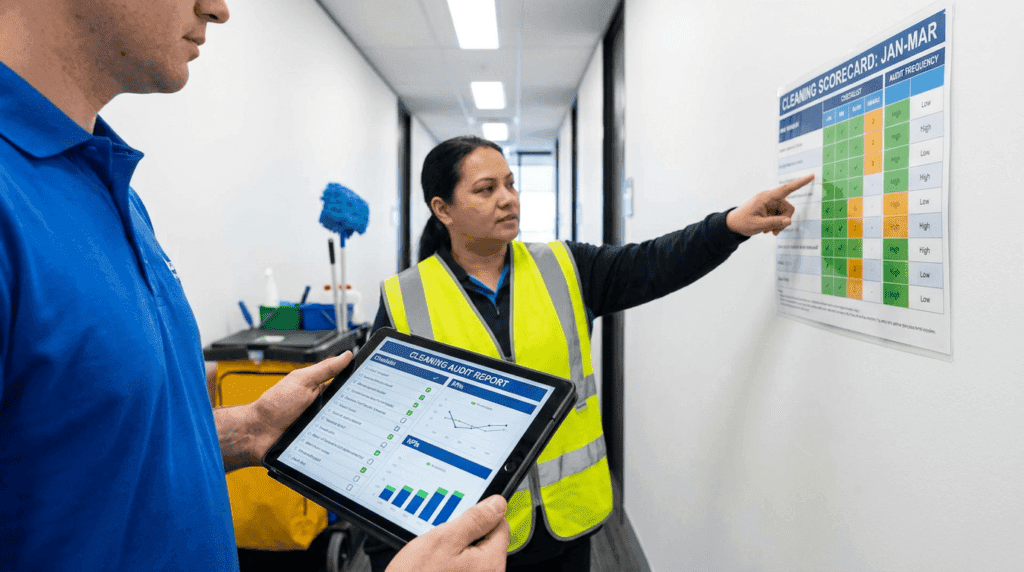
A commercial cleaning audit is a scheduled, scored inspection of a site against its written scope of works. It converts ‘the cleaning isn’t great lately’ into a number you can act on, and it gives a contractor a fair, objective way to demonstrate performance instead of relying on the absence of complaints.
Most Sunshine Coast businesses never audit their cleaning contract. The result is a relationship managed entirely by exception: nothing is said until someone is annoyed, and then the conversation is emotional rather than evidential. A twenty-minute monthly walk fixes that.
Why ‘no complaints’ is a poor measure of cleaning performance
Complaints measure visibility, not cleanliness. Staff notice an overflowing bin and a dirty toilet. They do not notice that skirtings have not been detailed in eight months, that the vacuum’s filtration is shot, or that the sealer on the vinyl has worn through in the traffic lane and the floor is now absorbing soil it cannot release.
By the time those become visible, the fix is a capital-cost restoration rather than a maintenance task. Auditing catches them while they are still cheap.
The three things a cleaning audit should measure
- Task completion. Was the scoped task done at the scoped frequency?
- Task quality. Was it done to an acceptable standard?
- Condition trend. Is the underlying asset — carpet, hard floor, grout, glass — improving, holding or degrading?
The third is the one people forget, and it is the one with the largest financial consequence. A site can score well on daily tasks for two years while its floor coverings quietly reach the point of replacement.
A simple scoring method that works
You do not need audit software. A four-point scale applied to a fixed list of zones is enough, and it is defensible because everyone can see how the score was reached.
| Score | Meaning | Action |
|---|---|---|
| 3 — Meets standard | Scoped task complete, no visible defects | None |
| 2 — Minor defect | Task done, isolated misses (one smeared pane, dust on one ledge) | Note; rectify next clean |
| 1 — Below standard | Task partially done or repeated misses across the zone | Rectify within 48 hours; re-inspect |
| 0 — Not done | Scoped task not performed | Rectify immediately; formal note on file |
Score each zone rather than each task, and record a one-line note for anything below 3. A typical office audit sheet has 10 to 15 zones: entry, reception, open plan, each meeting room, kitchen, each washroom, corridors, lift and lobby, store, external entry.
Express the result as a percentage of available points. Set the acceptable threshold in the contract — 90% is a reasonable benchmark for a routine commercial site — and define what happens below it.
Cleaning KPIs worth writing into a contract
Keep the KPI set small. Five measurable indicators beat twenty aspirational ones.
- Audit score. Monthly or quarterly, minimum 90%, walked jointly at least twice a year.
- Rectification time. Routine misses rectified at the next scheduled clean; safety or hygiene issues within four hours during business hours.
- Response time. Acknowledgement of a written request within one business day.
- Periodic works completion. Scheduled carpet, floor and window works completed within the agreed month, evidenced by a report.
- Consumable stockouts. Zero unplanned stockouts of toilet paper, hand towel or soap per quarter.
Optional additions for larger or regulated sites include site attendance records, supervisor attendance frequency, and completion of documented cleaning records where a regulator may ask to see them — relevant to medical centres, childcare services and aged care providers.
How often should you audit?
| Site type | Suggested audit frequency |
|---|---|
| Small single-tenancy office (under 300 m²) | Quarterly, plus one joint walk annually |
| Mid-size office or professional suite | Monthly self-audit, quarterly joint walk |
| Medical, dental or allied health practice | Monthly, with documented records retained |
| Childcare or education | Monthly, aligned to your own health and safety checks |
| Strata and body corporate common areas | Monthly, reported to the committee |
| Shopping centre or high-traffic retail | Fortnightly, plus daily presentation checks |
| Gym or fitness facility | Monthly, with equipment sanitisation spot checks |
What to look at that people usually miss
Anyone can see whether a bin was emptied. These are the checks that reveal whether the contract is genuinely being delivered:
- Skirtings and door frames. The reliable indicator of whether detail cleaning is happening at all.
- Chair bases and desk legs. Dust here means vacuuming is being done at speed around furniture, not under it.
- Carpet traffic lanes under raking light. Stand at one end of a corridor and look along the floor, not down at it. Greying lanes signal that steam cleaning intervals are too long.
- Grout colour variation. Compare grout under a cupboard toe-kick with grout in the open. If they differ noticeably, the floor is holding soil.
- Hard floor sheen in traffic lanes. A dull path through a glossy floor means the sealer is wearing through and a strip and seal is due before the substrate is damaged.
- Air vents and light diffusers. Grey furring means high dusting is not on rotation.
- Washroom under-rim and behind the pan. The most reliable single indicator of daily clean quality. See commercial washroom cleaning.
- Glass at eye height versus low level. Clean at 1.6 m and dirty at 0.4 m means the cleaner is not bending.
- Cleaner’s store. Colour-coded cloths, labelled bottles, a mop that has been laundered. A chaotic store almost always predicts a chaotic clean.
Running the audit so it improves things rather than sours them
The point is correction, not prosecution. A few practical rules:
- Walk it jointly at least twice a year. Standards drift because expectations differ. Walking together aligns them faster than any email.
- Audit at a consistent time. A site audited at 4pm on a Friday will always score worse than the same site at 9am on a Tuesday. Pick one and stay with it.
- Separate scope failures from quality failures. If a task was never in the scope, that is your document to fix, not the cleaner’s performance.
- Record trends, not just scores. Three consecutive 88% results with the same zone dragging is a specific, solvable problem.
- Close the loop. Every item below 3 gets a rectification date and a tick when done.
When audit scores stay low
Persistently low scores usually have one of four causes, and it is worth diagnosing which before escalating:
- Under-scoped hours. The task list cannot be completed in the time the price funds. Fix the scope or the price.
- Wrong equipment. Poor vacuum filtration, worn mop heads, no scrubbing machine on a floor that needs one.
- Staffing instability. Constant turnover with no induction. Ask for a named cleaner and a documented induction.
- Deferred periodic works. Daily cleaning cannot compensate for carpet, grout or sealer that is overdue for restoration.
Only after ruling those out is it fair to conclude the contractor is simply not performing — at which point our guide to changing commercial cleaning companies sets out how to move on cleanly.
Frequently asked questions
What is a good cleaning audit score?
For a routine commercial site, 90% or above against a well-written scope is a reasonable standard. What matters more than the absolute number is the trend and whether items below standard are being closed out.
Who should carry out the audit — us or the cleaning company?
Both, and jointly at least twice a year. Contractor self-audits catch issues early and are perfectly legitimate; client audits keep the self-audits honest. The joint walk is where expectations get calibrated.
Do we need audit software?
Not for most sites. A one-page zone-scored sheet, dated and filed, does the job. Software is worth considering for multi-site portfolios or where you need auditable records for a regulator.
Should KPIs have financial consequences?
For most small and mid-size contracts, a rectification obligation and a right to terminate after repeated failures is sufficient. Abatement regimes add administration that rarely pays for itself below a certain contract value.
How do audits work for strata and body corporate properties?
The committee or building manager audits common areas — lobbies, lifts, corridors, bin rooms, car park, pool surrounds — and the report goes into the committee pack. It gives the committee something concrete to point to at general meetings and helps justify the cleaning line in the administrative fund budget. See our strata cleaning services for how common area scopes are usually structured.
How long does an audit take?
Fifteen to thirty minutes for a standard office. An hour for a larger multi-zone site. If it is taking longer, the zone list is too granular.
Put a measurement system around your cleaning contract
If your current contract has no audit process, we can set one up — a zone list, a scoring sheet and a schedule you can run yourself, whether or not we do the cleaning. Contact Divine Commercial Cleaning to arrange a site walk and a first baseline audit.

Dianne, originally from Rockhampton, hails from a business-oriented family, with her father owning electrical stores and her uncle serving as Mayor. Moving to the Sunshine Coast at 13, she later pursued a rewarding real estate career and raised three children. As a single mom, she balanced university studies with domestic cleaning work. Armed with a Bachelor’s Degree in Business, majoring in Supply Chain Management, Dianne founded and grew Divine Commercial Cleaning into a thriving company. Her success is rooted in strong family mentorship, a positive attitude, and a solution-oriented approach, offering tailored cleaning services with integrity and strategic insight.