
If you have asked two commercial cleaning companies to quote the same building, you have probably noticed something frustrating: the numbers can differ by thousands of dollars a year. Not because one is dishonest, but because they are quoting two different jobs.
You will not find a price list on this page. Any number quoted before someone has walked your site is a guess, and a guess is not much use when you are the one signing the contract. What this page does instead is show you exactly what a cleaning company is looking at when it builds your number — so that when the quotes land on your desk, you can read them properly and compare them fairly.
Why two quotes for the same building differ so much
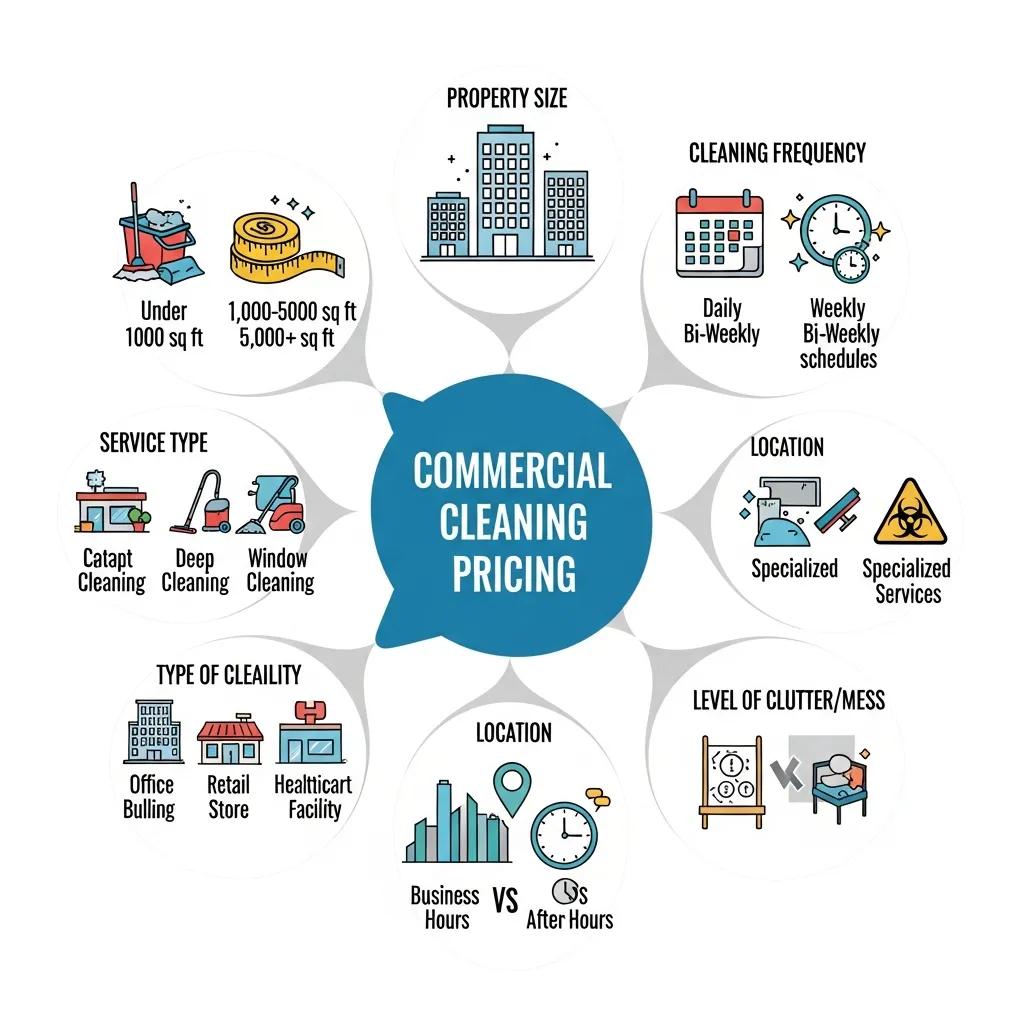
A commercial cleaning quote is not a price for a building. It is a price for a defined list of tasks, performed at a defined frequency, within a defined window of access, with a defined split on who supplies what.
Change any one of those four and the number moves. Most of the time, when two quotes are far apart, it is because one of them quietly assumed less work. The cheaper quote might exclude consumables, skip the internal glass, do the bathrooms less often, or leave periodic floor work out entirely and bill it separately later.
That is why comparing headline figures alone is close to meaningless. The useful comparison is scope against scope.
What actually moves your number
1. Floor area — but not on its own
Area is the starting point, not the answer. A thousand square metres of open-plan warehouse and a thousand square metres of partitioned consulting rooms are entirely different jobs. The warehouse is a small number of long, uninterrupted runs. The consulting rooms are dozens of doors, corners, skirtings, handles and edges, and every one of them takes time.
2. Layout and room count
The more the space is divided, the longer it takes. Cellular offices, treatment rooms, classrooms and individual units all multiply the touchpoints — door handles, light switches, desk edges, basin taps. Open-plan space with shared amenities is proportionally quicker to service than the same floor area chopped into small rooms.
3. What the floors are made of
Floor surface is one of the largest single variables, and the one most often missed when people compare quotes. Carpet, vinyl, tile and grout, timber and polished concrete each need different equipment, different methods and different periodic cycles.
Vinyl that needs stripping and sealing on a cycle carries a cost that tile and grout does not. Carpet that needs periodic steam extraction carries a cost that sealed hard floor does not. A quote that ignores your floor type is a quote that will be revised later.
4. What kind of facility it is
Different sectors carry different expectations, and those expectations take time to meet. A medical or imaging centre has infection-control expectations that a warehouse does not. A childcare centre has surfaces at toddler height and a regulator that takes an interest. A gym has equipment, mirrors and high-touch contact surfaces throughout. A strata common area has lifts, lobbies, bin rooms and residents who notice.
Divine works across thirteen service areas — carpet cleaning, daycare and schools, flood restoration, gym and dance studios, medical and health centres, pressure washing, professional offices, shopping centres, strata and body corporate, strip and seal flooring, tile and grout cleaning, x-ray and imaging centres, and window cleaning. Each of those carries its own scope of works, and the scope drives the price.
5. How often you want us on site
Frequency is your decision, not ours, and it is the single biggest lever you control. Daily service costs more than three visits a week, which costs more than weekly. There is no universally correct answer — it depends on your headcount, your foot traffic, the nature of your work and how much your own team handles in between.
We will give you a recommendation based on what we see when we walk the site. We will not tell you that you need daily service when you do not.
6. What your own staff already do
This one is routinely overlooked and it genuinely changes the number. If your team wipes down the kitchen, runs the dishwasher and empties desk bins, that work does not need to be in the contract. If nobody touches anything between cleans, it does.
Be honest about this when you are quoted. Overstating what your staff will do produces a cheap quote and a dirty building.
7. When we can get in
Access hours matter. Cleaning that happens during business hours works around people and moves slowly. Cleaning after hours moves faster but may carry different rates. Weekend or public-holiday work is different again.
Sites with alarm systems, key registers, swipe access, security escorts or restricted zones all add coordination that has to be accounted for. So does a site where the cleaner has to work around a shift that never fully ends.
8. Consumables — in or out
Hand towel, toilet paper, bin liners, soap, sanitiser. Someone has to buy them, and a quote that includes them will look higher than one that does not, for exactly the same cleaning.
This is the most common reason two quotes look different when they are not. Always ask which of the two you are looking at.
9. Periodic work versus routine work
Routine cleaning is what happens every visit. Periodic work happens on a cycle — carpet steam cleaning, strip and seal, high-pressure washing, external and internal window cleaning, tile and grout restoration.
Some providers fold an allowance for periodic work into the monthly figure. Others quote routine only and invoice periodic work as it arises. Neither is wrong, but if you compare a quote that includes it against one that does not, you are not comparing anything meaningful.
Working out your own cost per square metre
Cost per square metre is the figure most people go looking for, and it is genuinely useful — but as a way of comparing your own quotes against each other, not as a number you can look up and hold a provider to.
To work out your own, take the annual figure from a quote and divide it by your cleanable floor area. Cleanable area is not the same as your lease area: it excludes plant rooms, lift shafts, risers, car parks and any space nobody cleans. Using lease area instead will flatter every quote equally and tell you nothing.
Do that for each quote and you have a like-for-like figure — but only if the scope behind each one is the same. A low rate per square metre on a quote that excludes consumables, bathrooms twice a week and all periodic floor work is not a bargain. It is a smaller job.
Two things to keep in mind. The rate almost always falls as area rises, because setup, travel and equipment time spread across more floor — so a small tenancy will look expensive per square metre and may still be priced correctly. And surface mix can swing the figure more than area does, which is why a benchmark from another building tells you less than you would like.
What a proper scope of works looks like
The scope of works is the document that actually governs your cleaning. The quote is just its price. If you only ask for one thing before signing, ask for this.
A scope worth signing names:
- Every area — reception, open-plan areas, individual rooms, amenities, kitchen or staff room, lifts, stairwells, external entry.
- Every task, under its area — not “clean bathrooms” but the tasks that make up cleaning a bathroom.
- A frequency against each task, not just against the visit. Bins every visit, glass partitions weekly, skirtings monthly — that level.
- Periodic services named, with their cycle, and whether they are inside the quoted figure or billed separately.
- The consumables split, stated plainly.
- Access arrangements — hours, keys, alarms, who holds what.
- The escalation route — who you contact, and what happens next.
A provider who will not put this in writing before you sign is asking you to trust a verbal description of a service you are about to buy for a year. The scope is also what protects you later: when something is missed, a documented task list turns an argument into an administrative matter.
What is usually not in a commercial cleaning quote
Knowing the boundaries is as useful as knowing the inclusions.
- Clinical waste and sharps. Divine does not handle these. They stay with your licensed waste contractor, which is where they belong.
- Services we do not offer. We are specific about our thirteen service areas. If something falls outside them, we will tell you rather than take the work and subcontract it blind.
- Trade work. Plumbing, electrical, pest control, grounds maintenance and window repairs are separate trades.
- Anything your own protocols require of your own staff. In clinical settings especially, your practice’s own protocols come first, and there will be tasks your team keeps.
How to compare two quotes fairly
Put the quotes side by side and work through this list. If a quote cannot answer these, that is information in itself.
- Is the task list identical? Ask for the scope of works in writing, task by task, with the frequency of each task — not just a visit frequency.
- Are consumables in or out? And if in, at what usage assumption?
- Is periodic work included, allowed for, or excluded? Ask which periodic services, on what cycle.
- What are the access hours? And what changes if you need them shifted later.
- Is the provider insured, and for how much? Ask for the certificate of currency, not a yes.
- Are the cleaners police-checked? If your site is a medical centre, a childcare centre or a school, this is not optional.
- Who is actually attending? The same person each visit, or whoever is free that night?
- What happens when quality slips? Ask for the process, not a reassurance.
- What are the exit terms? How much notice, and is there a lock-in period.
- What is the price review mechanism? When can it change, by how much, and on what notice.
Questions worth asking before you sign
- Will you walk the site before quoting, or is this quoted off a floor plan?
- What happens if my regular cleaner is unavailable?
- How do I raise an issue, and how quickly is it answered?
- Do I get a record of what was done on each visit?
- Do you clean around our trading hours or do we need to give you the building?
- Who is my point of contact, and are they the person who quoted?
If you are changing cleaning companies
Most businesses do not go looking for a new cleaner because of price. They go looking because standards slipped, because nobody answered the phone, or because the person who sold the contract was never seen again.
If you are in that position, a few things are worth doing before you switch.
Check your notice period first — most commercial cleaning agreements carry one, and you want the new provider starting as the old one finishes, not three weeks later. Get your keys, fobs and alarm codes back in writing, and have the alarm code changed on handover. Ask the incoming provider to walk the site while the outgoing one is still attending, so the quote reflects the building as it actually is rather than as it will be after a fortnight without service.
And be candid with the new provider about what went wrong. A cleaner who knows the bins were the recurring complaint will build the scope around the bins.
How Divine quotes
We walk the site. We look at the floor surfaces, the layout, the amenities, the access and the things your own team already handles. We ask what has not worked with previous providers. Then we put a scope of works in writing — task by task, with the frequency against each — and quote against that scope.
If we think you are asking for more service than you need, we will say so. If we think the frequency you have in mind will not hold the standard you want, we will say that too.
What comes with the work: cleaners who are police-checked, full insurance, a documented checklist completed after every clean, a client portal so you can see what was done, a quality manager visit every ninety days, and no lock-in contract. We require separate mops and cloths for bathrooms, and bathroom cloths are not used anywhere else in your building.
Divine Commercial Cleaning is a family-owned business based in Birtinya, working across the Sunshine Coast, and some of our client relationships have run for years.
Frequently asked questions
Why will you not publish your prices?
Because a published rate would be wrong for almost everyone who reads it. Two buildings of identical size can differ by a factor of two on scope alone. We would rather walk your site and give you a number that holds than publish one that has to be revised.
Is commercial cleaning charged hourly or by the job?
Both models exist in the industry. What matters more than the model is whether the scope of works is defined. An hourly rate with no task list, and a fixed monthly figure with no task list, are equally difficult to hold anyone to.
Does a bigger building always cost more?
Usually, but not proportionally. Cost per square metre generally falls as area rises, because setup, travel and equipment time are spread across more space. Layout and surface type can easily outweigh raw floor area.
How often should my site be cleaned?
It depends on headcount, foot traffic, the nature of the work and how much your own staff do in between. We will recommend a frequency after seeing the site — it is your call, and we will not push you to a schedule you do not need.
Do you supply the consumables?
We can, or you can. It is a line item either way, and we will make clear which arrangement your quote assumes so you can compare it against anyone else’s.
Do you handle clinical waste or sharps?
No. Those stay with your licensed waste contractor. We clean around them.
Do I have to sign a lock-in contract?
No. We do not use lock-in contracts.
Get a quote for your site
Tell us what kind of facility you run, roughly how big it is, and when we can get in. We will walk the site, put a scope of works in writing, and quote against it.
Call 0459 949 969 or request a quote.

Dianne, originally from Rockhampton, hails from a business-oriented family, with her father owning electrical stores and her uncle serving as Mayor. Moving to the Sunshine Coast at 13, she later pursued a rewarding real estate career and raised three children. As a single mom, she balanced university studies with domestic cleaning work. Armed with a Bachelor’s Degree in Business, majoring in Supply Chain Management, Dianne founded and grew Divine Commercial Cleaning into a thriving company. Her success is rooted in strong family mentorship, a positive attitude, and a solution-oriented approach, offering tailored cleaning services with integrity and strategic insight.