
A commercial cleaning scope of works is a written document that defines exactly what will be cleaned, how often, to what standard, and who is responsible for supplying consumables and equipment. It is the single most useful thing a business owner or facility manager can prepare before requesting quotes, because it turns wildly different proposals into a genuine like-for-like comparison.
Most disputes between businesses and their cleaners on the Sunshine Coast are not caused by bad cleaning. They are caused by a vague brief. If the contract says ‘clean the kitchen’ and nobody wrote down whether that includes the inside of the microwave, the fridge or the rangehood filter, both parties are right and both parties are frustrated.
What a scope of works should contain
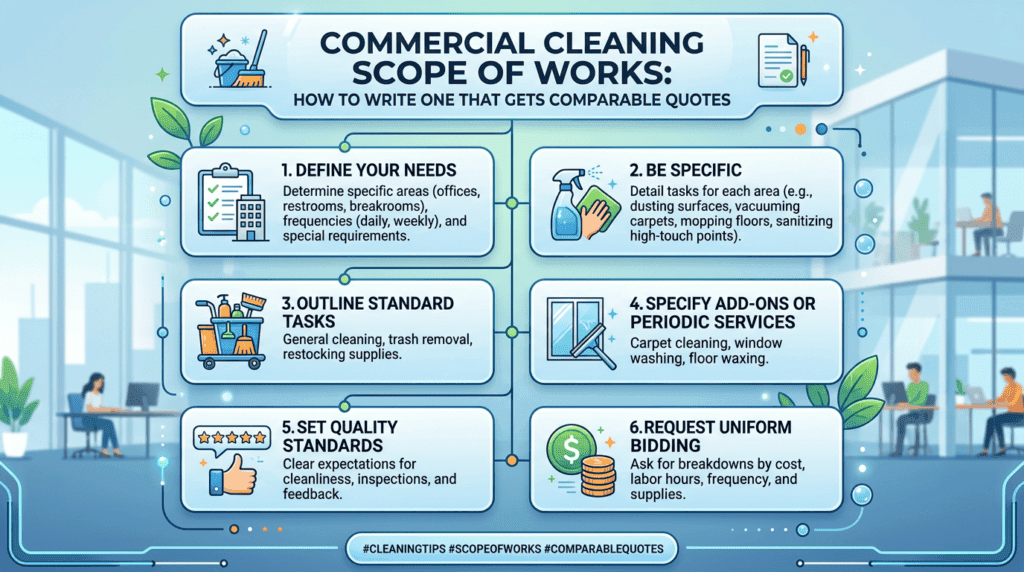
A workable scope of works has six parts. You do not need a legal document — a well-structured two to four page schedule is enough for most Sunshine Coast sites.
- Site details. Address, floor area, number of levels, access arrangements, alarm and key procedures, parking, hours the site is available, and any areas that are out of bounds.
- Area-by-area task lists. Broken down by room or zone rather than by task type. Reception, open-plan office, meeting rooms, kitchen, washrooms, corridors, lifts, external entry.
- Frequencies. Daily, three times weekly, weekly, fortnightly, monthly, quarterly, annually. Each task gets a frequency.
- Periodic and specialist works. Carpet steam cleaning, hard floor strip and seal, window cleaning, high dusting, pressure washing of external areas. These are usually priced separately.
- Consumables and equipment. Who buys and stocks toilet paper, hand towel, soap, bin liners and sanitiser. Who supplies vacuums, scrubbers, chemicals and ladders.
- Standards and reporting. How performance will be measured, how faults are reported, and how often the scope will be reviewed.
How to set cleaning frequencies that actually match your site
Frequency is where most budgets are won or lost. The honest answer is that frequency should follow foot traffic and risk, not habit.
| Area | Typical frequency | What drives it up |
|---|---|---|
| Washrooms and amenities | Daily | Headcount, public access, food handling on site |
| Kitchen and staff breakout | Daily | Shared appliances, on-site lunches, pest risk |
| Reception and entry | Daily | Client-facing, sand and salt tracked in from coastal sites |
| Open-plan desks and hot desks | Daily to weekly | Desk sharing, illness season, sit-stand desk turnover |
| Meeting rooms | Daily to weekly | Booking volume, catering |
| Carpet steam cleaning | 6–12 monthly | Traffic lanes, ground-floor entries, wet season |
| Hard floor strip and seal | 12–24 monthly | Trolley traffic, sealer wear, slip resistance |
| Internal glass and partitions | Monthly to quarterly | Fingerprints, pets, children |
| External windows | Quarterly to 6 monthly | Proximity to the beach, salt spray, construction dust |
| High dusting and vents | Quarterly to 6 monthly | Ceiling height, air-conditioning type, allergy complaints |
Beachfront and near-coastal sites at Mooloolaba, Alexandra Headland, Kings Beach and Noosa Heads almost always need external glass and entry matting attended to more often than an equivalent building at Kunda Park or Sippy Downs. Sand, salt spray and afternoon sea breeze put a measurable extra load on entries and glazing.
Frequencies also vary by facility type. A medical centre or childcare service works to clinical and regulatory frequencies that a standard office does not, and a strata property has to account for common areas nobody individually owns.
Writing tasks so they cannot be misread
Write the outcome, not the verb. ‘Clean the kitchen’ is unmeasurable. ‘Wipe all bench tops, sink, splashback, front of cupboards, appliance exteriors including microwave interior; empty and reline bins; mop floor’ is measurable by anyone standing in the room.
A few phrasings that consistently prevent arguments:
- Name the surfaces. ‘Spot clean glass entry doors including push plates and handles’ rather than ‘clean doors’.
- State inclusions and exclusions. ‘Desks cleared of loose paper are wiped; desks with personal items are dusted around only.’
- Define the trigger for as-required tasks. ‘Replace hand towel when the dispenser falls below one third.’
- Separate detail cleans from daily cleans. Skirtings, door frames, chair bases and vents belong on a monthly rotation, not on a daily list nobody can complete in the allotted hours.
Where scopes commonly go wrong
Hours are specified instead of outcomes
A brief that says ‘two hours per night’ tells a contractor nothing about what you expect and gives you nothing to hold them to. Specify the work; let the contractor tell you how long it takes.
Consumables sit in a grey zone
Decide early whether consumables are supplied by you at cost, supplied by the cleaner and on-charged, or included in the rate. Each is legitimate. Leaving it unstated guarantees an argument in month three.
Periodic works get buried in the monthly rate
Carpet cleaning, strip and seal and external window cleaning have very different costs depending on the site. Quote them separately so you can see what you are actually paying, and so you can move them to suit your budget cycle.
Nobody defines ‘as required’
If a task appears with the frequency ‘as required’, add the condition that triggers it. Otherwise it will not happen, and neither party will be able to prove it should have.
The scope is never reviewed
Fitouts change, headcounts change, tenancies change. A scope written for 18 staff on one floor does not fit 34 staff across two. Build in a six-monthly review.
A simple scope of works structure you can copy
For a typical Sunshine Coast professional office, the structure below is enough to get accurate, comparable quotes:
- Section 1 — Site information. Address, area in square metres, levels, headcount, access hours, security, parking, contact for faults.
- Section 2 — Daily tasks by area. Reception, offices, meeting rooms, kitchen, washrooms, corridors.
- Section 3 — Weekly and fortnightly tasks. Detail vacuuming, skirtings, internal glass, hard floor machine scrub.
- Section 4 — Monthly and quarterly tasks. High dusting, vents, chair bases, external entry pressure washing.
- Section 5 — Periodic works (priced separately). Carpet steam clean, strip and seal, window cleaning.
- Section 6 — Consumables and equipment. Supply responsibility, brands or specifications, restocking method.
- Section 7 — Performance and reporting. Audit frequency, communication method, response time for reactive requests, review date.
What to do once the scope is written
If you also want a task-level starting point, our commercial office cleaning checklist lists the individual tasks most offices need, and you can lift them straight into your area tables.
Send the identical document to every contractor you approach and ask each to price against it without substituting their own template. Any contractor who returns a proposal against their own scope is not comparable, and you should ask them to re-quote. Ask for a site walk-through before pricing — a quote produced without seeing the building is a guess, and guesses get revised upward later.
If you want to sanity-check your draft, a good commercial cleaning contractor will walk your site and mark up your scope for free. At Divine Commercial Cleaning we regularly help Sunshine Coast businesses tighten a scope before they go to market, even when they are also quoting other contractors — a clear brief makes the whole process cleaner for everyone.
Frequently asked questions
What is the difference between a scope of works and a cleaning schedule?
The scope of works defines what is cleaned and to what standard. The schedule defines when it happens — the days, times and rotation. Most contracts contain both, with the schedule usually appearing as a frequency column inside the scope.
Do I need a scope of works for a small office?
Yes, but keep it proportionate. A single-tenancy office of 150 square metres can be scoped properly in two pages. The benefit is the same at any size: comparable quotes and a shared definition of ‘done’.
Who should write the scope — me or the cleaning company?
Ideally you write the first draft and a contractor refines it. If a contractor writes it entirely, you lose the ability to compare quotes, because every contractor will scope to their own strengths. If you have no starting point, ask two contractors for their standard scope, then merge them into your own version.
How detailed should periodic works be?
Detailed enough to price. For carpet cleaning, state the method you expect (hot water extraction, encapsulation), the areas included, and whether furniture moving is in scope. For strip and seal, state the floor type, the number of sealer coats and whether after-hours access is available.
Should the scope include KPIs?
For sites above roughly 500 square metres, or any site with public access, yes. A short audit schedule and an agreed scoring method costs nothing to include and gives both parties an objective way to resolve a complaint.
Can I change the scope mid-contract?
Almost always, provided the contract allows variations in writing. Adding a tenancy, removing a floor or changing frequencies should trigger a repriced schedule rather than an informal agreement.
Get your scope of works reviewed
If you are preparing to go to market for a cleaning contract on the Sunshine Coast, or you suspect your current contract is too vague to enforce, we are happy to walk your site and mark up your scope. Talk to the Divine Commercial Cleaning team about a no-obligation site assessment.

Dianne, originally from Rockhampton, hails from a business-oriented family, with her father owning electrical stores and her uncle serving as Mayor. Moving to the Sunshine Coast at 13, she later pursued a rewarding real estate career and raised three children. As a single mom, she balanced university studies with domestic cleaning work. Armed with a Bachelor’s Degree in Business, majoring in Supply Chain Management, Dianne founded and grew Divine Commercial Cleaning into a thriving company. Her success is rooted in strong family mentorship, a positive attitude, and a solution-oriented approach, offering tailored cleaning services with integrity and strategic insight.