
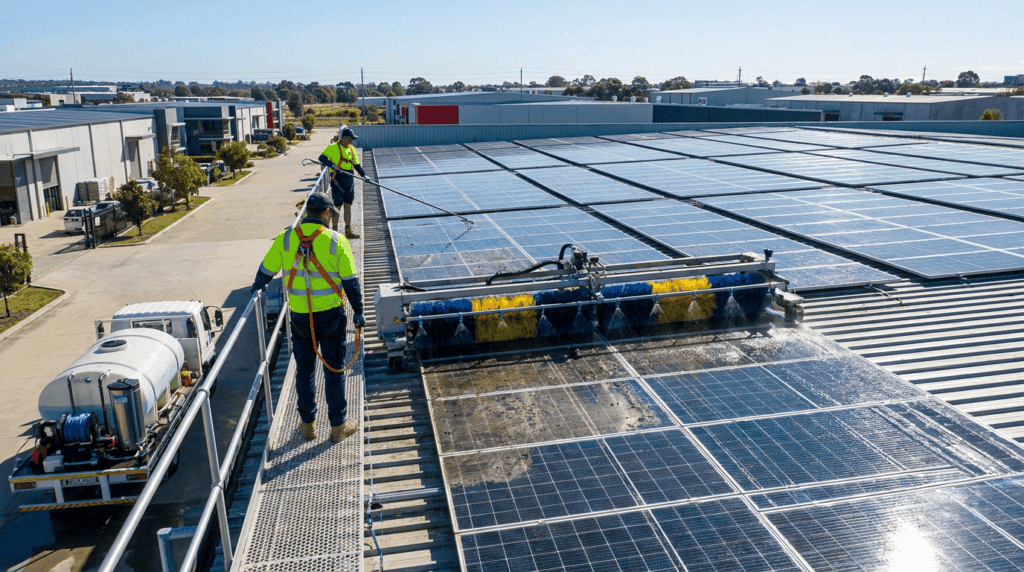
Commercial solar panels lose output when soiling blocks light reaching the cells, and on the Sunshine Coast the main culprits are salt spray, bird droppings, dust from nearby construction or industry, and pollen and organic matter that bonds to the glass during the wet season. Panels are self-cleaning in steady rain only up to a point — anything that adheres to the surface, or accumulates along the bottom edge of the frame where water runs off, stays there.
Commercial rooftop solar is now standard on Sunshine Coast warehouses, retail centres, medical centres, clubs and strata buildings. Very few of those systems are on a cleaning schedule, and most owners have no idea what their array is actually producing relative to what it should be.
Does cleaning solar panels actually improve output?
Yes, when there is measurable soiling — and no meaningfully, when there is not. This is worth being blunt about, because the industry has a habit of overselling it.
Light soiling on a steeply pitched array in a clean-air location that gets regular rain may cost you very little. Heavy, uneven or adhered soiling — bird droppings, lichen along the frame edge, salt film, construction dust, a layer of pollen and sap under a tree — costs considerably more, and the losses are worse than the surface area suggests.
The reason is how panels are wired. Cells are connected in series within strings. Heavy shading of even a small number of cells can drag down the output of an entire string, not just the shaded portion. Bypass diodes limit the damage but do not eliminate it. That is why a handful of bird droppings can have an outsized effect, while an even light dusting has a modest one.
The situations where cleaning most clearly pays
- Bird droppings. Opaque, adhesive, and acidic. The clearest case for cleaning.
- Low-pitch arrays. Panels at shallow angles — common on large flat commercial roofs — shed water and debris poorly and accumulate a soil band along the lower frame.
- Coastal sites. Salt film builds between rain events and holds dust.
- Near construction. Cement and silica dust bond hard once wet and dried.
- Near vegetation. Sap, pollen, leaf litter caught behind the frame, and lichen growth along the frame edge.
- Industrial precincts. Sites at Kunda Park, Warana and Coolum industrial areas pick up particulate that residential roofs do not.
- Extended dry periods. Winter and spring on the Sunshine Coast can go weeks without meaningful rain, allowing soil to accumulate and bond.
How to tell whether your array needs cleaning
- Check your monitoring data. Compare output on clear days across months, and against the same period last year. A gradual downward drift in clear-sky output that recovers after heavy rain is the classic soiling signature.
- Compare strings. If your inverter reports per-string data, an underperforming string often indicates localised soiling or shading rather than a system-wide issue.
- Look at the array from ground level with binoculars. You are looking for droppings, a dark band along the lower frame edge, lichen, and any uneven discolouration.
- Note the last rainfall. If output is down after two weeks of dry weather and recovers after a downpour, soiling is confirmed.
If output has dropped suddenly rather than gradually, or has not recovered after rain, the issue is more likely electrical — an inverter fault, a failed optimiser, a string disconnection — and it needs a licensed solar electrician, not a cleaner.
How commercial solar panels should be cleaned
The method is not complicated, but the wrong method causes real damage — micro-scratching of the glass, disturbed frame seals, water forced into junction boxes, and voided warranties.
- Clean early morning or late afternoon. Cold water on hot glass risks thermal shock. Panels in full afternoon sun on a Queensland summer day are extremely hot.
- Use purified or deionised water. Leaves no mineral residue, which matters because spotting itself reduces transmission.
- Soft brush and telescopic pole where reach allows. Working from the ground or an adjacent safe surface avoids roof access entirely on many single-storey commercial buildings.
- Never use high pressure. Pressure washing can force water past frame seals and into junction boxes, and can damage the anti-reflective coating.
- No abrasives, no solvents, no detergent unless specified by the manufacturer. Most panel manufacturers specify water and a soft brush, and some warranties exclude damage caused by chemical cleaning.
- Never walk on panels. Micro-cracks in cells are invisible and permanently reduce output.
- Clear the surrounds too. Leaf litter and debris trapped under and behind panels holds moisture, promotes corrosion and is a genuine fire consideration on commercial roofs.
Safety and access: the part that decides who can do the job
Roof work is high-risk work, and commercial solar cleaning is roof work in most cases. Before engaging anyone, confirm:
- They hold current public liability insurance and workers’ compensation cover.
- They have a documented working-at-heights control — harness and anchor points, edge protection, or an elevated work platform — and the training to match.
- They will not walk on the panels or on unrated roof sheeting.
- They understand the electrical hazard: panels generate DC voltage whenever there is light on them, and they cannot be ‘switched off’ at the panel. Damaged cabling or junction boxes must be reported, not touched.
- They will report anything unusual — discolouration, delamination, snail trails, hot spots, corroded mounting hardware, loose cable ties — rather than just washing over it.
On many low-rise commercial buildings the entire array can be reached with a telescopic water-fed pole from ground level or a stable adjacent surface, which removes the roof access risk altogether. That should always be the first option considered.
How often should commercial solar be cleaned?
| Situation | Suggested frequency |
|---|---|
| Standard commercial roof, inland, good pitch | Annually |
| Coastal site within ~1 km of the surf | 6-monthly |
| Low-pitch or near-flat array | 6-monthly |
| Near trees, or with regular bird activity | 3–6 monthly |
| Industrial precinct or adjacent to active construction | 3–6 monthly, or after the works finish |
| Agricultural or high-dust surrounds | Quarterly |
The most efficient approach for most Sunshine Coast businesses is a monitoring-led one: set a baseline, watch clear-sky output, and clean when the data says to. An annual clean scheduled at the end of winter, before the highest-yield months, suits many sites as a default.
Combining solar cleaning with other external works
Access is the expensive part of any roof or height work, so it makes sense to bundle. Businesses commonly combine panel cleaning with:
- Gutter and downpipe clearing ahead of storm season
- External window cleaning, particularly on coastal elevations
- Roof, awning and facade washing on salt-exposed buildings
- Pressure washing of car parks, walkways and loading docks
For strata schemes with rooftop solar on common property, scheduling all external works in a single annual visit is usually the cheapest way to keep the committee’s maintenance obligations covered.
Frequently asked questions
How much output do dirty solar panels lose?
It varies widely with the type and evenness of the soiling. Light, even dust has a modest effect; heavy or patchy soiling such as bird droppings has a disproportionate one, because shading a small number of cells can reduce the output of a whole string. The only reliable way to know your losses is to compare clear-sky output before and after a clean.
Doesn’t rain clean solar panels?
Rain removes loose dust on a well-pitched array. It does not remove bird droppings, lichen, sap, salt film or bonded construction dust, and on low-pitch commercial arrays it tends to leave a soil band along the lower frame edge where water pools before running off.
Will cleaning void my solar warranty?
Cleaning done to the manufacturer’s method generally will not. Damage from high pressure, abrasives, unapproved chemicals or walking on panels commonly will. Check your panel manufacturer’s cleaning guidance and give it to whoever does the work.
Can I clean commercial solar panels myself?
Only if the array is safely reachable without roof access and you have the right equipment. Roof-mounted commercial arrays involve working at heights and a live DC electrical installation, and that is not a task for general staff.
What time of day should panels be cleaned?
Early morning or late afternoon, when the glass is cool. Applying cool water to panels that have been in full Queensland sun risks thermal stress on the glass and cells.
Should solar panel cleaning be part of our regular cleaning contract?
It is usually scheduled as a periodic external service rather than part of the routine internal scope, priced per visit and often bundled with gutter clearing and external window cleaning to share the access cost.
Find out whether your array needs attention
If your Sunshine Coast commercial solar system has never been cleaned, or your output has been drifting down, we can assess the array, advise honestly whether cleaning is warranted, and quote it alongside your other external works. Contact Divine Commercial Cleaning to arrange an assessment.

Dianne, originally from Rockhampton, hails from a business-oriented family, with her father owning electrical stores and her uncle serving as Mayor. Moving to the Sunshine Coast at 13, she later pursued a rewarding real estate career and raised three children. As a single mom, she balanced university studies with domestic cleaning work. Armed with a Bachelor’s Degree in Business, majoring in Supply Chain Management, Dianne founded and grew Divine Commercial Cleaning into a thriving company. Her success is rooted in strong family mentorship, a positive attitude, and a solution-oriented approach, offering tailored cleaning services with integrity and strategic insight.