
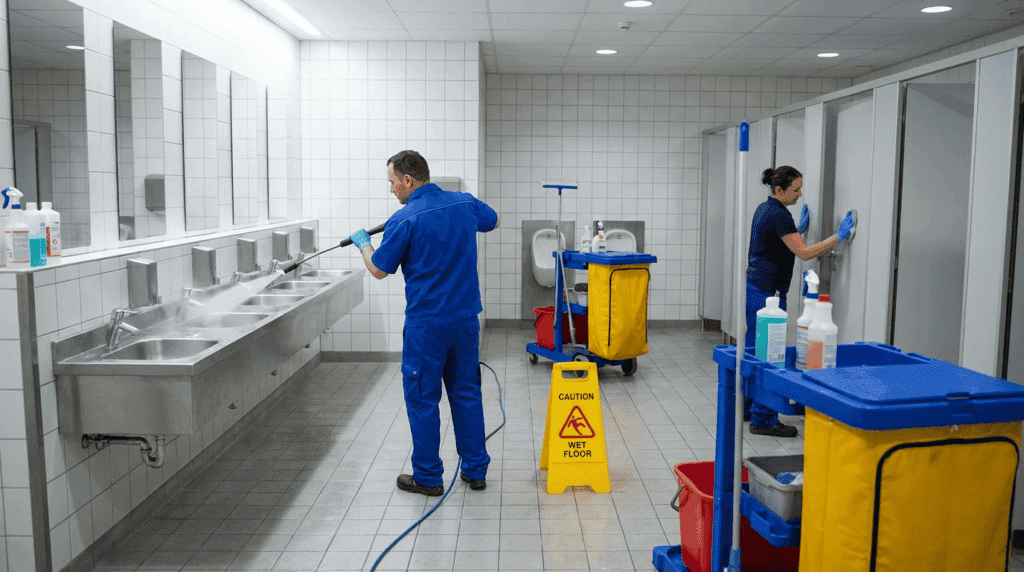
Washrooms are the single strongest signal of overall cleaning standards in any commercial building, and the area most likely to generate a complaint. A properly scoped washroom clean covers pan and urinal interiors including the under-rim, all touch points, dispensers restocked before they run out, floors and drains, extraction, and a periodic descaling program — and it needs the right consumable specification behind it, because most washroom complaints are really consumable failures.
Very few cleaning scopes we review have a washroom section detailed enough to be enforceable. ‘Clean toilets’ appears, and everything that actually causes complaints — under-rim staining, urinal odour, empty dispensers on Friday afternoon, a floor drain that smells — sits outside it.
Why washrooms drive perception disproportionately
Staff and visitors use a washroom close up, alone, and with time to look around. They notice things they would never notice in an open-plan office. A single stained pan or an empty soap dispenser undoes the impression created by an otherwise well-maintained building — and in customer-facing environments such as shopping centres, cafes and medical centres, it directly shapes what people conclude about the business.
What a proper washroom clean includes
Daily
- Pan interior including under the rim, seat top and underside, cistern, flush button and pan exterior including behind the pedestal
- Urinals including the bowl, the wall behind, the divider and the floor immediately in front
- Basins, tapware, splashback and the underside of the vanity
- Mirrors, edge to edge
- All touch points — door handles both faces, lock and indicator, cubicle latches, grab rails, light switches, dispenser levers and push plates
- Dispensers restocked and wiped: toilet paper, hand towel, soap, sanitiser, seat covers, sanitary bin liners
- Bins emptied and relined; sanitary bins checked
- Floor mopped, including behind the door and in cubicle corners
- Floor waste flushed and deodorised
Weekly
- Cubicle partitions washed full height, both faces
- Wall tiles washed to full height
- Skirtings and door frames detailed
- Grout inspected and spot treated
- Extraction grilles wiped
Periodic
- Descaling of pans, urinals and tapware, quarterly to six-monthly depending on water hardness
- Deep tile and grout restoration, annually to two-yearly
- Floor waste and trap servicing
- Extraction fan and duct grille cleaning
- Sanitary bin service, by a licensed provider on a scheduled cycle
Solving washroom odour properly
Persistent washroom odour is almost never fixed by more air freshener. Air freshener masks; it does not remove the source. There are five common sources, and each has a specific fix.
| Source | Sign | Fix |
|---|---|---|
| Uric scale in urinals and pipework | Sharp ammonia smell, worse in warm weather | Acid descale on a schedule; enzyme dosing of the waste line |
| Dry floor waste trap | Sewer smell, worse in rarely used washrooms | Flush the floor waste with water regularly — add it to the daily task list |
| Contaminated grout and floor-wall junction | Smell strongest at floor level near the pan | Deep grout clean; reseal; check the pan-to-floor seal |
| Failed or undersized extraction | Humidity, mirror fogging, mould on the ceiling | Mechanical — service or upgrade the fan; not a cleaning fix |
| Sanitary bins overdue for service | Smell concentrated in cubicles | Increase service frequency |
Work through them in that order. Adding a fragrance dispenser before diagnosing the source produces a washroom that smells like scented urine, which is worse.
Consumables: where most complaints actually originate
An empty dispenser generates more complaints than a mediocre clean. The fixes are unglamorous but effective:
- Restock at a threshold, not on empty. Specify replacement when a dispenser falls below one third. ‘Replace when empty’ guarantees an empty dispenser at some point every week.
- Match capacity to peak demand. A single-roll dispenser in a busy washroom will run out. Multi-roll or jumbo dispensers with a reserve solve it structurally.
- Buy hand towel by the dispensing rate, not the sheet count. Cheap thin towel gets pulled two or three sheets at a time and works out more expensive per dry pair of hands, plus it blocks bins faster.
- Consider the drying method deliberately. Paper towel is fast and quiet but generates waste; hand dryers reduce waste but are noisy and slower, which causes queues in a busy washroom.
- Keep a buffer on site. A locked reserve cupboard prevents a delivery delay becoming a Monday morning problem.
- Decide who supplies. Either you buy them or your cleaner does — both work, but it must be stated in the contract. Divine Commercial Cleaning offers a supply, organisation and delivery service so consumables are managed as part of the arrangement rather than being someone’s forgotten task.
Cross-contamination control
Washroom cleaning equipment must never be used elsewhere. The standard control is colour coding — red for sanitary areas, blue for general, green for kitchen, yellow for clinical — with cloths and mop heads laundered or disposed of rather than carried between zones.
Two related points:
- Never mix chlorine and acid products. Chlorine bleach combined with an acidic washroom cleaner releases chlorine gas, and washroom cubicles are exactly the confined, poorly ventilated spaces where this becomes dangerous. Do not store them in the same caddy. See cleaning chemical safety and SDS obligations.
- Clean before disinfecting. Disinfectant applied over soil does not work. Detergent and mechanical action first, then the disinfectant with its stated contact time.
Accessible washrooms
Accessible washrooms need specific attention that a general clean often misses:
- Grab rails cleaned as a designated touch point — they are gripped, not brushed past
- The emergency call cord kept clear, untied and reaching the floor; never looped up out of the way
- Baby change tables cleaned and sanitised on both faces, and checked for damage
- Clear floor space maintained — no bins, cleaning trolleys or stock relocated into the circulation space
- Adult change facilities, where present, cleaned to the same standard as a clinical space
Washroom cleaning frequency by building type
| Building type | Clean frequency | Check frequency |
|---|---|---|
| Office up to ~30 staff | Daily | Restock check daily |
| Office 30–150 staff | Daily | Midday presentation check |
| Medical or dental practice | Daily, plus reactive | Between sessions |
| Childcare or school | Daily, plus multiple daily checks | Hourly during operating hours |
| Gym or fitness facility | Daily, plus peak-period attendance | 2–3 times daily |
| Shopping centre or public washroom | Multiple times daily | Hourly, with a signed check sheet |
| Cafe or restaurant | Daily deep clean | Every service period |
| Warehouse or industrial | Daily | Shift changeover |
The distinction between a clean and a check matters. A public washroom in a shopping centre is deep cleaned nightly, but presentation is maintained by short hourly checks during trading — restock, spot clean, empty bins, wipe the vanity. Those checks are what people actually experience, and they are one reason many sites add a short daytime attendance to an after-hours contract — see day cleaning versus after-hours cleaning.
Frequently asked questions
How often should commercial washrooms be cleaned?
Daily as a minimum for any workplace washroom. High-traffic and public washrooms need multiple cleans or hourly presentation checks during operating hours. Childcare, gyms and food premises sit at the higher end because of usage patterns and risk.
Why does our washroom still smell after cleaning?
Most often uric scale in urinals and waste pipework, a dry floor waste trap letting sewer gas back into the room, or contaminated grout at the floor-wall junction. Failed extraction and overdue sanitary bin service are the other two common causes. Diagnose the source rather than adding fragrance.
Who is responsible for sanitary bin servicing?
Sanitary waste is clinical waste and is collected by a licensed provider on a scheduled cycle. It is usually a separate contract from cleaning, though your cleaner should be checking bins daily and telling you when the service frequency is inadequate.
Are hand dryers or paper towels better?
Both are acceptable. Paper towel dries hands quickly and helps with door-handle avoidance, but generates waste and needs bin capacity. Hand dryers reduce consumable cost and waste, but are noisy and slower, which causes queues in busy washrooms. Many sites use paper towel in customer-facing washrooms and dryers in staff areas.
How often should washroom tiles and grout be deep cleaned?
Annually to two-yearly for most commercial washrooms, more often in high-traffic or public facilities. Grout is porous and holds contamination that daily mopping cannot reach — it is usually the reason a washroom looks tired despite being cleaned every day.
What should be in a washroom cleaning checklist?
Pan interior including under the rim, urinals and the wall behind, basins and tapware, mirrors, every touch point, all dispensers restocked, bins emptied, floor mopped into corners, and floor waste flushed. Add a signed and timed check sheet in any public washroom.
Get your washrooms scoped properly
If washrooms are the recurring complaint in your building, the fix is usually a combination of a more detailed scope of works, a consumable specification that matches actual demand, and a periodic descaling and grout program. Ask Divine Commercial Cleaning for a washroom assessment — we will inspect, diagnose any odour source, and quote the routine and periodic work separately.

Dianne, originally from Rockhampton, hails from a business-oriented family, with her father owning electrical stores and her uncle serving as Mayor. Moving to the Sunshine Coast at 13, she later pursued a rewarding real estate career and raised three children. As a single mom, she balanced university studies with domestic cleaning work. Armed with a Bachelor’s Degree in Business, majoring in Supply Chain Management, Dianne founded and grew Divine Commercial Cleaning into a thriving company. Her success is rooted in strong family mentorship, a positive attitude, and a solution-oriented approach, offering tailored cleaning services with integrity and strategic insight.