

Carseldine Commercial Cleaning Prices — How Divine Commercial Cleaning Compares
If you’re responsible for a workplace in Carseldine, clear pricing makes choosing between in‑house staff, short‑term contractors or a managed cleaning service much easier. This guide breaks down local pricing models, explains the main cost drivers for offices, medical centres and strata, and shows how to read quotes so you can compare like‑for‑like.
You’ll see how per‑square‑metre, hourly, flat‑rate and contract pricing work, learn about hidden in‑house costs versus outsourcing, and discover how eco‑friendly practices, quality assurance and flexible scheduling change the overall return on investment. Finally, we outline how Divine Commercial Cleaning creates custom quotes and how to request an accurate estimate—so you can pick the right balance of cost, quality and operational fit.
What Are the Common Commercial Cleaning Pricing Models in Carseldine?
Local commercial cleaners usually quote using one of four approaches: area‑based (per square metre), hourly, flat‑rate per visit, or contract pricing for recurring work. Area pricing ties cost to measurable floor space, which helps standardise quotes. Hourly rates charge for labour time and suit variable or one‑off jobs. Flat rates are simple and predictable per visit but can misalign with variable needs. Contract pricing bundles frequency and services into a regular payment and often delivers savings and service guarantees for ongoing schedules. Knowing which model you’re comparing is the first step to an apples‑to‑apples evaluation—each model spreads labour, supplies and overhead differently and therefore affects perceived value.
Quick comparison of common pricing models:
- Area and hourly models connect price to measurable work volume.
- Flat‑rate models favour simplicity and easy budgeting for standard tasks.
- Contract pricing reduces admin and usually includes service checks or guarantees.
This sets up the practical calculations buyers in Carseldine will see when comparing quotes.
How Do Per Square Foot and Hourly Rates Affect Cleaning Costs?
Area pricing turns the job into a unit rate applied across a facility’s measured floor area, which scales simply for offices and retail. Providers usually quote a rate per square metre, then adjust for high‑traffic zones or special surfaces. Hourly pricing bills for labour time and is better for variable scopes like event clean‑ups or unknown workloads; it gives flexibility but can be less predictable if efficiency varies. For example, a 200 m² small office might be priced by area or estimated at 2–3 cleaner‑hours per visit under an hourly model—so converting hours to a per‑square‑metre equivalent makes direct comparisons possible.
That same conversion helps when weighing the predictability of flat rates and the savings potential of contract pricing.
Per‑square‑foot vs hourly (snippet‑friendly)
| Model | Typical Use | Quick Local Range (indicative) |
|---|---|---|
| Per‑square‑metre | Uniform office or retail spaces | Moderately predictable once scope is set |
| Hourly | One‑off or variable tasks | Flexible; depends on labour and efficiency |
| Example | 200 m² small office | Convert hours to area rate to compare |
Converting different models to a common unit is the simplest way to benchmark offers fairly.
What Are the Pros and Cons of Flat Rate and Contract-Based Pricing?
Flat‑rate pricing gives a single per‑visit fee for a clearly defined scope, which makes budgeting straightforward for tenants and small retailers. The downside: if the scope is underestimated quality can slip, and if it’s overestimated you’ll pay for unused services. Contract pricing locks in frequency and scope for an agreed term and often includes scheduled quality checks and volume savings—ideal for strata and larger offices wanting consistency. Contracts do require careful scoping and defined KPIs so you don’t end up locked into the wrong service level.
A quick pros/cons checklist to help choose:
- Flat‑Rate Pros: Easy budgeting, simple billing, low admin.
- Flat‑Rate Cons: May under‑ or over‑serve; limited flexibility.
- Contract Pros: Predictable spend, consistent standards, potential cost savings.
- Contract Cons: Needs accurate scope and agreed KPIs; less short‑term flexibility.
With those trade‑offs in mind, the next section looks at the facility factors that most influence which model is right for your site.
Which Factors Influence Commercial Cleaning Costs for Carseldine Businesses?
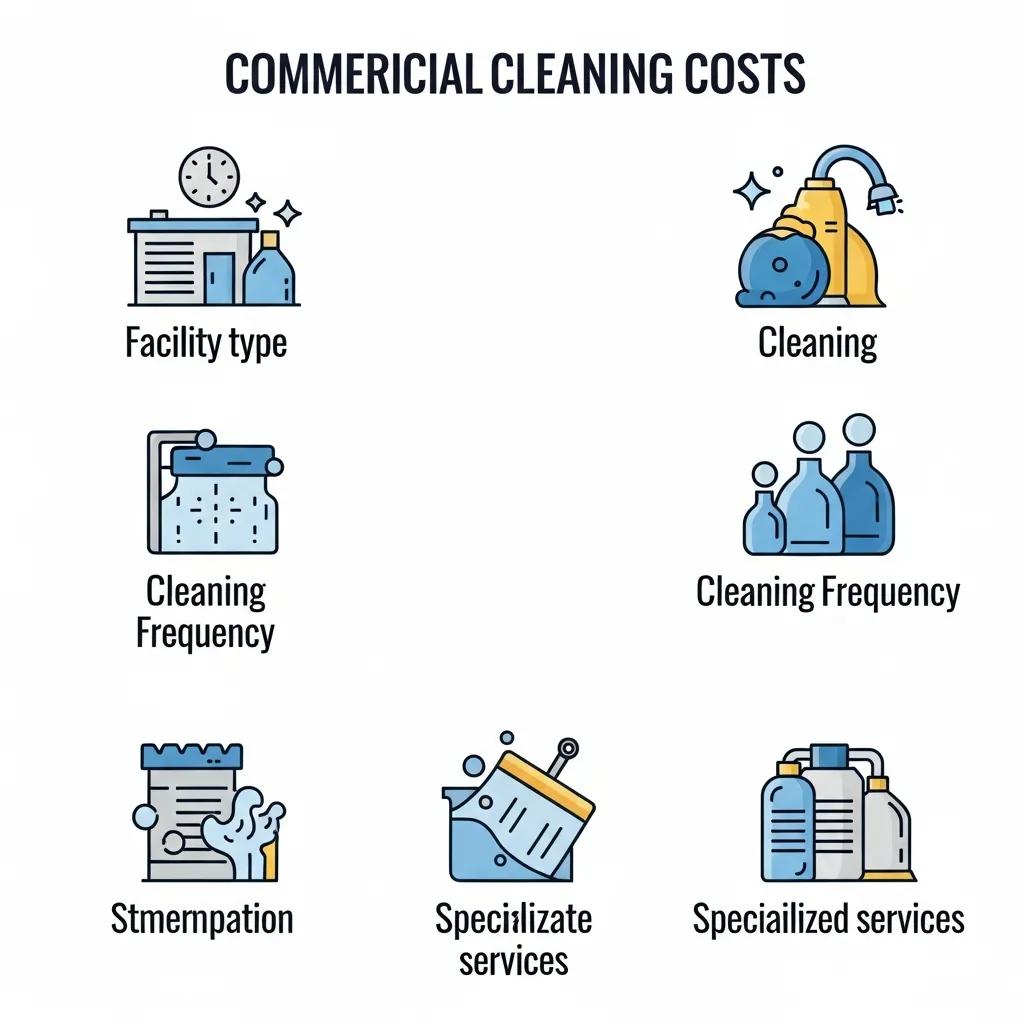
A range of variables shape a cleaning quote in Carseldine: facility type, total area, foot traffic, cleaning frequency, access windows, specialised services (carpet cleaning, high‑rise windows, electrostatic disinfection), choice of supplies, and any regulatory needs for clinical sites. Labour and supervision are often the biggest cost items, while equipment, insurance and compliance raise costs for medical or high‑risk facilities. Providers also price for deliverability—after‑hours work attracts a premium, while frequent daily cleans usually reduce the per‑visit rate through operational efficiencies. Knowing how these levers change a quote lets you decide whether to prioritise the lowest headline price or the best long‑term value.
Key factors to check quickly:
- Facility type and complexity, including clinical or regulated requirements.
- Cleaning frequency and any access or timing restrictions.
- Specialised services and required equipment or chemicals.
- Labour supervision needs, staff availability and insurance exposure.
These factors explain how size and use affect real quotes in everyday scenarios.
How Do Facility Type and Size Impact Your Cleaning Quote?
Facility type sets the baseline: offices typically need routine surface cleaning, vacuuming and waste management, while medical centres require clinical disinfection protocols, higher insurance and stricter waste handling. Size matters because larger sites spread fixed costs (travel, mobilisation, equipment) over more square metres, lowering the per‑unit cost—though high‑traffic zones inside larger sites can raise effective rates. Strata and body corporate cleaning adds coordination overhead for shared spaces and access, which providers often offset with site management fees or extra visits. Regulatory and insurance requirements for clinical or high‑risk environments also add measurable premiums to quotes.
Research highlights how simple floor‑area benchmarks can miss important usage and complexity differences in specialised buildings like hospitals.
Benchmarking Cleaning Costs by Floor Area in Hospitals
Public benchmarking reports frequently present only broad cost figures based on floor area and rarely disaggregate results by how spaces are used. This study highlights the limits of such aggregated benchmarks and why usage‑based comparisons matter.
Those service complexity differences lead into how frequency and add‑ons further shape pricing.
What Role Do Cleaning Frequency and Specialised Services Play in Pricing?
Frequency directly affects unit cost: regular daily or multiple‑times‑per‑week schedules lower the per‑visit charge because labour and routes are optimised, while infrequent or one‑off cleans carry higher per‑visit labour and materials. Specialised services—commercial carpet extraction, window access, deep cleans and electrostatic disinfection—are usually quoted as add‑ons because of extra equipment, chemicals and training. Bundling routine cleaning with periodic specialist tasks typically costs less overall than buying each service ad‑hoc. Ask for line‑item breakdowns that separate routine tasks from specialised work so you can see where savings or extra charges come from.
A short list to illustrate frequency trade‑offs:
- Higher frequency: Lower per‑visit cost and steadier cleanliness.
- Lower frequency: Higher per‑visit cost and higher risk of asset wear.
- Specialised add‑ons: Quoted separately; can add up if needed regularly.
Understanding these interactions helps you evaluate value beyond simply price per visit.
How Does Divine Commercial Cleaning Provide Value Beyond Price in Carseldine?
Divine Commercial Cleaning is a local, family‑owned team based in Birtinya, QLD, serving Brisbane and the Sunshine Coast — including Carseldine — with tailored cleaning plans, eco‑friendly products, flexible scheduling and ongoing quality checks. Beyond headline rates, Divine focuses on local knowledge and an experienced crew that fits into your daily routines to reduce disruption and improve consistency. For businesses that prioritise sustainability and workplace health, Divine’s green approach and regular inspections help lower long‑term risk and protect assets. Those non‑price benefits matter when you’re after predictable outcomes, not just the cheapest per‑hour or per‑square‑metre number.
Divine’s core non‑price value points:
- Local experience and customised cleaning plans.
- Insured, trained staff supported by QA processes.
- Eco‑friendly products and flexible scheduling to suit your operations.
Those features tie into specific eco practices and QA systems that influence operational outcomes and lifetime costs.
What Eco-Friendly Practices and Quality Assurance Does Divine Offer?
Divine chooses eco‑friendly products and sustainable methods that cut toxic exposure while meeting commercial hygiene standards. That protects staff and visitors and reduces chemical residue on surfaces. Quality assurance comes from routine inspections, trained supervisors and satisfaction guarantees, which create accountability and consistent results. These practices can lead to fewer sick days, longer life for carpets and surfaces, and a smaller environmental footprint compared with heavy‑chemical approaches. By pairing sustainability with verification, Divine aims to deliver more value than a low headline price alone.
Next, we look at how flexible scheduling and experienced staff improve day‑to‑day operations.
How Does Flexible Scheduling and Experienced Staff Benefit Your Business?
Flexible scheduling keeps cleaning out of busy periods, so retail spaces stay open and clinics or offices remain operational when they need to be. Experienced teams work faster and more consistently, which reduces rework and supervision time; they also spot early signs of wear and can recommend preventive care that extends asset life. For businesses with access constraints or after‑hours security needs, a provider that offers adaptable scheduling and trained personnel increases safety and predictability. Often, these operational gains are what tip the balance between otherwise similar quotes.
With that operational view, the next section compares Divine’s pricing position against common local benchmarks.
How Do Divine Commercial Cleaning Prices Compare to Local Benchmarks in Carseldine?
To see where Divine sits versus local benchmarks, compare typical ranges for common service types and note how Divine’s custom quotes map to those ranges while including QA, eco‑practices and coverage. Divine generally prices to reflect overall value—competitive for core office and strata work, while appropriately higher for clinical or specialist jobs that need extra compliance. Transparent, line‑item quotes let Carseldine businesses weigh cost against what’s included so they can pick the lowest short‑term price or the best long‑term value. That clarity is what matters when benchmarking providers.
Australia’s commercial cleaning market is competitive, with many local operators and a handful of larger firms driving price and service pressure.
Intro paragraph before table of benchmarks:
Commercial Cleaning Industry Price Competition & Contract Pricing
The industry is highly competitive: many small and medium enterprises operate alongside a few larger national players, which creates downward pricing pressure and challenges for maintaining margins while delivering quality services.
| Service Type | Local Benchmark Range (indicative) | Divine’s Positioning / Notes |
|---|---|---|
| Office cleaning | Competitive mid‑range | Custom plans with regular QA checks |
| Medical centre cleaning | Higher range (clinical premiums) | Includes compliance‑focused protocols |
| Strata & body corporate | Variable by access & common areas | Scalable management and flexible scheduling |
Reviewing benchmarks this way shows why quotes should be normalised by scope and inclusions before deciding which provider offers the best overall value.
What Are Typical Price Ranges for Office, Medical, and Strata Cleaning?
Office cleaning in Carseldine typically sits in a predictable mid‑range because tasks are regular and repeatable; converting quotes to a per‑square‑metre figure makes them easy to compare. Medical centre cleaning carries higher rates because of clinical‑grade disinfectants, stricter protocols and insurance needs. Strata cleaning varies widely: shared areas, access logistics and resident expectations all influence cost, and periodic deep cleans add to the total. Always compare ranges against what’s included—consumables, deep cleans and reporting—to get a fair comparison.
After outlining typical ranges, here’s how Divine aligns its custom pricing with the market.
How Does Divine’s Customised Pricing Align with Local Market Rates?
Divine starts every quote with a scope review—facility type, area, traffic, frequency and specialised needs—then delivers a line‑item estimate that maps to local benchmarks while including eco‑products, QA visits and flexible scheduling options. This transparency lets clients adjust scope to trade cost for coverage, for example by reducing special‑service frequency or bundling deep cleans. Divine aims to remain competitive for standard office work and to price appropriately higher for clinical or specialist requirements where compliance and risk management matter. Clear, itemised quotes help Carseldine businesses compare offers on substance, not just headline price.
Next we compare the full economics of in‑house teams versus outsourcing to show the true cost picture.
What Is the True Cost of Commercial Cleaning: In-House vs. Outsourced in Carseldine?
A true comparison between in‑house cleaning and outsourcing must look line‑by‑line at labour, recruitment and training, management overhead, supplies and equipment, insurance and administrative burden. In‑house teams hide indirect costs such as rostering, HR, specialised procurement and compliance management, while outsourced providers spread those costs across many clients and typically deliver efficiencies through scale. A lower apparent wage for an in‑house cleaner can be offset by supervisor time, leave liabilities and inconsistent quality that shortens asset life. The table below contrasts typical in‑house expenses with outsourced values to make the financial case clearer.
Research has examined the full cost‑benefit of outsourcing cleaning services, even in complex settings like hospitals, to show the broader financial impact.
Outsourcing vs. Insourcing Cleaning: Cost-Benefit Analysis for Hospitals
This study estimates the net cost benefit of outsourcing cleaning in a hospital setting. Using before‑and‑after data, it compares total costs and service quality to show how outsourcing can be assessed from a facility manager’s perspective.
EAV table comparing cost components:
| Cost Component | In‑house (Typical) | Outsourced (Typical) |
|---|---|---|
| Labour & payroll | Direct wages plus leave and benefits | Managed labour cost included in the service fee |
| Supplies & equipment | Purchased and maintained by the employer | Supplies and equipment included or charged within contract |
| Insurance & compliance | Employer arranges and pays separately | Included or covered by provider overhead |
| Management overhead | Internal supervisor time and HR | Built into the vendor’s service fee |
That breakdown shows how outsourcing converts many hidden internal costs into a predictable service fee, often improving cost certainty and reducing total cost of ownership.
How Do Labor Costs and Efficiency Affect Overall Cleaning Expenses?
Labour is usually the largest cost in cleaning. Efficiency improvements—better training, route optimisation and consistent scheduling—reduce hours per task and lower unit costs. In‑house teams carry additional HR costs like onboarding, leave accrual and rostering inefficiencies that are often underestimated. Outsourced providers optimise shifts and task lists across multiple sites, reducing effective labour hours per square metre. For Carseldine businesses, translating hourly or per‑visit rates into a per‑square‑metre cost that accounts for efficiency gives a clearer picture of real economics.
This labour‑focused view highlights the long‑term advantages of professional outsourcing beyond hourly wage comparisons.
What Are the Long-Term Benefits of Professional Outsourced Cleaning?
Outsourcing brings several long‑term benefits: correctly maintained carpets and surfaces last longer, healthier workplaces reduce sick days, compliance and safety management move to specialists, and site managers face less admin overhead. Those outcomes improve ROI by delaying asset replacement and supporting productivity. Outsourced providers also scale services up or down without the friction of hiring or letting staff go. For businesses focused on total cost, these benefits often outweigh small differences in per‑visit rates.
With costs and benefits reviewed, here are practical next steps for getting accurate quotes and comparing providers.
Frequently Asked Questions
What should I look for in a commercial cleaning contract?
Check the scope of work, cleaning frequency, and any site‑specific requirements first. Make sure pricing, payment terms and cancellation rules are clear, and look for quality metrics such as inspection schedules or KPIs. A good contract will spell out responsibilities, reporting and remedies for missed standards so you know what to expect.
How can I ensure the cleaning service is eco-friendly?
Ask about the products and methods they use, and look for recognised eco labels or certifications. Request details on waste handling, microfiber usage and energy‑efficient equipment. A reputable provider will share product data sheets or certifications and explain how their practices reduce environmental impact.
What are the benefits of using a local cleaning service?
Local providers offer faster response times, personalised service and a better understanding of community expectations. They often build long‑term relationships and can tailor schedules and services to local needs. Being local also helps when you want quick site visits, extra checks or fast problem resolution.
How often should I schedule commercial cleaning services?
Frequency depends on your business type, foot traffic and hygiene standards. High‑traffic areas usually need daily or multiple‑times‑per‑week cleaning; lower‑traffic offices may be fine with weekly or bi‑weekly visits. Discuss your operations with your cleaner to find a schedule that balances cleanliness and cost.
What should I do if I'm not satisfied with the cleaning service?
Tell the provider exactly what’s wrong and when it happened. Most companies will investigate and correct the issue quickly. If problems continue, review your contract’s service levels and complaint process, and consider switching providers if you don’t see improvement.
Are there any hidden costs associated with commercial cleaning services?
Hidden costs can include extra charges for specialised tasks, additional supplies, after‑hours work or emergency cleans. Always ask for a detailed, line‑item quote that separates routine work from add‑ons and clarifies overtime rates and change‑of‑scope charges to avoid surprises.
How can I assess the quality of a cleaning service?
Request references or case studies, and ask about their QA program—inspection routines, supervisor visits and staff training. Evaluate responsiveness during the quoting process and consider a short trial period to judge performance before committing to a long contract.
How Can I Get an Accurate Quote from Divine Commercial Cleaning?
To get a precise quote, have site details ready: total area or floor plan, desired cleaning frequency, any specialised needs (carpet extraction, clinical disinfection) and preferred access windows. Divine can provide remote estimates for straightforward sites and site visits for complex requirements, producing a clear line‑item quote that reflects eco‑friendly product choices and QA inclusions. Expect a prompt turnaround and options to bundle periodic deep cleans with routine services to reduce long‑term cost. Contact Divine by phone or email to arrange a site review or request a tailored estimate.
Following these steps will help you compare quotes consistently, using the same criteria for each provider.
What Factors Should I Consider When Comparing Cleaning Quotes?
Normalise quotes by confirming what’s included: consumables, deep‑clean frequency, reporting and QA visits, insurance and staff training. Beware of very low prices with vague scopes, missing insurance details, or no service‑level commitments—these are common red flags. Use a simple checklist to score each quote on price, inclusions, scheduling flexibility and QA processes. Prioritise providers that give transparent, itemised quotes and can explain how each element affects immediate cost and long‑term value.
Practical checklist for comparing quotes:
- Scope clarity: Are tasks and frequencies clearly defined?
- Inclusions: Are supplies, deep cleans and QA visits itemised?
- Risk coverage: Does the quote confirm insurance and compliance?
- Flexibility: Can schedules and services be adjusted without penalty?
Use these criteria to complete your decision framework and to request informed quotes from providers like Divine Commercial Cleaning.
Knowing how commercial cleaning pricing works in Carseldine helps you make decisions that balance cost and quality. By considering facility type, cleaning frequency and value‑added services from providers like Divine Commercial Cleaning, you can choose a solution that delivers the best long‑term result for your budget. Request a tailored quote that reflects your needs and see how a cleaner, healthier workspace improves efficiency and satisfaction.

Dianne, originally from Rockhampton, hails from a business-oriented family, with her father owning electrical stores and her uncle serving as Mayor. Moving to the Sunshine Coast at 13, she later pursued a rewarding real estate career and raised three children. As a single mom, she balanced university studies with domestic cleaning work. Armed with a Bachelor’s Degree in Business, majoring in Supply Chain Management, Dianne founded and grew Divine Commercial Cleaning into a thriving company. Her success is rooted in strong family mentorship, a positive attitude, and a solution-oriented approach, offering tailored cleaning services with integrity and strategic insight.