
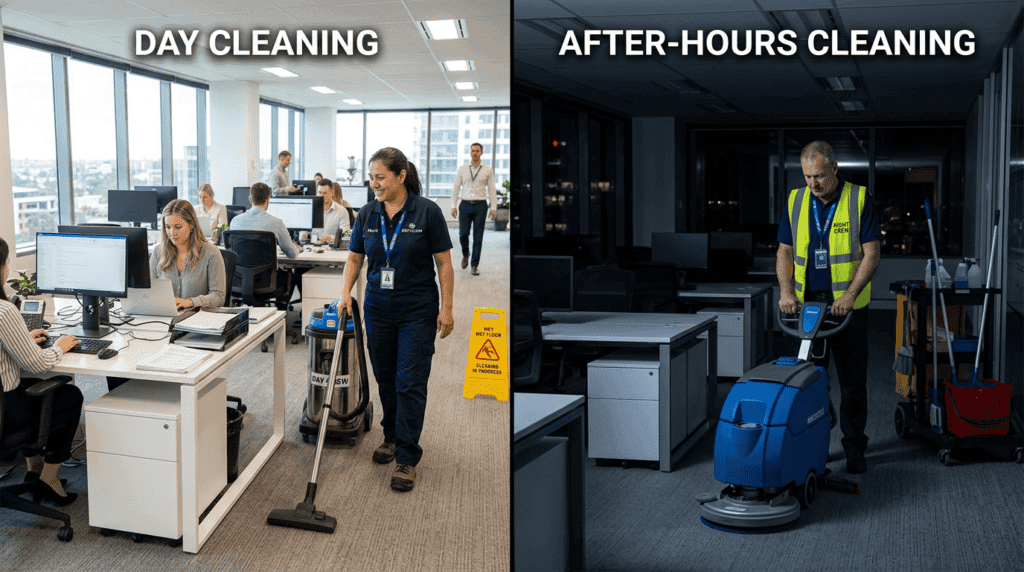
After-hours cleaning suits sites where the cleaner needs uninterrupted access and staff should not be disturbed — most professional offices, medical practices and retail. Day cleaning suits sites where visible presentation matters through the day, where security or access restrictions make after-hours attendance difficult, or where the building wants the energy and security savings of an empty night. Many Sunshine Coast businesses end up with a hybrid, and that is usually the right answer.
This is a genuine trade-off, not a matter of one model being better. The right choice depends on your building, your hours, your risk profile and what your staff and customers actually experience.
Quick comparison
| After-hours cleaning | Day cleaning | |
|---|---|---|
| Productivity impact | None — staff unaffected | Some noise and interruption; needs scheduling discipline |
| Cleaning efficiency | Higher — unobstructed access to desks, meeting rooms, floors | Lower — occupied rooms are skipped or done later |
| Presentation through the day | Declines from morning to afternoon | Maintained continuously |
| Cost | Higher labour rates for night and weekend hours | Lower base rates; may need more hours for the same result |
| Security | Unsupervised access after hours; needs keys, codes and vetting | Cleaners on site while staff are present; less access risk |
| Energy | Lights and HVAC run for cleaning after hours | Uses existing lighting and conditioning |
| Consumable management | Restocked overnight; can run out during a busy day | Restocked as needed; far fewer stockouts |
| Communication | Indirect — via logbook or email | Direct — issues raised and fixed immediately |
| Reactive response | Next scheduled clean, unless called out | Immediate |
The case for after-hours cleaning
After hours remains the default for most commercial cleaning in Australia, for solid reasons.
- Access is complete. Every desk, meeting room and office is available. Floors can be machine scrubbed, sealed or carpet extracted with full drying time before anyone walks on them.
- The work is faster. No working around people, no rescheduling around meetings, no interruption. The same scope takes measurably fewer hours.
- No disruption. Vacuum noise during a client call is a real problem in professional services and in medical practices, where consultations are confidential.
- Confidentiality is easier to manage in some respects. Clean desk policies and locked cabinets are simpler to enforce overnight than to manage around occupied desks.
- Periodic works are possible. Strip and seal, carpet extraction and high-level dusting essentially require an empty building.
What after-hours cleaning requires from you
- Robust key, access card and alarm management, with a documented register
- Police-checked cleaners — unsupervised access to your premises and information makes this non-negotiable. All our cleaners hold police checks.
- A clean desk expectation so desks can actually be cleaned
- A reporting channel — a logbook, shared email or checklist — because there is no face-to-face contact
- Consumable capacity that survives a full day without a restock
The case for day cleaning
Day cleaning has grown in Australia over the last decade, driven by energy costs, security preferences and a shift towards visible service.
- Presentation holds through the day. Washrooms restocked at 2pm rather than being empty from 3pm onward. This is the single biggest practical benefit — see commercial washroom cleaning.
- Immediate response. A spill, a broken glass, an overflowing bin or a sick child in a childcare centre is dealt with now, not tonight.
- Better communication. Issues are raised and resolved in conversation. Standards drift far less when the cleaner and the client see each other daily.
- Lower energy use. The building can go dark at 6pm rather than running lighting and HVAC for cleaning.
- Security simplicity. No after-hours access, no alarm codes issued, no unsupervised presence in the building.
- Better working conditions. Daytime hours attract and retain more stable staff, which translates directly into consistency on your site.
What day cleaning requires from you
- Tolerance for some noise, and a scheduling protocol for meeting rooms and quiet zones
- Realistic expectations — occupied offices get done when they are free, not on a fixed run
- A separate arrangement for periodic works, which still need an empty building
- Somewhere for the cleaner to store equipment discreetly
The hybrid model, which suits most Sunshine Coast businesses
The most common effective arrangement is a full clean after hours plus a short daytime presence:
- Overnight or early morning: the full scope — desks, floors, washrooms, kitchen, meeting rooms, detail tasks.
- Midday: a one to two hour daytime attendance covering washroom checks and restocking, kitchen tidy, reception and entry presentation, bin emptying in high-use areas, and reactive spills.
This captures most of the benefit of both models at modest additional cost, and it is particularly effective in buildings where washroom complaints are the recurring issue.
What suits which type of site
| Site type | Usual best fit | Why |
|---|---|---|
| Professional office | After hours, hybrid if busy | Quiet working environment; full desk access |
| Medical or dental practice | After hours, plus between-session attendance | Confidentiality; clinical turnover between patients |
| Childcare centre | After hours, plus daytime hygiene attendance | Cannot clean around children; but incidents need immediate response |
| School | After hours, plus daytime amenities checks | Classrooms need to be empty; washrooms need mid-day attention |
| Gym or fitness facility | Hybrid, weighted to day | Continuous equipment sanitisation during opening hours |
| Shopping centre or retail | Overnight deep clean plus day presence | Presentation during trading is the entire point |
| Strata common areas | Business hours | Residents present around the clock; noise restrictions at night |
| Warehouse | Between shifts | Forklift and pedestrian separation |
| Cafe or restaurant | After close | Kitchen must be empty and cool |
Cost: the honest picture
Night and weekend hours attract penalty loadings under the Cleaning Services Award 2020, so the hourly cost of after-hours labour is genuinely higher than daytime labour. But after-hours cleaning is more efficient per hour because access is unobstructed, so the total hours required for the same scope are lower.
The net result is that the two models often land within a similar range for a comparable outcome. Where they diverge:
- Day cleaning tends to be cheaper for simple, low-obstruction sites — warehouses, gyms, common areas.
- After-hours tends to be cheaper for dense, desk-heavy offices where daytime access is genuinely obstructed.
- Hybrid costs more than either alone, but usually less than the additional hours you would need to achieve the same presentation with day cleaning alone.
Ask contractors to quote both models against the same scope of works so you can see the difference for your specific site rather than relying on generalisations.
Periodic works still need an empty building
Whichever model you choose, these tasks need the building unoccupied and need drying or curing time:
- Strip and seal of hard floors — typically a weekend, with cure time before traffic
- Carpet hot water extraction — overnight or weekend, with drying time
- High-level dusting and light fitting cleaning — requires access equipment
- External window cleaning at height
- Machine scrubbing of large floor areas
Frequently asked questions
Is day cleaning cheaper than after-hours cleaning?
The hourly rate is lower because night and weekend penalty rates do not apply, but day cleaning usually needs more hours to achieve the same result because access is obstructed. For most sites the total cost lands in a similar range — the real difference is in presentation, response time and energy use.
Is it disruptive having cleaners in during business hours?
It can be, without a protocol. Sites that manage it well agree quiet hours, schedule vacuuming away from client-facing periods, use low-noise equipment, and let the cleaner work around meeting room bookings. Most staff adjust within a fortnight.
Can we switch from after-hours to day cleaning mid-contract?
Usually yes, though it needs repricing because the labour cost structure changes, and it may affect the contractor’s staffing. Give reasonable notice and expect a revised schedule rather than the same scope shifted forward.
What about security with after-hours cleaning?
Manage it properly: a documented key and access card register, individual alarm codes where the system supports it, police-checked cleaners, and a consistent named team rather than rotating relief staff. Change alarm codes whenever a contractor or cleaner changes — see changing commercial cleaning companies.
Do cleaners need supervision during day cleaning?
No more than during after-hours cleaning — but they do need clear zones, an agreed quiet-hours protocol and somewhere to store equipment. Day cleaning tends to be self-correcting on quality precisely because everyone can see the work.
What is the best option for a childcare centre?
Almost always a full after-hours clean once children have left, supported by daytime hygiene attendance for washrooms, nappy change areas and incident response. Cleaning cannot happen around children, but hygiene incidents cannot wait until evening. See daycare and school cleaning.
Not sure which model suits your site?
We run after-hours, day and hybrid cleaning arrangements across the Sunshine Coast and can quote your site both ways against the same scope so you can compare directly. Ask Divine Commercial Cleaning for a comparison quote.

Dianne, originally from Rockhampton, hails from a business-oriented family, with her father owning electrical stores and her uncle serving as Mayor. Moving to the Sunshine Coast at 13, she later pursued a rewarding real estate career and raised three children. As a single mom, she balanced university studies with domestic cleaning work. Armed with a Bachelor’s Degree in Business, majoring in Supply Chain Management, Dianne founded and grew Divine Commercial Cleaning into a thriving company. Her success is rooted in strong family mentorship, a positive attitude, and a solution-oriented approach, offering tailored cleaning services with integrity and strategic insight.