
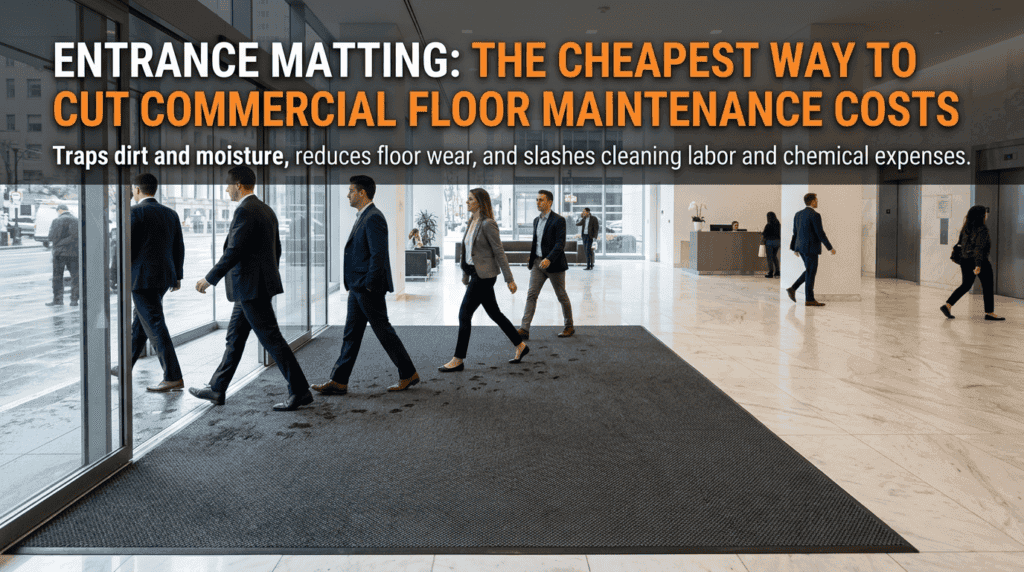
Entrance matting is the cheapest floor maintenance investment a commercial building can make, because the overwhelming majority of soil inside a building walks in through the front door. An adequately sized matting system stops that soil at the entry, where it can be vacuumed out easily, rather than letting it grind into carpet fibre and hard floor sealer across the whole tenancy.
Almost every Sunshine Coast building we assess has undersized matting. The typical arrangement is a single 1200 mm mat inside a glazed entry, which captures roughly the first step and a half. Everything after that walks onto the carpet.
Why matting matters more than it sounds
Soil tracked into a building does three things:
- It abrades. Sand and grit are hard, angular particles. Every footstep grinds them against carpet fibre and hard floor sealer. Carpet does not usually wear out from traffic — it wears out from the grit that traffic drives into it, which cuts the fibre and destroys the light-reflecting surface. The result reads as a permanently grey traffic lane that no amount of cleaning restores.
- It costs labour. Soil spread over 400 square metres takes far longer to remove than the same soil captured in six square metres of matting.
- It creates slip risk. Water carried in during Sunshine Coast wet season rain makes hard floors genuinely dangerous, and wet floors at entries are a leading cause of slip incidents in commercial buildings.
On the Sunshine Coast there is an additional factor: sand. Buildings anywhere near the beach — Mooloolaba, Alexandra Headland, Kings Beach, Coolum, Noosa — take a continuous sand load that inland buildings do not. Sand is one of the most abrasive soils a floor can encounter, and it is present year round.
How much matting do you actually need?
The working rule used across the industry is that a matting system should be long enough for a person to take six to eight full steps across it before reaching the finished floor. That is roughly 4.5 to 6 metres of matting in the direction of travel.
Most commercial entries have between 1 and 2 metres. That is the gap.
If the full length is not achievable — and in many tenancies it is not — the priorities are:
- Get as much length as the entry allows. Length matters far more than area. A long, narrow mat outperforms a wide, short one.
- Full width of the doorway, plus a margin. People walk around a mat that is narrower than the door opening, which defeats it entirely.
- Prioritise the primary entry. If budget is limited, put the full system at the busiest door rather than spreading it thinly across four.
The three-zone matting system
Effective matting works in stages, because different mat constructions remove different things.
| Zone | Location | Purpose | Typical construction |
|---|---|---|---|
| Zone 1 — Scraper | Outside the door | Remove heavy soil, grit, mud, sand | Rubber or coir scraper, open grid |
| Zone 2 — Scraper/wiper | Immediately inside | Remove finer soil, begin absorbing moisture | Combination rubber-backed with nylon or polypropylene fibre |
| Zone 3 — Wiper | Continuing into the lobby | Absorb remaining moisture, polish the sole | High-absorbency nylon or cotton-blend |
The mistake most buildings make is fitting only a Zone 3 wiper mat inside the door. A soft absorbent mat receiving heavy grit saturates immediately and then simply redistributes it.
Choosing between mat types
- Recessed matwell systems. Aluminium frame set flush into the floor at the entry, with replaceable inserts. The best solution — no trip edge, no movement, high capacity. Requires construction work, so it is a fitout or refurbishment decision.
- Rental / laundered mats. Supplied and exchanged on a cycle by a service provider. Consistent appearance, no cleaning burden, and someone else owns the replacement cost. Ongoing rental cost.
- Purchased mats. Lower long-term cost, but you must maintain them — and an unmaintained mat is worse than no mat.
- Logo mats. Effective and good branding at reception, provided the construction is genuinely functional rather than decorative.
- Runners in corridors. Useful in wet weather for the route from a lift lobby or car park entry.
Backing matters
Rubber-backed mats laid on carpet can trap moisture underneath, which in a subtropical climate becomes a mould reservoir — a genuine issue during the Sunshine Coast wet season. Lift mats regularly, clean beneath them and allow both surfaces to dry. See our guide to preventing mould in commercial buildings.
Maintaining matting so it keeps working
A saturated mat has no remaining capacity. It stops capturing and starts contributing. Practical requirements:
- Vacuum daily at high-traffic entries, using a machine with genuine agitation rather than suction alone.
- Extract periodically. Matting fills with soil the same way carpet does and needs hot water extraction on a schedule — typically monthly to quarterly depending on traffic. See commercial carpet cleaning.
- Lift and clean beneath. Both the mat underside and the floor below.
- Dry saturated mats during wet weather. In sustained rain, a mat can hold litres of water. Have spares to rotate.
- Replace when the pile is crushed. A flattened mat with no remaining pile does nothing. Matting is consumable, not permanent.
- Check the lay. Curled edges and rucks are trip hazards and a liability exposure.
Wet weather management
During Sunshine Coast storm season, entries need active management rather than a fixed schedule:
- Deploy additional runner matting extending further into the lobby
- Increase the frequency of mat changes or drying
- Place wet floor signage — and remove it when the floor is dry, because permanent signage is ignored
- Assign someone to check and dry the entry at intervals through the day
- Consider umbrella bags or stands at customer-facing entries
Wet entries during storm season are also a slip resistance issue. AS 4586 classifies new pedestrian surface materials and AS 4663 addresses existing installed surfaces; cleaning method and residue build-up directly affect how an installed floor performs when wet, which is worth knowing before an incident rather than after. Our guide to storm season preparation covers the wider building picture.
What good matting saves you
Where a building fixes its matting, the visible effects usually appear within a few months:
- Traffic lanes stay lighter for longer, extending the interval between carpet extractions
- Hard floor sealer lasts longer between strip and seal cycles, because less grit is abrading it
- Daily vacuuming takes less time across the tenancy
- Slip incidents at entries drop during wet weather
- Carpet reaches replacement age later — the largest single saving, and the one that matters at makegood
Frequently asked questions
How long should entrance matting be?
Long enough for six to eight full footsteps in the direction of travel — roughly 4.5 to 6 metres. Where that is not achievable, prioritise length over width, and cover the full door opening so people cannot walk around it.
How often should entrance mats be cleaned?
Vacuum daily at busy entries. Hot water extraction monthly to quarterly depending on traffic. Lift and clean beneath the mat at the same interval, and dry saturated mats during wet weather.
Should we rent or buy entrance mats?
Rental suits sites that want consistent appearance without a maintenance burden and where mats saturate quickly. Purchase is cheaper over time if you have a reliable cleaning program including periodic extraction. The wrong answer is buying mats and then never maintaining them.
Can entrance matting be a trip hazard?
Yes, if it curls, ruckles, moves or has a raised edge. Recessed matwell systems eliminate the issue. For surface-laid mats, choose a bevelled edge, ensure a non-slip backing suited to the floor, and inspect the lay daily.
Does matting really extend carpet life?
Yes, substantially. Most carpet in commercial buildings degrades because abrasive grit cuts the fibre, not because of foot traffic itself. Capturing that grit at the entry is the most direct way to slow the process.
What matting suits a beachfront commercial property?
Prioritise scraper-type matting outside and in Zone 2, because sand is the dominant soil and needs mechanical removal rather than absorption. Add capacity for water during the wet season, and expect to clean and extract mats more often than an inland building would. Our guide to cleaning coastal commercial buildings covers the wider implications.
Have your entries assessed
If your carpet is greying in the traffic lanes or your hard floors are losing their finish faster than they should, the entry is usually where the problem starts. Ask Divine Commercial Cleaning to assess your entries and we will tell you what matting your building actually needs — and what it will save you in floor maintenance.

Dianne, originally from Rockhampton, hails from a business-oriented family, with her father owning electrical stores and her uncle serving as Mayor. Moving to the Sunshine Coast at 13, she later pursued a rewarding real estate career and raised three children. As a single mom, she balanced university studies with domestic cleaning work. Armed with a Bachelor’s Degree in Business, majoring in Supply Chain Management, Dianne founded and grew Divine Commercial Cleaning into a thriving company. Her success is rooted in strong family mentorship, a positive attitude, and a solution-oriented approach, offering tailored cleaning services with integrity and strategic insight.