Restaurant and Food Service Facility Cleaning and Hygiene: Solutions for Commercial Kitchen Deep Cleaning and Compliance
Keeping a commercial kitchen and food service facility hygienic requires specialised cleaning protocols that go beyond routine janitorial work, because food safety risks—microbial contamination, grease buildup and cross-contamination—directly affect public health and business continuity. This article is designed to attract food service operators, inform them about proven cleaning methods, build trust in professional approaches, and generate leads by explaining how to request tailored cleaning proposals and follow-up quality assurance. You will learn why specialised restaurant cleaning matters for foodborne illness prevention, which deep-cleaning services target grease and exhaust-related fire risks, how HACCP principles guide sanitation, and which eco-friendly technologies reduce residues while improving indoor air quality. The content balances technical guidance with practical checklists and tables so managers can implement or evaluate a compliant sanitation program. After reviewing operational best practices and verification steps, the final section explains how to request a free quote, what to expect during a site assessment, and the documentation a professional provider should supply.
Why Is Specialised Restaurant Cleaning Essential for Food Safety and Business Success?
Specialised restaurant cleaning is the targeted application of sanitation methods, degreasing chemistry and mechanical extraction designed to remove food residues, biofilms and grease that standard cleaning overlooks; this combination reduces pathogen survival, lowers fire risk and maintains inspection readiness. Effective cleaning interrupts contamination pathways at critical control points such as food prep surfaces, drains and equipment exteriors, which in turn protects customers and staff while preserving equipment uptime. Recent studies and industry audits show that systematic deep cleaning and documented sanitation schedules correlate with higher inspection scores and fewer closure events, supporting both public health and brand reputation. For operators, the business case is straightforward: fewer customer complaints, lower insurance exposure, and improved staff safety translate into sustained revenue and reduced unexpected downtime. The next section explains how proper cleaning prevents foodborne illness and meets hygiene compliance requirements in practical terms.
How Does Proper Cleaning Prevent Foodborne Illness and Ensure Hygiene Compliance?
Proper cleaning physically removes soils, grease and microbial biofilms from surfaces and equipment, while sanitising reduces remaining microorganisms to safe levels; together these steps break contamination chains that lead to foodborne illness. Cleaning uses mechanical action, detergents and degreasers to strip residues from grills, cutting boards and drains, and sanitising agents applied at validated concentrations inactivate pathogens such as Salmonella or Listeria on contact surfaces. Critical control points in a kitchen—food contact surfaces, slicers, refrigeration seals and dishwashing stations—require documented cleaning frequencies and verification to ensure ongoing compliance with food safety rules. Scheduled cleaning interrupts transmission pathways by removing hiding places for microbes and by preventing cross-contamination between raw and ready-to-eat zones, which supports both HACCP principles and inspection expectations.
What Are the Benefits of Maintaining High Restaurant Hygiene Standards?
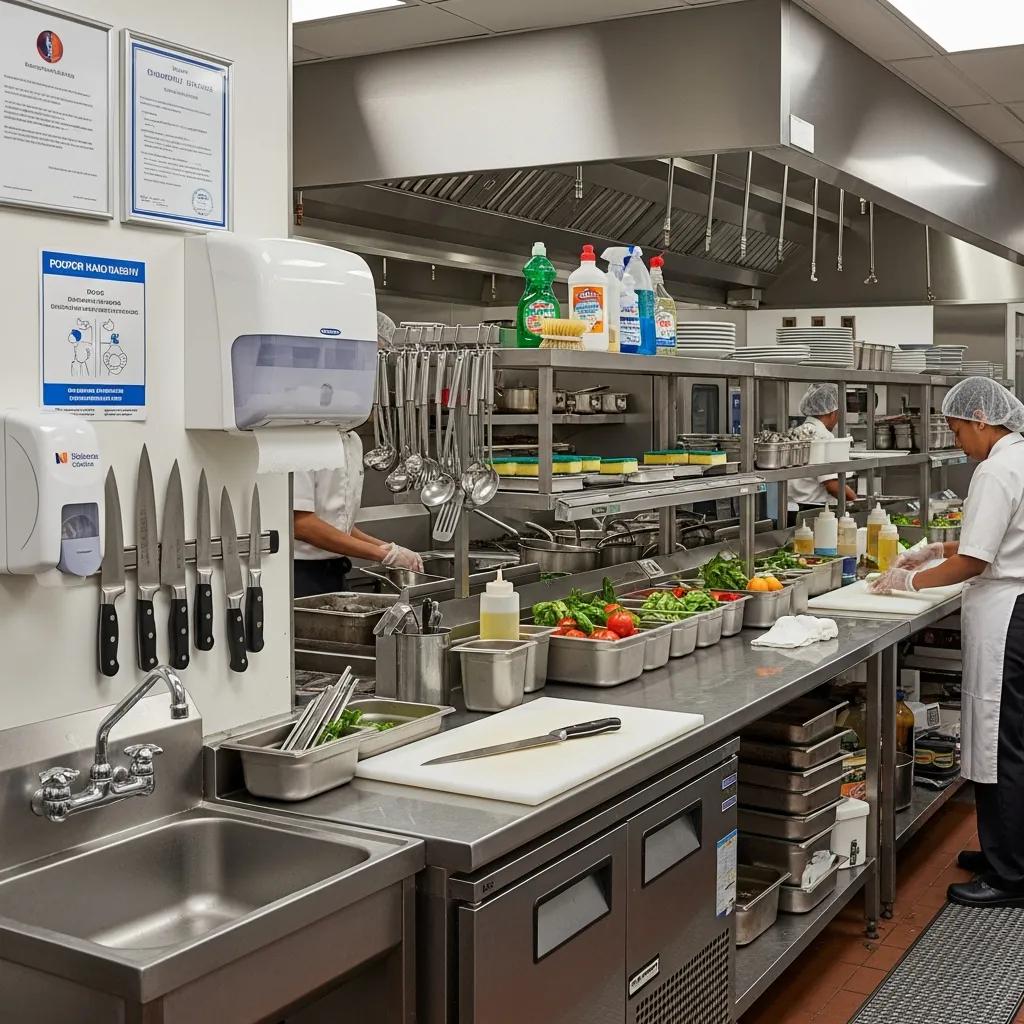
Maintaining high hygiene standards yields measurable benefits across operations, compliance and customer experience, including improved inspection outcomes, fewer food-safety incidents and enhanced customer confidence that supports repeat business. Financially, proactive sanitation lowers the likelihood of fines, temporary closures and costly remediation while also reducing the risk of grease-related fires that damage equipment and disrupt service. Operationally, consistent cleaning extends equipment life and reduces unplanned maintenance, and visible cleanliness in dining areas and restrooms elevates perceived quality for patrons. For managers, documented sanitation programmes simplify audit preparation and make staff training more effective, creating an operational culture that prioritises safety and service continuity.
What Comprehensive Cleaning Services Does Divine Commercial Cleaning Offer for Food Service Facilities?
This section outlines core service areas specialised for food service facilities, focusing on procedures and deliverables operators should expect when contracting professional sanitation teams. Services include systematic commercial kitchen deep cleaning that addresses ovens, grills and floors; canopy, exhaust and grease trap maintenance to reduce fire risk and improve indoor air quality; and dining-area and restroom sanitisation to protect patrons beyond the kitchen. Providers will typically supply documented scope-of-work, recommended frequencies based on kitchen volume, and verification records after each visit to support audit-readiness. Below is a compact comparison table summarising main service components, recommended frequency and compliance outcomes so managers can scan offerings quickly and compare priorities.
Service components, scope and compliance outcomes.
| Service Area | Typical Scope | Recommended Frequency |
|---|---|---|
| Commercial kitchen deep clean | Ovens, grills, fryers, walls, floors, equipment exteriors | Monthly to quarterly, depending on volume |
| Exhaust & canopy system | Filters, hood, duct access, fan inspection, grease removal | Quarterly to biannually, based on use |
| Grease trap maintenance | Pumping, degreasing, residue removal, record of waste disposal | Monthly or per regulatory schedule |
This table clarifies which services target specific risks and helps prioritise maintenance to meet health and fire-safety expectations. The next subsections detail how deep cleaning and exhaust/grease services are performed and verified.
How Is Commercial Kitchen Deep Cleaning Performed to Remove Grease and Grime?
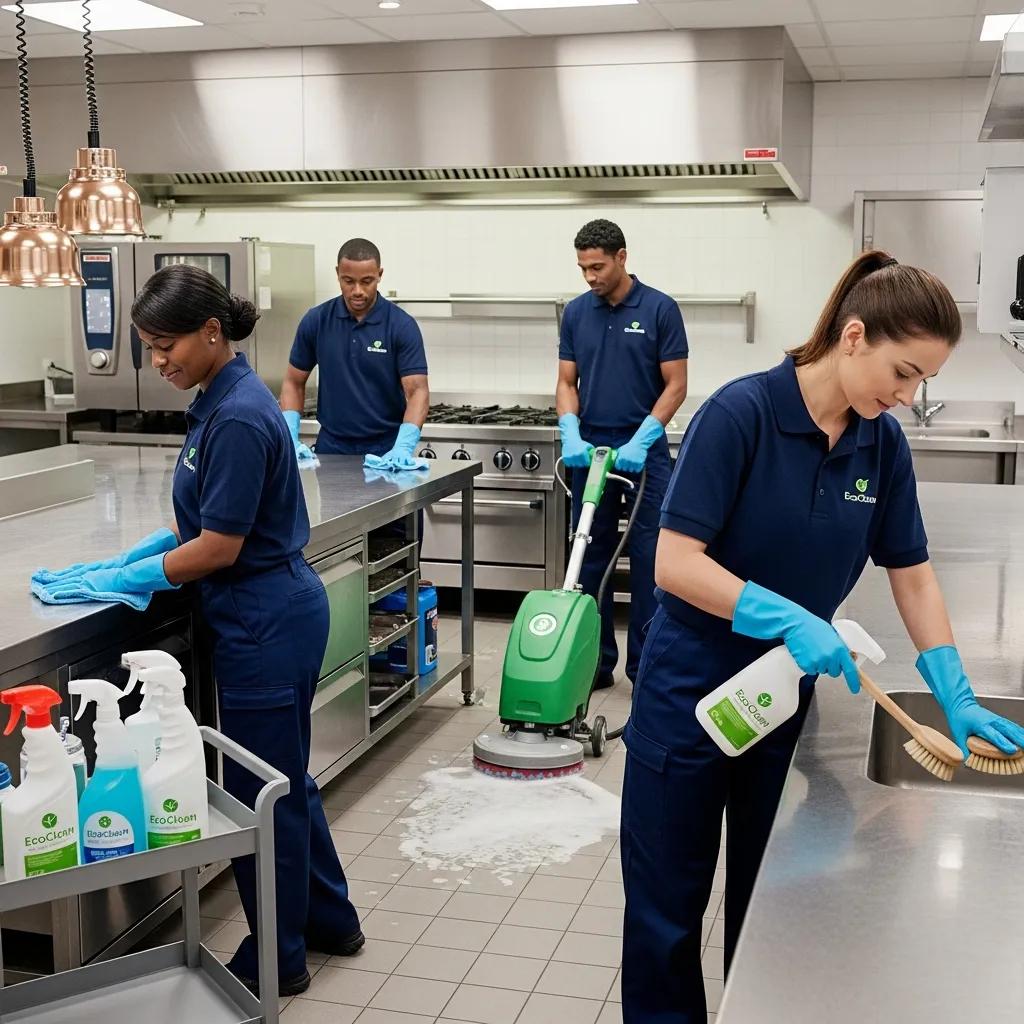
Commercial kitchen deep cleaning follows a methodical sequence: pre-inspection, de-energising equipment, mechanical degreasing, targeted chemical application, steam or low-residue rinsing, and sanitisation followed by verification checks. Technicians often combine manual scraping, high-temperature steam cleaning and food-safe alkaline degreasers to dissolve baked-on oils from ovens, grills and floor joints, then apply sanitiser at validated contact times to reduce microbial load. Safety steps include lockout-tagout procedures for equipment, ventilation management and use of PPE to protect staff and prevent chemical residues on food surfaces. A short checklist—site assessment, grease removal, rinse, sanitise, document—provides a consistent framework for quality assurance and helps operators schedule based on kitchen throughput.
What Does Grease Trap and Exhaust System Cleaning Include for Fire Safety and Air Quality?
Grease trap and exhaust cleaning encompass canopy filter exchange, hood interior and exterior cleaning, ductwork access and degreasing, fan inspection and grease trap pumping with proper disposal records to reduce both fire risk and airborne particulate levels. Removing the meronym components such as filters, ductwork and trap interiors prevents progressive grease accumulation that feeds fires and degrades indoor air quality (IAQ), and it often forms part of insurance and regulatory expectations. Frequency recommendations vary with cooking volume, but routine inspections and documented cleans ensure readiness for health and fire-safety audits. Completing these tasks improves ventilation performance and reduces odour, which benefits both kitchen staff and dining-area comfort.
How Does Divine Ensure Food Safety and Hygiene Compliance in Restaurant Cleaning?
Ensuring food safety and hygiene compliance involves aligning cleaning activities with HACCP principles, maintaining documentation and supporting operators during health department inspections through clear records and audit-ready logs. Professional cleaning providers integrate monitoring, corrective actions and verification steps into every service, producing checklists and service reports that map cleaning actions to critical control points. For food business operators, this documentation demonstrates due diligence and simplifies responses to regulatory queries or customer concerns. The table below maps common standards to the cleaning actions and compliance evidence a provider should supply to support HACCP and local health rules.
Introductory table: Mapping standards to cleaning actions and compliance evidence.
| Standard / Requirement | Cleaning Action | Compliance Evidence |
|---|---|---|
| HACCP critical control | Targeted cleaning of CCPs (e.g., food contact surfaces) | Cleaning logs, verification swabs |
| Health department inspections | Regular sanitisation and documented frequencies | Service reports, schedules |
| Fire safety / insurance | Exhaust and grease trap maintenance | Inspection certificates, maintenance logs |
This mapping helps operators understand how sanitation tasks translate into audit-ready documentation and where to prioritise verification during routine inspections. The subsections below explain HACCP linkage and regulatory protection in practice.
What Are HACCP Principles and Their Role in Food Service Facility Sanitation?
HACCP (Hazard Analysis and Critical Control Points) is a preventive framework that identifies potential hazards in food operations and establishes controls at points where risks can be prevented, reduced or eliminated; cleaning and sanitation are core controls that support several HACCP principles. Cleaning actions address identified CCPs—such as prep surfaces and slicing equipment—by setting frequencies, monitoring effectiveness through visual inspection or ATP/surface swabs, and executing corrective actions when verification fails. Documentation of monitoring, corrective steps and supervisor sign-off forms the backbone of HACCP compliance and demonstrates that sanitation is managed as an active control measure. Integrating cleaning schedules into the HACCP plan ensures that sanitation is not ad hoc but a measurable, auditable process.
How Does Compliance with Health Department Regulations Protect Your Business?
Compliance reduces the risk of fines, temporary closures and reputational damage by ensuring the facility meets established standards for food handling, sanitation and waste management; proactive cleaning is a primary defence. Health department inspections typically focus on high-risk areas such as temperature control, cross-contamination prevention and cleanliness of equipment and premises, and professional cleaning firms can help address common fail points with targeted services and supporting documentation. Operators who maintain service logs, verification records and scheduled maintenance are better positioned to respond to inspection findings and to implement corrective action plans quickly. The final sentence introduces eco-friendly techniques that maintain compliance while minimising environmental impact.
What Eco-Friendly and Advanced Cleaning Technologies Are Used in Food Service Facility Hygiene?
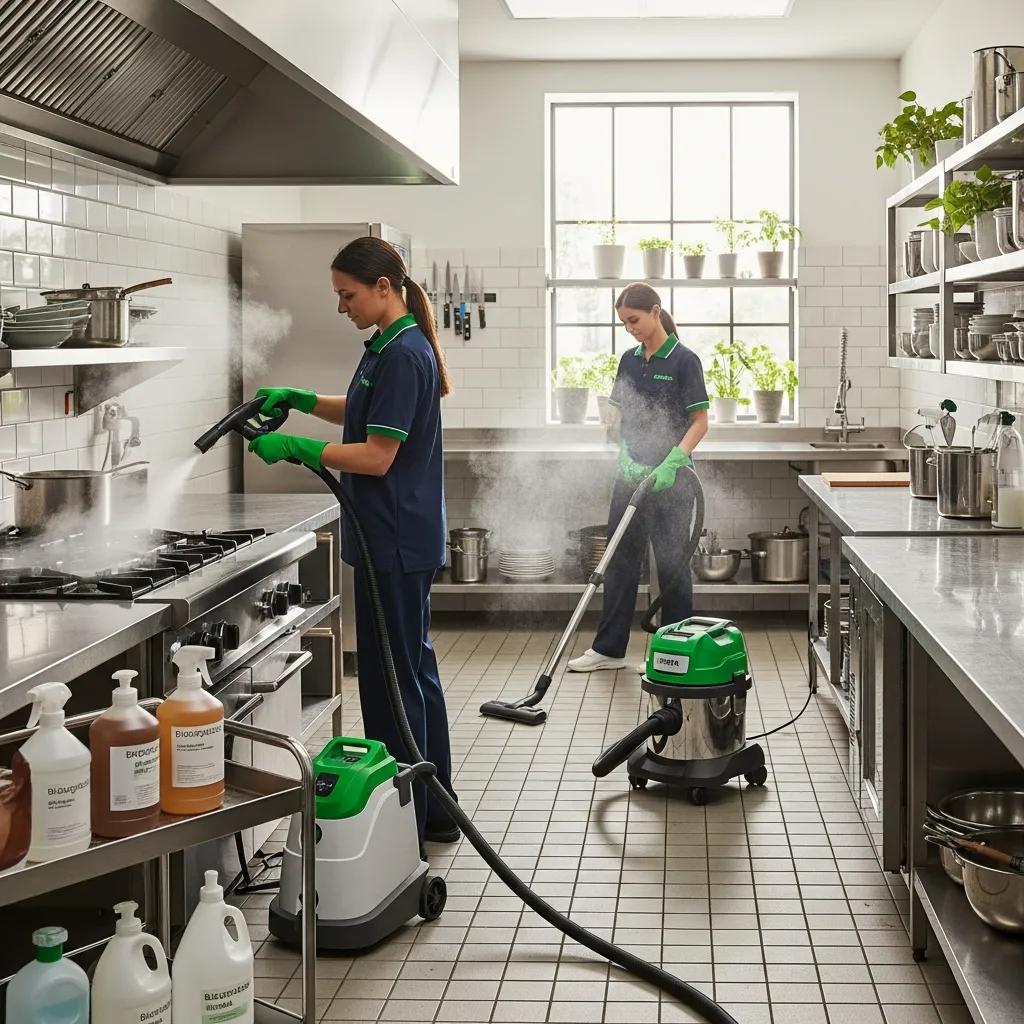
Modern food service sanitation increasingly uses sustainable products and advanced equipment—biodegradable degreasers, steam cleaners and HEPA filtration vacuums—that reduce chemical residues, improve indoor air quality and maintain efficacy for microbial control. Choosing products with recognised eco-attributes decreases hazardous disposal needs and lowers staff exposure to aggressive chemistries while still achieving industry-standard sanitisation when used per manufacturer instructions. Technology such as steam or touchless disinfection systems can complement chemical approaches by delivering residue-free cleaning that shortens downtime and supports fast verification. The table below compares common technologies, their environmental attributes and on-site benefits to help operators select balanced solutions.
| Technology / Product | Environmental Attribute | Benefit / Use Case |
|---|---|---|
| Steam cleaning | Chemical-free, low-residue | Deep degreasing with reduced rinse needs |
| Biodegradable degreasers | Readily biodegradable | Safer disposal and lower aquatic toxicity |
| HEPA filtration vacuums | Particle capture efficiency | Improved IAQ and reduced airborne grease |
This comparison highlights trade-offs and helps managers choose methods that reduce environmental impact while maintaining measurable sanitation outcomes. The H3 subsections that follow describe benefits and equipment use-cases in practical terms.
How Do Sustainable Cleaning Products and Methods Benefit Restaurants and the Environment?
Sustainable cleaning products—formulated to biodegrade rapidly and leave minimal residue—reduce environmental load and lower the risk of contaminating wastewater systems, while also protecting staff and food-contact surfaces from unnecessary chemical exposure. Operational benefits include reduced neutralisation steps, simpler rinse procedures and safer storage and handling for janitorial teams, which streamlines daily routines and reduces potential for cross-contamination. Customer-facing benefits include the perception of responsible business practice, which can attract environmentally conscious patrons and support brand positioning. These methods still require validation through verification swabs or inspection checklists to ensure that environmental gains do not compromise microbial control.
What Modern Equipment and Techniques Enhance Cleaning Efficiency and Effectiveness?
Equipment such as high-temperature steam cleaners, high-pressure degreasers and filtration vacuums increase cleaning effectiveness by loosening baked-on grease and capturing particulates without excessive chemical use, enabling deeper cleaning in less time. Selecting the right tool depends on the substrate and contamination level—steam works well for ovens and grills while HEPA vacuums are useful for reclaiming particulate from ductwork—so providers must match technique to task to achieve consistent results. Technology also supports verification: touchless dispensing systems and dosing controls ensure repeatable chemical concentrations, and digital logs provide traceable evidence of dosing and service. Proper training and safety procedures are essential to implement these technologies without increasing downtime or risk.
Why Choose Divine Commercial Cleaning for Restaurant and Food Service Facility Hygiene in Sunshine Coast and Brisbane?
Divine Commercial Cleaning is a family-owned provider based in Maroochydore, QLD, serving the Sunshine Coast and Brisbane with tailored commercial cleaning solutions that prioritise experienced professional cleaners, environmentally conscious practices and a satisfaction guarantee. For food service operators, choosing a local provider offers faster response times, familiarity with regional health department expectations and the ability to build recurring schedules that align with peak service demands. Divine emphasises no lock-in contracts and custom plans so restaurants can trial service levels and extend or adapt schedules as operational needs change. The following list summarises unique value propositions to help operators evaluate fit.
- Experienced Teams: Professional cleaners trained specifically for commercial kitchen environments and sanitation verification.
- Tailored Plans: Custom schedules and scopes designed around kitchen volume, menu types and inspection cycles.
- Satisfaction Guarantee & No Lock-In Contracts: Flexibility to adjust services with assurance that remediation will be provided if standards are not met.
These UVPs demonstrate practical advantages for food businesses, and the next subsection outlines how local expertise and the guarantee process benefit clients in operational terms.
What Unique Value Propositions Does Divine Offer to Food Service Businesses?
Divine’s unique value propositions include experienced professional cleaners who apply industry-specific procedures, tailored cleaning plans that match kitchen throughput, and an environmentally conscious approach that reduces chemical residue while maintaining compliance. The no lock-in contract policy allows operators to start services without long-term commitment, and the satisfaction guarantee gives operators a clear remediation pathway if performance expectations are not met. For restaurants that require verified sanitation records, Divine provides documented service reports and checklists that support audit-readiness and simplify inspection responses. These features work together to reduce business risk and build operational resilience.
How Does Divine’s Local Expertise and Satisfaction Guarantee Benefit Clients?
Local expertise means cleaners understand Sunshine Coast and Brisbane inspection patterns, typical regulatory touchpoints and seasonal demands that affect kitchen operations, which enables proactive scheduling and prioritisation. The satisfaction guarantee provides a defined process: if cleaning outcomes fail to meet agreed standards, corrective action and re-cleaning are arranged promptly to minimise service disruption. Faster scheduling and local presence also enable quicker emergency responses for urgent degreasing or exhaust maintenance needs. Clear communication and documented feedback loops help managers track performance and make adjustments as their operational needs evolve.
How Can You Request a Free Quote and Learn More About Restaurant Cleaning Services?
Requesting a free quote involves a short information exchange followed by a site assessment and a customised proposal; preparing key details in advance helps providers deliver accurate pricing and scope recommendations. Typical information to provide includes facility size, primary cooking equipment, estimated customer volume, current cleaning schedule and any recent inspection findings that indicate priority areas. After the initial enquiry, a professional provider usually conducts a site visit to verify conditions, then issues a proposal with scope, recommended frequency and QA measures; this proposal will note contract flexibility such as no lock-in terms and outline the satisfaction guarantee. The numbered steps below present a clear three-step pathway to convert an enquiry into a customised plan.
- Initial Enquiry: Provide facility details and cleaning priorities to request a quote.
- Site Assessment: Schedule an on-site review to evaluate equipment, exhaust systems and grease traps.
- Proposal & Onboarding: Receive a customised scope, frequency recommendation and onboarding timeline with QA checkpoints.
These steps set expectations for timing and documentation and lead directly into how a customised plan is developed.
What Is the Process to Get a Customised Cleaning Plan for Your Food Service Facility?
A customised plan begins with a consultation and site assessment to document equipment, CCPs and existing sanitation gaps, then moves to a written proposal that specifies tasks, frequency and verification procedures. The proposal typically includes onboarding details such as initial deep-clean scheduling, staff communication protocols, and sample log templates for ongoing monitoring. Onboarding also covers safety briefings and any coordination required for after-hours or staged cleaning to minimise service disruption. Regular QA checks and periodic reassessments ensure the plan evolves with the kitchen’s operating profile and inspection trends.
Where Can You Find Answers to Common Questions About Restaurant and Food Service Cleaning?
For answers to common questions, operators should consult provider FAQs, technical resource pages and relevant regulatory guidance, and they can request facility-specific clarifications directly from their cleaning partner; these resources typically address frequency, verification methods and how waste streams are handled. Below are short answers to frequent operator questions that surface during proposals and assessments.
- How often should deep cleaning occur?: Frequency depends on volume; high-throughput kitchens often require monthly deep cleans while lower-use sites can operate quarterly.
- Are chemical residues safe for food contact surfaces?: When providers use food-safe formulations and follow correct rinse and contact-time procedures, residues are minimised and surfaces are safe.
- Will cleaning records help during inspections?: Yes; documented logs, swab results and service reports streamline inspector reviews.
If operators need tailored answers for specific equipment or kitchen layouts, direct consultation during the site assessment provides the most reliable guidance.

Dianne, originally from Rockhampton, hails from a business-oriented family, with her father owning electrical stores and her uncle serving as Mayor. Moving to the Sunshine Coast at 13, she later pursued a rewarding real estate career and raised three children. As a single mom, she balanced university studies with domestic cleaning work. Armed with a Bachelor’s Degree in Business, majoring in Supply Chain Management, Dianne founded and grew Divine Commercial Cleaning into a thriving company. Her success is rooted in strong family mentorship, a positive attitude, and a solution-oriented approach, offering tailored cleaning services with integrity and strategic insight.