
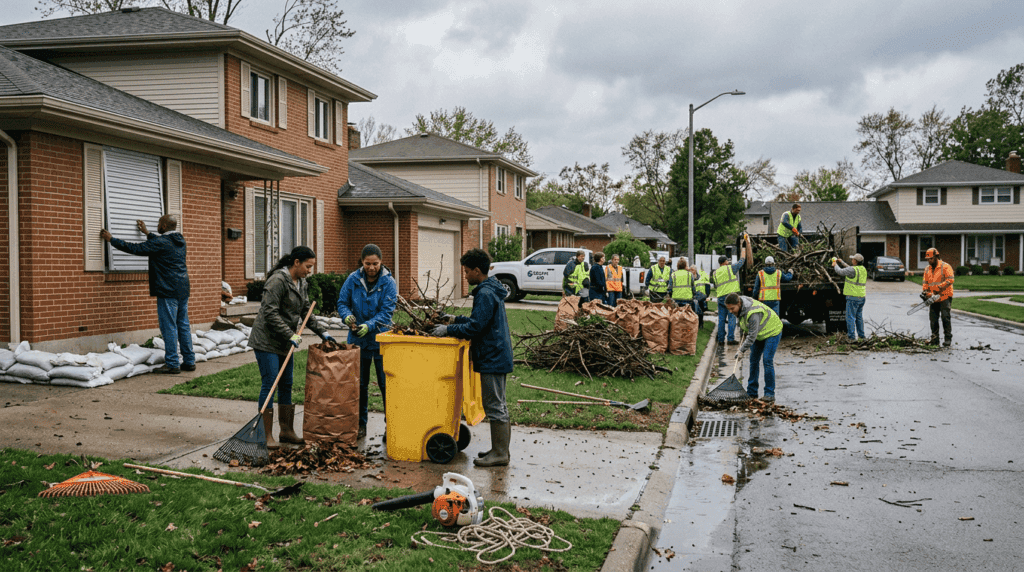
The two things that most reduce storm damage to a Sunshine Coast commercial property are clearing gutters, downpipes and roof drainage before the season starts, and having a named contractor you can call within hours of water entering the building. Almost everything that becomes an expensive claim — ruined carpet, delaminated flooring, mould through a tenancy — traces back to water that sat for two or three days before anyone extracted it.
Sunshine Coast Council notes that storms usually occur from November to March, east coast low pressure systems from January to June, and cyclones from December to April. Inland flooding of the region’s waterways, creeks and low-lying plains is a regular occurrence during extremely heavy rainfall. For a business, that means the risk window is most of the year, and preparation belongs in the October operating budget rather than the February crisis budget.
Before the season: the October and November checklist
Roof and drainage
- Clear gutters, box gutters, sumps and downpipes. Box gutters on commercial roofs are the single most common failure point — they have limited freeboard and back up quickly when partially blocked.
- Check and clear rainwater heads and overflow provisions.
- Inspect flashings, penetrations and roof sheeting fixings.
- Clear leaf litter from roof valleys and behind parapets.
- Check the discharge point of every downpipe actually goes somewhere.
Ground level and surrounds
- Clear stormwater grates, pits and channel drains in car parks and loading docks. Pressure washing of hardstand before the season also flushes sediment out of grates — see commercial car park cleaning.
- Check that door thresholds, particularly roller doors and glazed shopfronts, still have effective seals.
- Trim vegetation away from the building and from drainage lines.
- Secure or store loose external items — bins, A-frames, outdoor furniture, planters, signage.
- Check that car park and driveway falls have not been altered by resurfacing or landscaping.
Inside the building
- Lift stock, records and electrical equipment off the floor in ground-level storerooms. 150 mm of clearance solves a surprising number of problems.
- Photograph the premises, fitout and stock now, and store the images off site. Insurance claims move considerably faster with pre-event condition evidence.
- Identify where water has entered before. Buildings are repeat offenders and the same entry points recur.
- Check that the air conditioning condensate drain is clear — storms and high humidity together overload marginal drains.
People and paperwork
- Confirm your insurance covers flood, storm water ingress and business interruption, and check the excess.
- Write a one-page response plan: who assesses the building, who calls whom, who has keys and after-hours access.
- Agree an emergency response arrangement with a restoration contractor before the season. After a regional event, every contractor on the coast is booked out, and existing clients are attended first.
Immediately after a storm: the first 48 hours matter most
Mould can begin establishing on damp organic materials within roughly 24 to 48 hours in warm conditions. On the Sunshine Coast in February, that clock runs fast. The order of operations is:
- Make it safe. Do not enter water where electrical services may be live. Isolate power to affected areas. Watch for ceiling sag — a saturated plasterboard ceiling can come down without warning.
- Document everything before you move it. Photograph and video every affected area, including water lines on walls, before extraction begins.
- Stop the ingress. Tarp, bung, sandbag or divert. Extraction while water is still entering achieves nothing.
- Extract standing water. Within hours, not days.
- Remove what cannot be saved. Saturated underlay, wet plasterboard below the water line, sodden ceiling tiles and porous insulation are generally removed rather than dried.
- Apply an appropriate antimicrobial. To affected surfaces, after gross contamination is removed.
- Dry the structure, and measure it. Air movers and dehumidifiers, with moisture readings taken and logged until the structure reaches dry standard. This is the step most often cut short.
- Clean and restore. Carpet extraction, hard floor restoration, detail clean, then reoccupy.
Our flood restoration service follows this sequence — inspection, extraction, antimicrobial application, air movement, dehumidification, hygrometer monitoring and a final clean — and our complete flood recovery guide walks through it in more detail.
Categories of water: why the response differs
| Type | Source | Typical response |
|---|---|---|
| Clean water | Burst supply pipe, rainwater through a roof, overflowing basin | Extract and dry; most materials recoverable if addressed quickly |
| Greywater | Dishwasher, washing machine, aged clean water sitting more than ~48 hours | Extract, clean, sanitise; porous materials often removed |
| Blackwater | Sewage, creek or river flood water, storm water carrying ground contamination | Treat as contaminated; porous materials removed; specialist decontamination |
Flood water that has crossed roads, car parks or ground is not clean water, regardless of how it looks. Carpet, underlay and porous items affected by it are generally not salvageable, and attempting to dry them in place is a false economy.
The clean-up jobs businesses consistently underestimate
- Silt in car parks and loading docks. Fine sediment dries to a hard crust and gets tracked through the building for weeks. Pressure washing hardstand early prevents a month of internal soiling.
- Debris and organic matter in stormwater grates. Leaving it means the next downpour floods the same area again.
- Contaminated entry matting. Usually needs replacing after blackwater exposure, not cleaning.
- Wind-blown salt and grit on glazing. An east coast low drives salt spray well inland. Storm-affected glass should be washed promptly to prevent bonding — see salt air and coastal building cleaning.
- Air conditioning after water ingress. Have the system checked before running it. Circulating air through a wet system distributes contamination through the whole tenancy.
- Bin rooms and waste areas. Flooded bin rooms are a health issue and need decontamination, not a hose-down — see bin room and waste area cleaning.
Storm preparation by property type
Strata and body corporate
Common property drainage, roof, car park grates and bin rooms are the body corporate’s responsibility to maintain in good condition. A documented pre-season inspection protects the committee as much as the building. Circulate the response plan to residents and tenants before November, and make sure the building manager and cleaning contractor both hold after-hours contacts. See our strata cleaning services.
Retail and shopping centres
Entry matting capacity, slip management during sustained rain and rapid response to roof leaks over trading floors are the priorities. Wet floor incidents spike during storm periods. Our shopping centre cleaning scopes include increased wet weather attendance.
Medical and childcare
Any water ingress into a clinical or child-occupied area needs a documented clean and, where materials are affected, removal rather than drying. Keep the records — they are part of your compliance evidence. See medical centre cleaning and daycare and school cleaning.
Ground-floor offices and warehouses
Elevate stock and records, check roller door seals, and know where your stormwater discharges. Warehouses with concrete floors often escape lightly if water is extracted quickly — racking bases and stored goods are the real exposure.
Frequently asked questions
When is storm season on the Sunshine Coast?
Sunshine Coast Council advises that storms usually occur from November to March, east coast lows from January to June, and cyclones from December to April. Preparation work is best completed in October.
How quickly do we need water extracted after a flood?
As fast as practical, and certainly within the first 24 to 48 hours. Mould can begin establishing on damp organic materials within that window in warm conditions, and the difference between drying a building and rebuilding part of it usually comes down to those first two days.
Can flooded carpet be saved?
It depends on the water category and elapsed time. Clean water addressed within about 48 hours often allows carpet to be extracted, treated and dried, with underlay replaced. Carpet affected by storm or creek water is generally treated as contaminated and replaced.
Should we arrange a restoration contractor before storm season?
Yes. After a widespread event, demand across the region exceeds capacity within hours and contractors attend existing clients first. A simple pre-agreed arrangement with contact details and site access costs nothing and changes your position materially.
Who is responsible for storm clean-up in a leased commercial premises?
It depends on your lease. Typically the landlord is responsible for the building structure, roof and common areas, and the tenant for the fitout, stock and contents. Read the make-good and damage clauses before you need them, and notify your landlord in writing as soon as ingress occurs.
Does insurance cover storm water entering the building?
Cover varies significantly between storm damage, rainwater ingress and flood, and these are defined differently in policies. Check your specific policy wording and excess before the season, and speak to your broker if the definitions are unclear — this is not something to discover after an event.
Get your building ready before November
Divine Commercial Cleaning provides pre-season external cleaning and drainage clearing across the Sunshine Coast, and flood restoration with structural drying and moisture monitoring when water does get in. Talk to us about a storm season preparation visit and about setting up a priority response arrangement for your site.

Dianne, originally from Rockhampton, hails from a business-oriented family, with her father owning electrical stores and her uncle serving as Mayor. Moving to the Sunshine Coast at 13, she later pursued a rewarding real estate career and raised three children. As a single mom, she balanced university studies with domestic cleaning work. Armed with a Bachelor’s Degree in Business, majoring in Supply Chain Management, Dianne founded and grew Divine Commercial Cleaning into a thriving company. Her success is rooted in strong family mentorship, a positive attitude, and a solution-oriented approach, offering tailored cleaning services with integrity and strategic insight.