

What affects the cost of commercial cleaning? A practical guide for Caloundra businesses
Commercial cleaning prices add up from labour, consumables, equipment, travel and the management needed to keep a workplace safe, hygienic and presentable. Understanding these parts helps Caloundra businesses forecast and control cleaning budgets. Local market conditions on the Sunshine Coast also shape quotes, so a clear breakdown of pricing models and cost drivers reduces surprises and makes supplier selection easier.
This guide walks through typical pricing approaches, the main cost drivers that push prices up or down, how schedule and scope affect unit rates, and the role location plays in final quotes. It finishes with practical tips for getting an itemised estimate and which contract terms protect your budget — including how we at Divine Commercial Cleaning approach estimates. Read on to understand cost breakdowns for offices, medical centres, strata and retail premises across Caloundra and the Sunshine Coast.
What are the common pricing models for commercial cleaning in Caloundra?
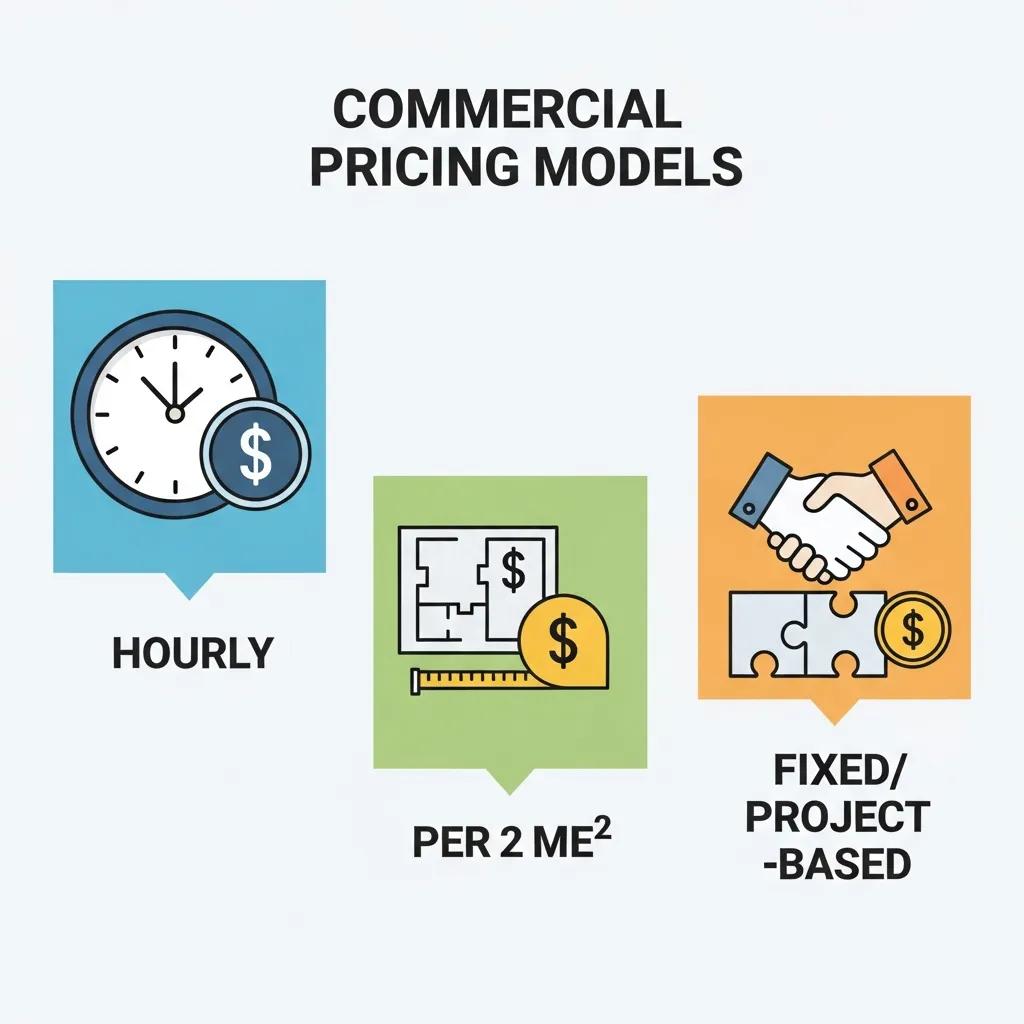
Most commercial cleaners use one of three pricing models: hourly, per square metre, or fixed/project-based. Each model gives different levels of predictability and transparency. The right choice depends on site complexity, how often you need cleaning and whether tasks are routine or specialised. Hourly suits small or one-off jobs that need flexibility, per-square-metre works well for large open-plan areas on a regular schedule, and fixed pricing is best for defined one-off projects like strip & seal or major deep cleans. Knowing how each model is calculated helps you compare quotes and forecast monthly cleaning spend.
Introductory comparison table: the table below explains how each model is worked out, common local rate ranges, and typical use cases to help Caloundra businesses choose the best approach.
| Pricing Model | How the Price Is Calculated | Typical Local Rate Range | Best For |
|---|---|---|---|
| Hourly | Total hours on site × cleaner hourly rate plus supplies and travel | $30–$60 per hour | Small offices, irregular tasks, short-notice jobs |
| Per square metre | Square metres × unit rate, adjusted for floor type and access | $2–$6 per m² | Large open-plan spaces, regular recurring cleans |
| Fixed / Project | Scoped quote for defined deliverables and schedule | Project-based pricing (itemised) | Deep cleans, strip & seal, specialised one-offs |
This comparison shows how model choice affects predictability and admin overhead. Below we outline practical examples so you can see the trade-offs in action.
How do hourly, per square metre and fixed pricing models compare?
Hourly pricing bills actual labour time on site and usually covers basic supplies and travel. It’s flexible but can cause month-to-month variability. Per-square-metre pricing turns the space into a unit cost that scales predictably with size — handy for consistent layouts but sometimes unfair for complex, room-by-room work. Fixed or project pricing bundles labour, materials and any specialised equipment into a single price for a defined scope, giving certainty for one-off jobs but requiring clear scoping to avoid changes later. For example, an occasional clean of an 80 m² office might be cheaper by the hour, while a 1,200 m² open-plan workspace on a regular schedule is often best priced per m². Ask for itemised calculations to compare like-for-like.
Pros and cons of each commercial cleaning pricing model
Each model balances transparency, scalability and simplicity differently, so match the model to your needs. Hourly rates are easy to understand and flexible but can be costly if travel or setup dominates time on site. Per-square-metre gives steady budgeting for repeatable work but may not reflect time spent on high-touch or cluttered areas. Fixed/project pricing offers cost certainty for specific jobs, but poor scope definitions can lead to change orders. For Caloundra businesses, think about whether your layout is mostly open-plan or divided into many small rooms, how often you need cleans, and whether you require specialist compliance (for example, medical or school settings). These factors determine the best long-term value.
Which key factors affect commercial cleaning prices for Caloundra businesses?
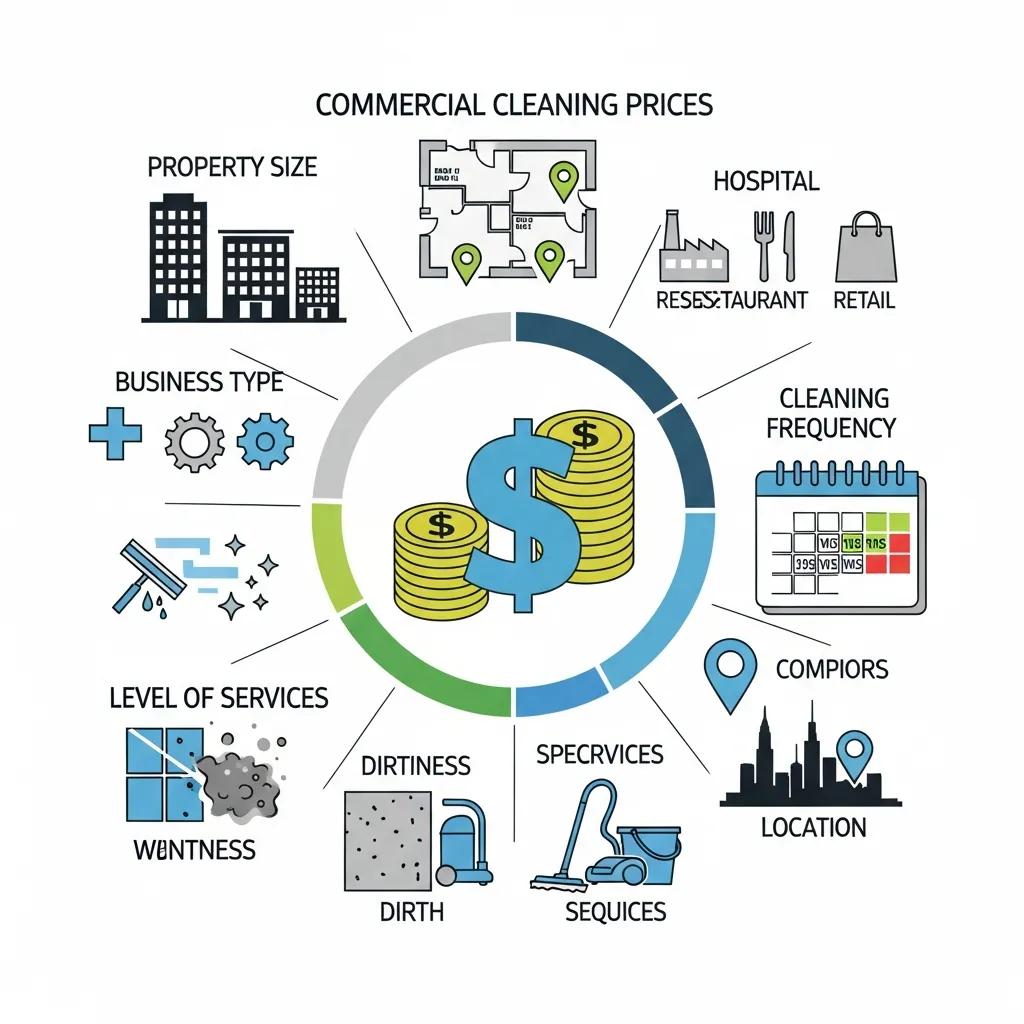
Quotes are driven by a handful of consistent cost drivers that together set the final price: property size and layout, business type and specialised needs, labour and material costs, and cleaning frequency and contract terms. Each driver changes time on site, the skill level required, the consumables needed and whether special equipment or certification is required. Asking suppliers to show these line items helps you spot where savings or trade-offs are possible without lowering standards.
Below is a clear view of the main cost drivers and their typical impact on Caloundra quotes.
| Cost Driver | How It Affects Price | Example Impact / Relative Cost |
|---|---|---|
| Property size & layout | Larger or more complex layouts increase labour hours and set-up time | Multi-level or many small rooms can raise costs by 20–50% |
| Business type / compliance | Medical or school cleaning requires protocols, PPE and training | Specialized tasks often add a premium of 15–40% |
| Labour & wages | Higher local wages and skilled staff increase hourly lines | Skilled or vetted staff raise base rates noticeably |
| Equipment & supplies | Specialist equipment or eco-friendly products raise material lines | One-off equipment hire can add upfront cost |
| Travel & logistics | Remote sites require travel allowances or minimum call-out fees | Travel time may add a fixed surcharge per visit |
| Frequency & contract length | Recurring schedules usually reduce per-clean cost through efficiencies | Weekly contracts typically cost less per clean than ad-hoc |
Ask suppliers to break a quote into these drivers so you can see where trade-offs lie and negotiate scope or frequency where it makes sense.
- Property size and layout determine base labour and set-up time.
- Business type drives compliance, training and PPE needs.
- Labour, equipment and materials set the ongoing cost baseline.
- Travel and logistics add predictable surcharges for non-central sites.
- Frequency and contract terms change per-clean pricing via efficiencies.
- Add-on services and one-off projects create significant cost variances.
These six points explain most quote differences and show how property features change estimates.
How does property size and layout influence cleaning costs?
Size and layout determine how labour scales and where efficiencies are possible — square metres matter, but they’re not the whole story. Open-plan areas let cleaners work more steadily, lowering the per-m² cost compared with the same area split into many small rooms that require repeated set-up and transitions. Multiple levels, limited access or sites that need equipment moved between floors add set-up time and internal travel, which shows up as higher labour charges. For example, a 300 m² open-plan office will normally cost less per m² than a 300 m² suite made up of many small consultation rooms. Request line-by-line time estimates in quotes so you can identify layout-driven costs and consider options like staggered schedules or zone cleaning to reduce them.
Research supports that building features are a major influence on commercial cleaning costs.
Commercial cleaning cost drivers and building characteristics
Building features — size, layout and room mix — consistently influence cleaning time and cost. In a study of more than 100 owner‑operated offices, those characteristics proved to be key determinants of cleaning expense.
Cleaning management of owner‑operated real estate, C Stoy, 2008
What impact do business type and specialised requirements have on pricing?
Different business types carry distinct cleaning protocols and regulatory needs that affect both staff skill level and consumable or disposal costs. Medical and dental clinics, for example, need infection-control routines, surface disinfection and trained staff for clinical waste handling — all of which add time, PPE and specialist supplies. Schools and childcare centres require safe-product choices, extra attention to touchpoints and scheduling around operating hours, which can mean more training and different shift patterns. Retail and gyms face heavy foot traffic and often need more frequent deep cleans for carpets and equipment, pushing up ongoing costs. These specialised needs change time per task, add materials or equipment, and sometimes require extra vetting like police checks or higher insurance cover.
How do cleaning frequency and scope of services drive commercial cleaning costs?
Frequency and scope are two of the strongest levers for cost. Regular schedules generally lower the cost per clean because set-up and travel are spread across more visits and tasks become routine. Deep cleaning, carpet shampooing, window washing or strip‑and‑seal flooring need more site time, specialist machinery and different consumables, so they’re quoted separately or as add-on projects at higher unit rates. For budgeting, compare per-clean costs under different frequencies and decide which add-ons are essential versus occasional — either include them in a regular plan or schedule them as needed.
- Regular recurring contracts often yield a lower per-clean cost through routing and task efficiency.
- Fortnightly or monthly schedules can suit low-traffic sites but usually need periodic deep cleans.
- After-hours or emergency cleans commonly incur overtime or call-out fees that raise the price.
- Bundling add-ons into a contract can be cheaper than constant one-off projects.
Use these principles to decide whether to prioritise lower per-clean costs or keep specialised work as targeted interventions.
How does the cleaning schedule affect overall pricing?
A consistent schedule reduces variability in labour and travel costs, making negotiated rates and monthly budgeting more reliable. Fixed weekly visits cut mobilisation time and let staff work more efficiently, so suppliers often pass those savings on. Last‑minute, off‑hours or emergency cleans usually cost more because of overtime and disrupted logistics. Contract length also matters: longer agreements often bring discounts while short-term or one-off jobs carry higher rates to cover fixed costs. Knowing how scheduling affects price helps you choose the right balance between cleanliness standards and cost.
What extra costs do add-on services like deep cleaning and window washing incur?
Add-on services need specialist tools, more labour and different consumables, so they’re typically priced apart from routine cleaning. Deep cleans take longer per m² and use stronger or specialised products and machines like rotary scrubbers or HEPA vacuums, which raises labour and equipment costs. Window cleaning, carpet shampooing and external pressure washing may require lift access or subcontractors, so they attract project-based pricing that can be much higher than standard cleans.
One-off projects also include mobilisation and often a site-specific risk assessment, so expect separate estimates with a clear scope, frequency recommendations and guidance on ongoing maintenance. Itemised quotes for add-ons make it easier to choose whether to schedule them regularly or bring them in as needed.
What role does location play in commercial cleaning rates in Caloundra and the Sunshine Coast?
Location affects pricing through local wage levels, travel time, demand and competition. On the Sunshine Coast, factors such as dispersed suburbs and seasonal tourist peaks influence scheduling and rates. Providers must account for travel between sites, busy seasonal periods that strain staffing, and local wage standards. Caloundra businesses close to central service hubs often see lower travel surcharges and more competitive hourly rates, while remote or coastal properties may face higher minimum charges. Understanding local dynamics helps you judge whether a slightly higher base rate delivers better overall value once travel and reliability are included.
Introductory table showing local adjustments and examples:
| Location | Local Factor | Typical Rate Adjustment / Example |
|---|---|---|
| Caloundra central | High local supplier presence, lower travel time | Slightly lower travel surcharge; competitive hourly rates |
| Outlying Sunshine Coast | Increased travel and logistics | Travel allowance or minimum call-out fee applies |
| Peak tourist zones | Seasonal demand spikes | Temporary rate increases or constrained availability |
| Remote or multi-site clusters | Longer transit times | Consolidated scheduling can reduce per-site cost |
This table maps locality to practical rate adjustments; next we explain how market conditions feed into pricing mechanics.
How do local market conditions influence service pricing?
Local labour availability, provider competition and seasonal demand cycles shape the baseline rates in quotes. Where there are many skilled cleaners and firms, quotes tend to be more competitive; where demand exceeds supply — for example during Sunshine Coast peak season — providers may limit availability or raise temporary rates. Travel time between sites reduces productive hours and is often reflected in minimum call-out charges or travel surcharges. When comparing quotes, factor in a provider’s capacity to meet your schedule reliably, not just the headline rate.
What are typical commercial cleaning rates in Caloundra compared to the Sunshine Coast?
Typical local ranges are useful for setting expectations but actual quotes vary by scope, layout and special requirements. Common ranges include hourly rates between $30 and $60 and square‑metre rates between $2 and $6, with higher figures for specialised or compliance-heavy work. Small, irregular jobs in Caloundra central may fall toward the lower end due to shorter travel times, while one-off deep cleans or medically compliant services across the Sunshine Coast command higher per-hour or project pricing because of training, equipment and consumables.
Always request a clear line-by-line breakdown so you can tell whether a higher quote reflects necessary specialisation or if scope adjustments can reduce cost.
Why does Divine Commercial Cleaning offer strong value for commercial cleaning?
Divine Commercial Cleaning combines local, family ownership with experienced teams and flexible contracts to deliver reliable, accountable service for Caloundra businesses. Being family‑run gives us a stronger local focus and continuity — we can assign the same cleaner regularly and tailor solutions to your needs — which cuts rework and speeds issue resolution. Our commitment to fully insured teams, police checks and eco-conscious practices can slightly increase material or vetting costs but usually reduces incidents, client risk and the need for corrective visits. Those factors balance an initial price against the total cost of ownership, so a modestly higher per-clean rate can deliver better value over time.
Below is a short list that summarises Divine Commercial Cleaning’s local value drivers and how they improve cost-effectiveness.
- Family-owned service means personalised attention and consistent crews.
- Experienced, vetted staff reduce mistakes and minimise rework.
- Eco-friendly products protect surfaces and support sustainability goals.
- Flexible contracts and tailored plans let clients match cost to operational needs.
This shows how selective service terms and quality practices cut hidden costs and raise value. The next sections explain how those benefits affect pricing and risk.
How do experienced staff and eco-friendly practices affect pricing and quality?
Skilled staff may cost more per hour but work faster and make fewer errors, which lowers rework and long-term costs. Eco-friendly products can raise consumable costs slightly, but they reduce surface wear, improve indoor air quality and may lengthen the time between deep cleans. Insurance and police checks add to provider overheads but give measurable benefits in risk reduction and trust — important for public-facing businesses or regulated sites. When reviewing quotes, weigh these quality-related line items against potential savings from fewer incidents and disruptions.
What benefits do flexible contracts and money-back guarantees provide?
Flexible, no-lock-in contracts let you scale services without penalty, reducing the risk of paying for unnecessary capacity. Money-back guarantees shift performance risk to the provider and encourage consistent delivery; they may be reflected in slightly higher base rates to cover that exposure, but they offer protection if standards slip. For many Caloundra businesses, consistent crews, custom schedules and performance guarantees simplify vendor management and stabilise cleaning budgets as needs change.
How can Caloundra businesses get transparent and accurate commercial cleaning quotes?
Transparent quotes start with clear information: a site visit or accurate floorplan, an itemised task list and a breakdown of labour, materials, equipment and any travel or admin fees. Ask for a written, itemised estimate that lists tasks, frequencies and unit rates so you can compare providers and see where differences come from. A good quote will also state assumptions — access hours, waste disposal responsibilities and who supplies consumables — so surprises are minimised.
Below is a simple step-by-step process you should expect from a reputable local provider and request from all bidders.
- Initial enquiry and scope discussion to capture operating hours, traffic patterns and special requirements.
- On-site assessment or floorplan review to measure area, examine layout and identify access or equipment needs.
- Itemised written quote that separates labour, supplies, equipment hire and travel charges.
- Review and sign-off with agreed schedules, key performance indicators and any guarantee terms.
This checklist helps clients compare proposals and sets clear expectations for deliverables and performance metrics.
What is the process for receiving a detailed cleaning cost estimate?
A detailed estimate usually follows enquiry, assessment, draft quotation and finalisation, with clear timeframes so you know when to expect a proposal.
After initial contact, a site inspection captures square metres, layout complexity, any hazards and current cleanliness standards; this is also when the provider notes special equipment or compliance needs.
The provider then prepares an itemised draft quoting labour hours, frequency, consumables, equipment and travel, and suggests efficiencies or scope changes to meet budget goals.
Finalisation happens after client review and any scope tweaks, resulting in a signed agreement that documents schedules, performance expectations and any guarantees or flexible terms.
Frequently Asked Questions
What should I consider when choosing a commercial cleaning service?
Look at reputation, experience and the range of services offered. Check reviews or testimonials from local businesses. Ask about staff qualifications, police checks and insurance, and whether they use eco-friendly products. Make sure they can work to your schedule and that their quoting process is transparent — that tells you a lot about how they’ll communicate day to day.
How can I ensure the cleaning service meets my specific needs?
Give a detailed brief at the first consultation: frequency, areas needing special attention and any compliance standards. Ask for a customised cleaning plan that lists tasks and expected outcomes. Regular feedback and scheduled reviews keep standards on track and let you tweak the plan quickly if needed.
Are there any hidden costs I should be aware of?
Hidden costs can appear if a quote is vague. Always request an itemised quote listing labour, materials, travel and any extras. Clarify overtime, call-out fees and who supplies consumables. Clear assumptions in the contract prevent unexpected charges later.
What is the typical duration for a commercial cleaning contract?
Contract length varies — from one-off deep cleans to ongoing agreements that last months or years. Many providers offer flexible terms so you can adjust frequency and scope as your needs change. Discuss potential changes up front and include review points in the contract.
How can I evaluate the quality of cleaning services provided?
Set clear performance metrics in the contract and inspect cleaned areas regularly. Gather staff feedback and schedule periodic reviews with the provider. If the service consistently meets your KPIs and staff are satisfied, that’s a good sign of quality and reliability.
What are the benefits of using eco-friendly cleaning products?
Eco-friendly products improve indoor air quality and reduce exposure to harsh chemicals for employees and clients. They’re gentler on surfaces, which can extend fixture life, and they support your sustainability commitments. Upfront costs can be a little higher, but the long-term benefits include better health outcomes and lower maintenance.
How can I negotiate better rates with cleaning service providers?
Start by understanding market rates and exactly what’s included. Ask for a detailed cost breakdown to find areas for adjustment. Consider longer contracts or bundling services for discounts. Building a good working relationship and showing a willingness to collaborate can also lead to better terms. If you find a better offer elsewhere, ask if they’ll match it.
Knowing the main cost drivers for commercial cleaning helps Caloundra businesses make smarter choices that match budget and operational needs. By understanding pricing models, frequency effects and specialised requirements, you can design a cleaning plan that delivers the best value. Working with a trusted local provider like Divine Commercial Cleaning means transparent quotes and tailored solutions that protect both cleanliness and your bottom line. Ready to get clarity on costs? Request a detailed, itemised quote today.

Dianne, originally from Rockhampton, hails from a business-oriented family, with her father owning electrical stores and her uncle serving as Mayor. Moving to the Sunshine Coast at 13, she later pursued a rewarding real estate career and raised three children. As a single mom, she balanced university studies with domestic cleaning work. Armed with a Bachelor’s Degree in Business, majoring in Supply Chain Management, Dianne founded and grew Divine Commercial Cleaning into a thriving company. Her success is rooted in strong family mentorship, a positive attitude, and a solution-oriented approach, offering tailored cleaning services with integrity and strategic insight.